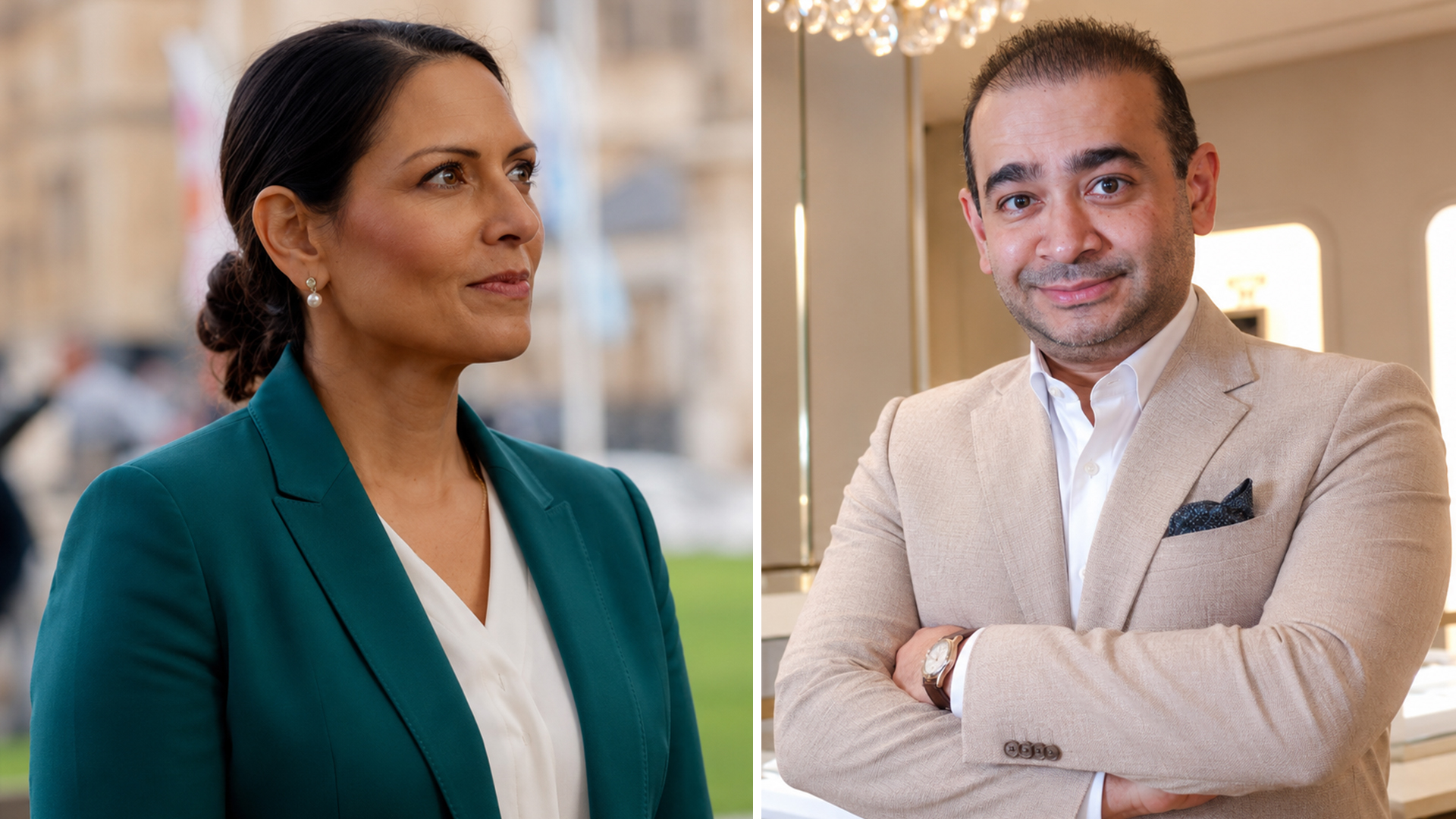
Former UK Home Secretary Priti Patel has expressed concern over the prolonged delay in the extradition of fugitive diamond trader Nirav Modi, saying his continued stay in the United Kingdom is damaging bilateral relations with India. Speaking at a recent public event, Patel said she was “shocked” that Modi remains in Britain despite an approved extradition order, adding that many people in India are “hugely angry” and “horrified” by the delay.
Her remarks have once again brought the Nirav Modi extradition case into the spotlight, years after the businessman fled India following allegations of one of the country’s biggest banking frauds. Patel’s comments reflect growing frustration over the lengthy legal process, even after British authorities cleared his extradition several years ago.
Addressing members of the Indian diaspora, Patel said she understood the disappointment and anger felt in India. According to her, the extradition issue continues to cast a shadow over otherwise improving India-UK relations. She stressed that while the UK government has already taken its decision, the case remains tied up in legal proceedings that have prevented Modi’s return to India.
Patel said she believes Nirav Modi “should be in prison” and questioned why he continues to remain in the UK despite the extradition order. She added that the prolonged delay risks undermining public confidence in the justice system and has become a recurring point of concern during discussions between the two countries.
Nirav Modi is wanted in India in connection with the ₹13,000-crore Punjab National Bank (PNB) fraud case, one of the largest financial scams in the country’s banking history. The Central Bureau of Investigation (CBI) and the Enforcement Directorate (ED) have accused him of criminal conspiracy, cheating, money laundering and fraud involving fraudulent Letters of Undertaking issued by officials at Punjab National Bank.
The businessman left India in early 2018, shortly before the alleged fraud came to light. He was later traced to the United Kingdom, where he was arrested by British authorities in March 2019 following India’s extradition request. Since then, the case has moved through several stages of the British legal system.
In February 2021, a UK court ruled that Nirav Modi could be extradited to India after finding sufficient evidence to answer the charges. The court also concluded that India’s prison conditions met human rights standards. The extradition order was subsequently approved by then Home Secretary Priti Patel in April 2022, clearing the way for his transfer.
However, the extradition has not yet taken place because Modi has continued to pursue multiple legal avenues available under UK law. His legal team has filed appeals and sought relief on various grounds, including concerns related to mental health and human rights protections. These proceedings have significantly extended the timeline of the case.
Patel acknowledged that while judicial independence must be respected, the continued delay has become difficult to explain to people in India. She noted that many Indians believe justice has been unnecessarily delayed despite the completion of the government’s role in the extradition process.
The comments come at a time when India and the United Kingdom are strengthening cooperation across trade, defence, technology and investment. Both countries have made significant progress in expanding their strategic partnership, including closer collaboration in security and economic matters. Patel suggested that resolving high-profile legal cases such as Nirav Modi’s extradition would further reinforce public trust between the two democracies.
Legal experts point out that extradition proceedings in the UK often take several years, particularly in complex financial crime cases where multiple appeals are permitted. Once all legal remedies are exhausted, the Home Office can proceed with the transfer of the accused to the requesting country.
The Nirav Modi case has remained one of India’s most closely watched extradition battles. It has frequently been cited alongside other cases involving economic offenders who fled abroad after being accused of large-scale financial fraud. Indian investigative agencies have consistently maintained that Modi must return to face trial in Indian courts.
Authorities in India have also attached and recovered assets linked to Nirav Modi under anti-money laundering laws as part of efforts to recover losses suffered by banks. The Enforcement Directorate has repeatedly stated that it continues to pursue legal action against assets connected to the businessman both in India and overseas.
Patel’s remarks have resonated with many members of the Indian community in Britain, who continue to follow the case closely. Her statement also reflects wider political interest in ensuring that legal cooperation between India and the UK delivers timely outcomes in cases involving financial crime and fugitives.
While the final decision now rests with the British courts, the renewed attention generated by Patel’s comments has highlighted the broader significance of the case beyond legal proceedings. The extradition of Nirav Modi is viewed not only as an important step in India’s fight against financial fraud but also as a test of international judicial cooperation.
As legal proceedings continue, both governments are expected to closely monitor developments. For India, securing Nirav Modi’s return remains a key objective in pursuing accountability for one of the country’s biggest banking frauds. For the UK, concluding the long-running case could help remove a longstanding irritant in India-UK relations, reinforcing confidence in bilateral cooperation and the rule of law.