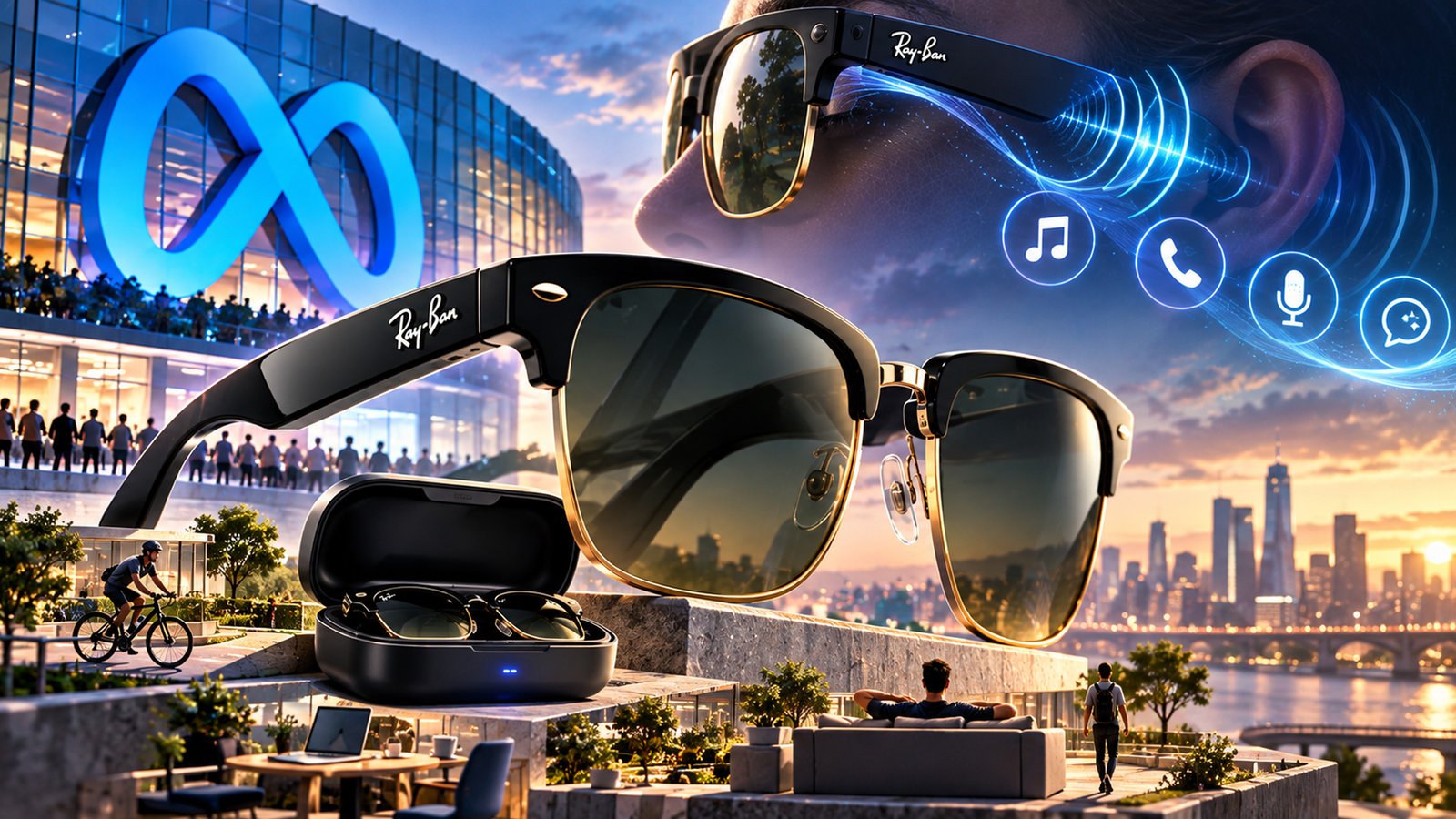
Meta is expanding its push into wearable technology with a new range of AI-powered glasses, camera-free smart eyewear and a lighter virtual reality device. The company unveiled the products at its annual Connect event, positioning glasses as a key part of its plans for the next generation of computing.
The announcements include new Ray-Ban Meta glasses, an audio-only model without a camera, hearing enhancement features and a new pair of virtual reality glasses. Meta also introduced Muse, an AI assistant designed to make its glasses more useful for everyday tasks.
The company is increasingly moving beyond smartphones by putting artificial intelligence directly into devices that users can wear. Instead of pulling out a phone to search, translate or identify something, users can interact with Meta AI through voice commands while keeping their hands free.
Muse brings AI closer to users
Meta’s new Muse AI system is designed to work as a personal assistant through its smart glasses.
Users can ask Muse questions about objects or information around them. The system can recognise what a person is looking at, read text and provide information without requiring a smartphone screen.
Meta is also working to connect Muse with external services, allowing the AI to assist with tasks involving areas such as shopping, travel, productivity and payments.
The idea is to make AI interaction more natural by combining voice commands with information gathered from the user’s surroundings.
Meta’s approach reflects a wider technology-industry shift towards AI agents that can perform tasks rather than simply respond to questions.
Camera-free glasses target privacy concerns
Meta also introduced Ray-Ban Meta Audio, a new pair of smart glasses that does not have a camera.
The glasses are designed primarily for listening to music and podcasts, making calls and interacting with Meta AI. They weigh about 43 grams and offer up to 12 hours of battery life, according to the company.
The glasses will be priced from $349, with shipments expected to begin on October 13.
Removing the camera addresses one of the most sensitive issues surrounding smart glasses. Camera-equipped wearables have raised concerns about people being recorded without their knowledge, particularly in public spaces.
The audio-only model gives Meta a way to offer some of the convenience of smart glasses without the same camera-related privacy concerns.
New Ray-Ban Meta model
Meta also launched the Ray-Ban Meta Gen 3, an updated version of its AI glasses developed with EssilorLuxottica.
The glasses feature a slimmer design, improved battery life and a 12-megapixel camera capable of recording 3K video. Meta says the device can provide up to nine hours of battery life.
A six-microphone system is designed to improve voice calls and interactions with Meta AI, particularly in noisy environments.
The glasses start at $449.
Meta is also expanding the number of designs available across its smart-glasses portfolio. The company expects more than 100 AI-enabled glasses options across its Ray-Ban, Oakley and Meta brands by the end of 2026.
Hearing support added
Meta is also bringing hearing assistance to its AI glasses.
The hearing enhancement feature is aimed at adults with perceived mild to moderate hearing loss. Meta said the feature has received US Food and Drug Administration clearance and can be configured at home without a prescription or clinic visit.
The feature is expected to launch in the US later this year at $149.99, or through Meta’s subscription service.
The move broadens the potential use of smart glasses beyond entertainment and communication, bringing accessibility features into wearable devices.
Lighter approach to virtual reality
Meta‘s second major hardware announcement was a new pair of virtual reality glasses.
Unlike traditional VR headsets, the new device is designed around a glasses-style form factor and weighs about 100 grams.
The company sees the product as a portable display for gaming, entertainment and work. Users can watch films, play games and access virtual screens without carrying a conventional headset.
The device will cost $1,299 and is expected to ship in spring 2027.
Meta says the glasses will support entertainment content from services including YouTube, Prime Video and ESPN. The company also plans to offer 3D content and immersive live sports experiences.
Privacy remains a major test
Meta’s growing focus on AI glasses comes with a significant challenge: privacy.
Devices that can see and hear their surroundings raise questions about how recordings and other information are collected and processed. The concern becomes more complicated when AI systems can analyse what a wearer is seeing or hearing.
Meta’s existing camera-equipped glasses use an external light to indicate when the camera is recording. However, privacy advocates continue to debate whether such measures are enough in crowded public environments.
The company’s decision to introduce camera-free glasses suggests that it recognises the need for different approaches to wearable technology.
Glasses become Meta’s next platform bet
Meta’s latest announcements show how quickly smart glasses are moving beyond simple cameras and speakers.
The company is combining generative AI, voice assistants, cameras, audio, accessibility tools and virtual reality in products designed to be worn throughout the day.
The bigger question is whether consumers will adopt glasses as an everyday computing platform. Price, battery life, comfort, privacy and the usefulness of AI will all influence that decision.
For Meta, the strategy is clear: make AI available through devices that sit naturally on a person’s face rather than another screen that users have to hold. The latest lineup represents another step in that direction, while also showing how wearable technology is beginning to merge smartphones, AI assistants and immersive computing.