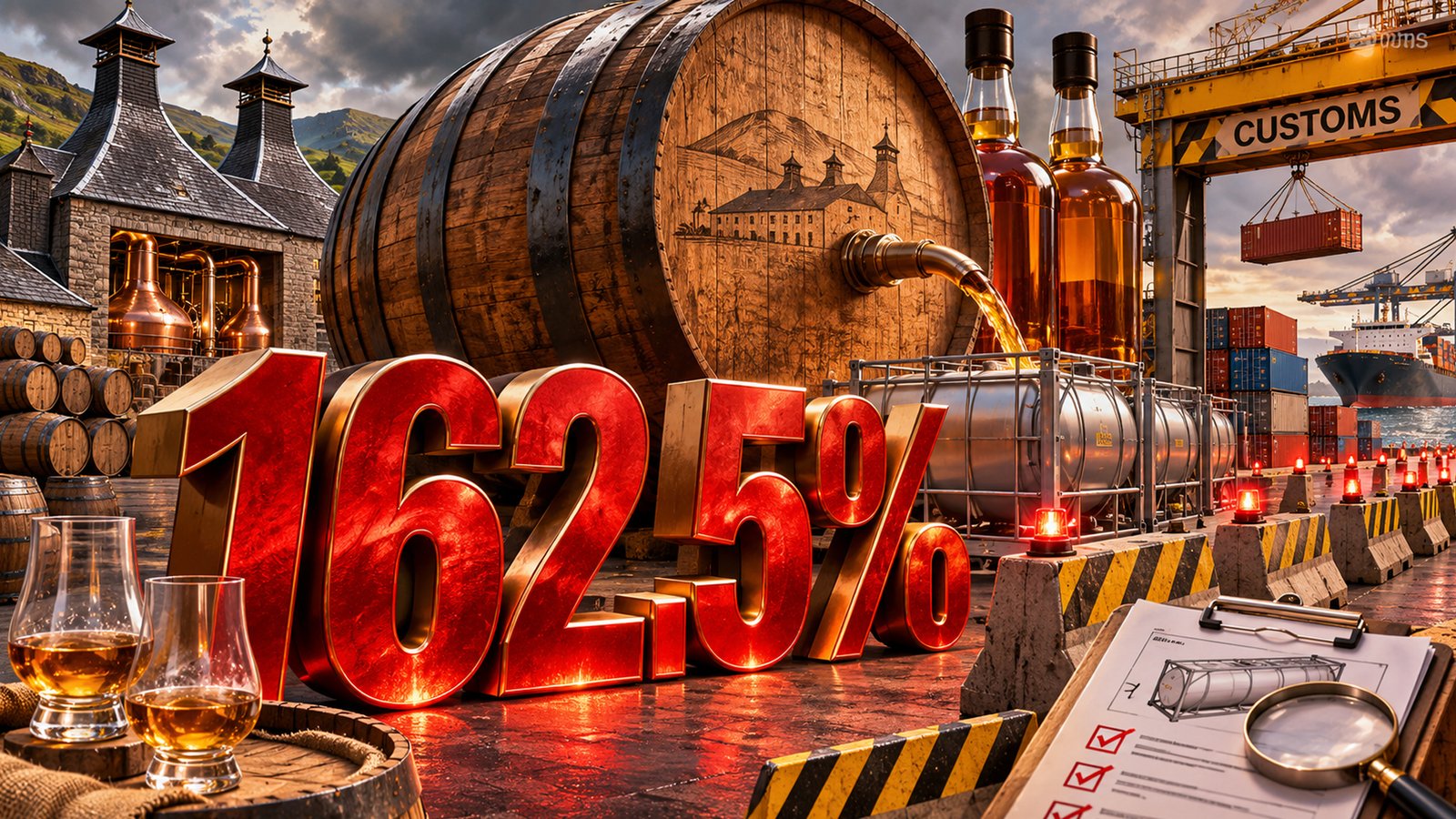
India’s decision to impose an effective 162.5% duty and tax on bulk Scotch whisky imports has triggered a fresh dispute with the United Kingdom, putting liquor manufacturers under pressure and raising questions about the implementation of the India-UK trade agreement.
The levy is higher than the 150% import tariff that applied before the trade agreement came into force in July 2026. The agreement had reduced the duty on eligible Scotch whisky imports to 75%, offering significant relief to international liquor companies that bring Scotch into India in bulk and blend it with locally produced spirits.
The latest development has unsettled companies such as Pernod Ricard and Diageo, which have substantial businesses in India. Their operations depend partly on imported Scotch whisky used in producing blended whisky brands for the domestic market.
The dispute centres on how bulk Scotch imports should be classified under India’s customs regulations. Indian investigators maintain that certain bulk Scotch concentrates used as raw materials in manufacturing alcoholic beverages should be treated as ‘compound alcoholic preparations’ rather than finished Scotch whisky.
This classification attracts a basic customs duty of 150%. An additional consumption tax takes the effective duty and tax burden to 162.5%, according to a government document reviewed by Reuters.
The companies importing the consignments, however, argue that bulk Scotch should also qualify for the preferential tariff available under the India-UK trade agreement. They maintain that the reduced rate should apply to eligible Scotch imports regardless of whether the whisky arrives in bottles or bulk containers.
The classification issue has become particularly important because a separate customs category for compound alcoholic preparations was introduced in May 2026 under tariff item 21069051. The Directorate of Revenue Intelligence (DRI), in a memorandum dated November 4, asked customs commissioners to continue applying the higher duty to the disputed imports.
Investigators argue that the preferential tariff under the trade agreement covers finished products such as bottled Scotch whisky, rather than bulk concentrates used in manufacturing. Importers disagree, saying the distinction could deny them an important benefit negotiated under the bilateral agreement.
Under the India-UK Comprehensive Economic and Trade Agreement (CETA), which came into effect on July 15, 2026, India agreed to reduce the import tariff on eligible Scotch whisky from 150% to 75% immediately. The agreement also provides for a gradual reduction to 40% over the next 10 years.
The preferential rate is structured through a 25% basic customs duty and a 50% Agriculture Infrastructure and Development Cess, subject to the conditions specified in the customs notification. However, the concession covers specified Scotch whisky categories and does not extend to the separate classification for compound alcoholic preparations.
The disagreement has already affected shipments. More than 80 shipping containers carrying bulk Scotch belonging to Pernod Ricard, Diageo and Bacardi have been held at Indian ports as the customs investigation continues.
Authorities have permitted provisional release of some consignments, but importers must meet stringent financial conditions. Under the arrangement, companies have to pay an amount equivalent to 75% of the value of the goods upfront and provide bank guarantees for the remaining amount.
This has created additional pressure on companies that need regular supplies of imported Scotch to maintain production. While larger players such as Pernod Ricard and Diageo are arranging the necessary bank guarantees, smaller liquor manufacturers could find it harder to secure the funds.
The issue is significant for India’s blended whisky industry, where imported Scotch is an important ingredient. Around 80% of Scotch whisky imports from Britain, measured by volume, arrive in bulk rather than in retail bottles.
Indian manufacturers blend imported Scotch with other spirits to produce Indian-made foreign liquor (IMFL) whisky. These products are generally more affordable than premium imported brands such as Chivas Regal and Johnnie Walker, making bulk Scotch an important part of the domestic liquor market.
India is also the world’s largest Scotch whisky market by volume, making the outcome of the dispute important for British exporters and Indian manufacturers alike.
The higher levy triggered a sell-off in liquor company shares on Thursday, November 19, as investors assessed the possible impact on production costs and profitability.
Shares of United Spirits, Diageo’s Indian subsidiary, fell more than 4% in early trade before recovering some losses. Radico Khaitan declined around 3.5%, while Allied Blenders and Distillers dropped more than 2%.
Tilaknagar Industries also came under pressure. Shares of Diageo in London and Pernod Ricard in France declined following the news.
The companies have reason to be concerned about the financial implications. A higher import duty could increase the cost of Scotch used in domestic whisky production, potentially reducing the benefits they had expected from the India-UK trade agreement.
ICICI Securities warned that the higher levy could put pressure on profit margins and working capital. The requirement to arrange bank guarantees could further affect cash flows, particularly for companies with significant dependence on imported Scotch.
The industry could also face supply disruptions if shipments remain held at ports for an extended period. Manufacturers may have to absorb additional costs, explore alternative sourcing arrangements or eventually pass some of the increase on to consumers.
The dispute has emerged as one of the first major challenges to the implementation of the India-UK trade agreement.
India’s Commerce Secretary Rajesh Agrawal had said on November 13 that the government would honour the duty concessions agreed under the pact. He also indicated that the Finance Ministry had consulted industry stakeholders and that the issue would be resolved soon.
However, the continued application of the higher levy has prompted concerns among British exporters and liquor companies.