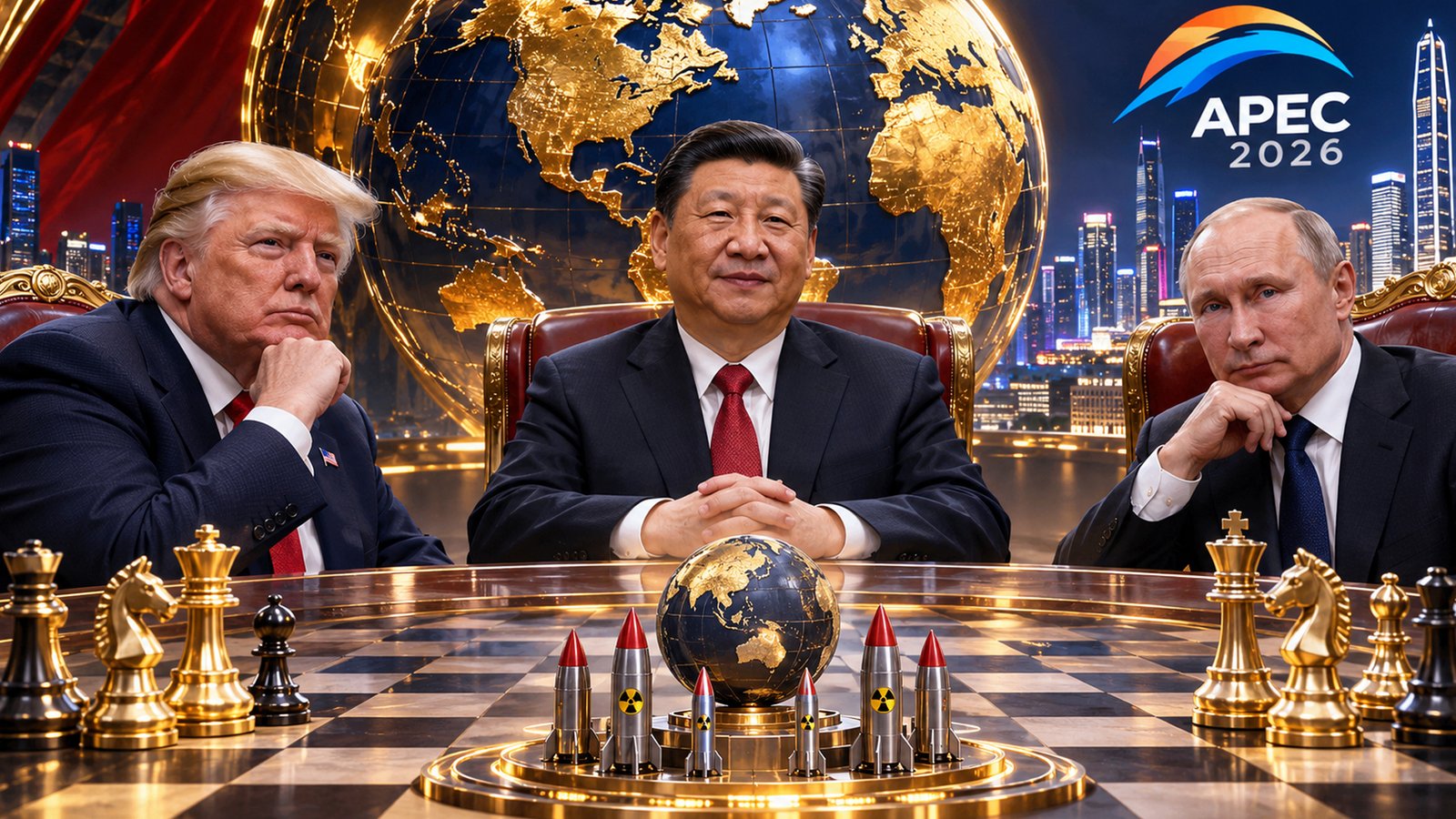
US President Donald Trump, Chinese President Xi Jinping and Russian President Vladimir Putin have held an unprecedented trilateral meeting in China’s Shenzhen, bringing together the leaders of the world’s three largest nuclear powers for discussions on international security, nuclear weapons and ongoing global conflicts.
The historic meeting, held on Thursday, November 19, on the sidelines of the Asia-Pacific Economic Cooperation (APEC) summit, marked the first formal three-way engagement between the leaders of the United States, China and Russia. The gathering attracted international attention, with the three countries playing a central role in shaping global security, economic relations and geopolitical developments.
Trump described the meeting as an opportunity to make history, stressing that the three nations had a special responsibility to maintain international peace and stability. He said the United States, Russia and China were uniquely positioned to discuss reducing nuclear weapons and lowering the risks associated with their possible use.
“As presidents of three of the world’s largest countries, we have a special responsibility to maintain open, respectful and productive dialogue on issues impacting not just our people but the entire planet,” Trump said.
He acknowledged, however, that nuclear disarmament would not be easy, particularly given the difficulties countries face in reducing their military capabilities.
The meeting comes at a time when international arms-control arrangements are under pressure. The New START treaty, the last major nuclear arms-control agreement between Washington and Moscow, expired in February 2026. Trump has expressed interest in developing a broader agreement that would also include China, although Beijing has shown little enthusiasm for joining negotiations that place limits on its nuclear arsenal.
Chinese President Xi Jinping emphasised the importance of peaceful coexistence between major powers, warning that confrontation could create instability and uncertainty across the world. He described the meeting as having groundbreaking significance and called for greater cooperation in addressing international challenges.
“History is the best textbook,” Xi said, underlining the need for countries to learn from the past while shaping a more stable international order.
Xi also stressed that every effort must be made to prevent nuclear war. According to China’s state news agency Xinhua, he called for nuclear weapons to be comprehensively prohibited and completely destroyed.
Putin, meanwhile, highlighted the shared responsibilities of the three countries in maintaining international peace and security. The Russian president called for discussions on global and regional relations, economic cooperation, food security and energy security.
He said the three nations had several converging interests in resolving international conflicts and maintaining stability. The Russian leader also referred to their shared responsibility for preserving the international order established after the Second World War.
The ongoing Russia-Ukraine war was another important issue surrounding the summit. Trump has repeatedly expressed his desire to bring the conflict to an end and indicated that Washington and Beijing could work together towards that objective.
Before the trilateral meeting, Trump held separate discussions with Putin and Xi. During his meeting with Xi, he said both countries had an interest in ensuring that oil continued to flow through the Strait of Hormuz, a strategically important shipping route affected by the continuing Iran conflict.
Trump also said he wanted China to help address the Ukraine war. However, Xi did not directly refer to the conflict in his public remarks, reflecting Beijing’s cautious approach to the issue.
Putin, on the other hand, openly referred to Ukraine, saying the three countries shared several interests in resolving regional conflicts. He also suggested that constructive cooperation between Washington, Moscow and Beijing could contribute to greater global stability.
The three leaders also discussed the wider implications of nuclear proliferation and the need to prevent further escalation of international conflicts.
Trump additionally criticised the International Criminal Court (ICC), describing it as being “out of control”. His remarks attracted attention because Putin remains subject to an arrest warrant issued by the court in March 2023 over alleged war crimes relating to the deportation and transfer of Ukrainian children from occupied Ukrainian territories to Russia.
The historic gathering followed separate bilateral meetings between Trump and the two leaders.
Trump’s meeting with Putin was particularly significant as it marked their first face-to-face engagement in more than a year. The discussions reportedly included the Ukraine conflict, with the Kremlin describing the Russian president as being in an excellent mood following the meeting.
Trump also held discussions with Xi lasting just over an hour. Both leaders struck a positive note on the state of China-US relations, which have experienced tensions over tariffs, trade restrictions and access to advanced technology.
The two countries have recently extended their trade truce, although disagreements remain over semiconductor exports, artificial intelligence and technology restrictions. Washington has also raised concerns about reports of advanced Nvidia chips being diverted to China through Southeast Asian countries.
According to estimates from the Stockholm International Peace Research Institute, China had approximately 620 nuclear warheads as of January 2026, compared with 5,042 held by the United States and 5,420 by Russia. Beijing has so far resisted joining nuclear reduction negotiations with Washington and Moscow, arguing that its arsenal is substantially smaller.
The absence of Ukraine and several European and Asian allies from the discussions has also raised concerns about the possibility of major powers making decisions that could affect smaller countries without their participation.
The trilateral meeting lasted around 90 minutes and concluded without an immediate joint announcement from the three leaders. Nevertheless, the engagement itself marked a significant diplomatic moment, bringing together three presidents whose decisions have far-reaching consequences for the international order.