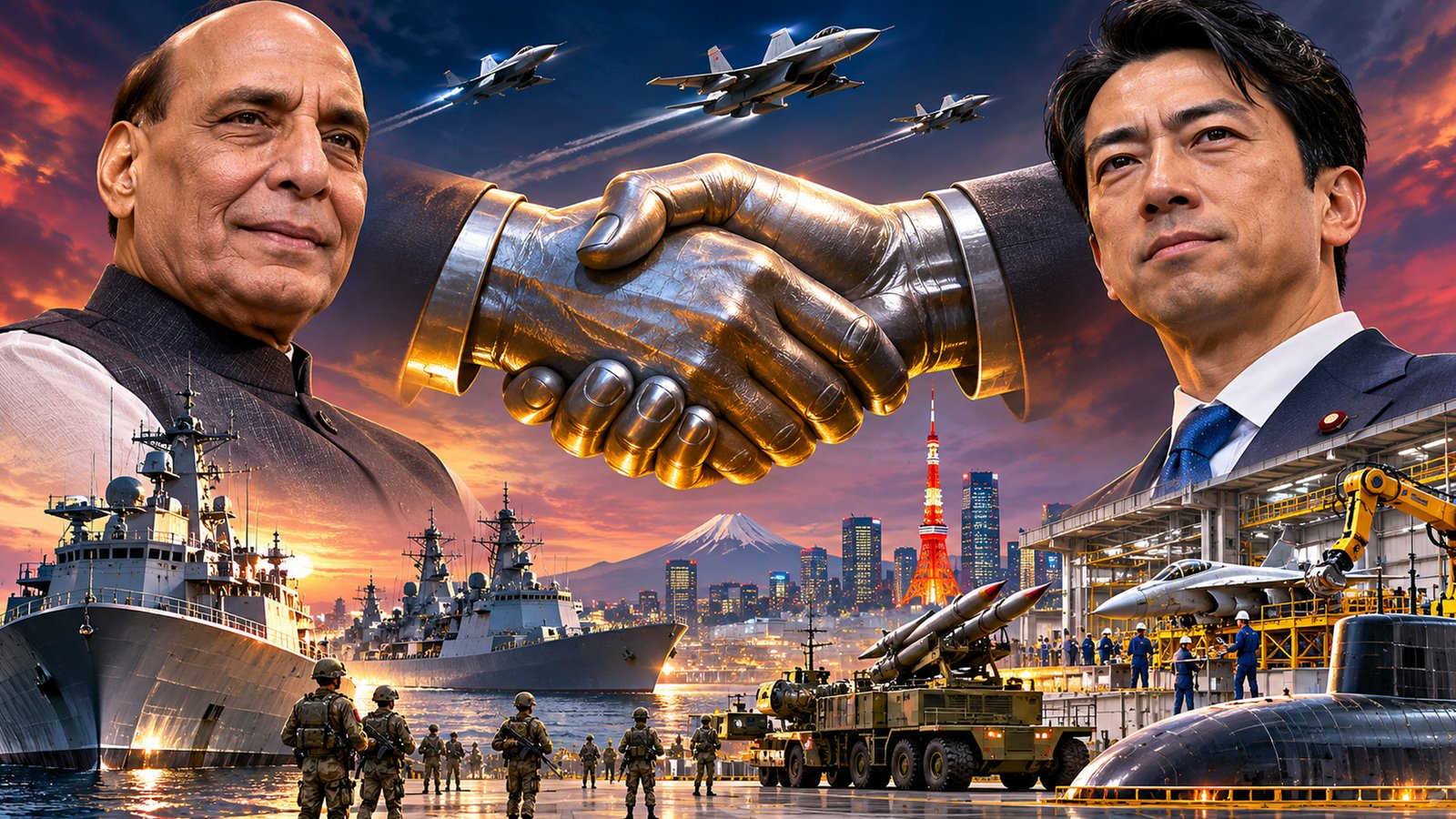
India and Japan have agreed to significantly expand defence, economic and strategic cooperation, with a renewed focus on military exercises, defence manufacturing, maritime security and emerging technologies, as the two countries seek to strengthen stability in the Indo-Pacific region.
The decisions were taken during the fourth India-Japan Foreign and Defence Ministers’ Dialogue, popularly known as the 2+2 Ministerial Meeting, held in Tokyo on November 19. Defence Minister Rajnath Singh and External Affairs Minister S Jaishankar represented India, while Japan was represented by its Foreign Minister Toshimitsu Motegi and Defence Minister Shinjiro Koizumi.
The meeting reflected the growing strategic partnership between the two countries amid increasing geopolitical uncertainty and emerging security challenges. Both sides emphasised the importance of maintaining a free, open and rules-based international order, while agreeing to work more closely on regional and global security issues.
A major outcome of the discussions was the decision to expand joint military exercises and strengthen defence industry partnerships. The two countries agreed to make their military exercises more complex, introduce unmanned systems and explore the possibility of conducting bilateral and multilateral exercises at short notice.
The discussions also covered greater cooperation between the Indian and Japanese air forces. Both sides welcomed the first-ever visit of Japan Air Self-Defence Force fighter aircraft to India for the joint air exercise Veer Guardian 26. The exercise marked an important step in expanding operational cooperation between the two countries.
Another significant development was the signing of a Letter of Intent towards allowing Japan’s Self-Defence Forces to use firing ranges in India. Under the proposed arrangement, Japanese forces could conduct live-fire training in India for the first time, including exercises involving surface-to-ship missiles. Defence authorities from both countries have been asked to speed up discussions to implement the arrangement.
India and Japan also agreed to strengthen defence manufacturing and technology cooperation under the framework of ‘Design with Japan, Make in India’. The initiative is expected to encourage Japanese investment, promote joint development and manufacturing, and create opportunities for Indian defence companies to work with Japanese counterparts.
The two sides also discussed progress on cooperation involving UNICORN, a naval communication antenna system developed by Japan, and India’s Acceptance of Necessity (AoN), with the aim of advancing the necessary arrangements by February 2027.
Addressing the discussions, Rajnath Singh said India and Japan had made considerable progress in defence relations and that security cooperation had emerged as an increasingly important pillar of their partnership. He highlighted the complementary strengths of the two countries and called for greater focus on joint development, manufacturing and long-term technological partnerships.
Japanese Defence Minister Shinjiro Koizumi also underlined the importance of closer cooperation, noting that the security environment surrounding both countries was becoming increasingly challenging. He pointed to the mutual trust between the two nations and their shared commitment to the rule of law.
Maritime security emerged as another important area of cooperation. India and Japan agreed to accelerate practical collaboration between the Indian Navy and Japan Maritime Self-Defence Force following the signing of a Memorandum of Arrangement on Maritime Security Cooperation.
The proposed areas include maritime and air domain awareness, information sharing, search and rescue operations and humanitarian assistance and disaster relief. Both countries also expressed interest in strengthening mine countermeasure capabilities and exploring opportunities for joint naval shipbuilding and design.
Cooperation between the coast guards of the two countries will also receive greater attention. The ministers welcomed the fifth Coast Guard Global Summit, scheduled to be held in India in February 2027.
The two sides further agreed to strengthen coordination between India’s Indo-Pacific Oceans Initiative and MAHASAGAR initiative and Japan’s updated Free and Open Indo-Pacific vision. The objective is to support a peaceful, stable and prosperous Indo-Pacific through closer regional partnerships.
Alongside defence cooperation, India and Japan placed considerable emphasis on economic security and building more reliable supply chains.
During the 19th India-Japan Foreign Ministers’ Strategic Dialogue, held separately in Tokyo, Jaishankar and Motegi discussed strengthening economic security and expanding government-to-government, business-to-business and people-to-people connections.
Jaishankar highlighted concerns over the growing weaponisation of connectivity, resources, services, supply chains and market access, pointing out that these developments could have direct implications for national security.
The two countries agreed to promote practical cooperation in five strategic sectors: semiconductors, critical minerals, information and communication technology, clean energy and pharmaceuticals. Greater participation by government agencies, businesses and research institutions will be encouraged to identify investment opportunities and reduce vulnerabilities in critical supply chains.
The ministers also welcomed progress under the Economic Security Dialogue and the first Private-Sector Economic Security Dialogue. The discussions are expected to create stronger links between industries and research institutions in both countries.
Artificial intelligence, cybersecurity and space cooperation also featured prominently. Both sides agreed to strengthen collaboration in AI-enabled cybersecurity, protect critical digital infrastructure and develop secure communication networks, including undersea cable systems.
They also agreed to expand cooperation in space situational awareness and the use of space-based technologies for maritime domain awareness.
Beyond strategic and economic issues, both countries recognised the importance of closer people-to-people connections. The foreign ministers discussed expanding exchanges involving skilled professionals, local governments and other institutions. They also agreed to hold a consular dialogue to improve coordination in assisting their nationals overseas.
India and Japan will mark 75 years of diplomatic relations in 2027. The anniversary will be celebrated throughout the year as the ‘India-Japan Year of Shared Horizons’. The official logo for the celebrations was unveiled in Tokyo, with both countries viewing the milestone as an opportunity to strengthen friendship and mutual understanding.
The ministers also reiterated their support for reforming the United Nations Security Council, including expansion of both permanent and non-permanent membership. India and Japan expressed mutual support for each other’s candidature for permanent membership in a reformed council.
Both countries also reaffirmed their commitment to working together through the Quad and engaging with ASEAN nations to strengthen regional security and economic resilience.
The fifth India-Japan 2+2 Ministerial Meeting will be held in India on a mutually convenient date, continuing the momentum generated by the latest discussions.