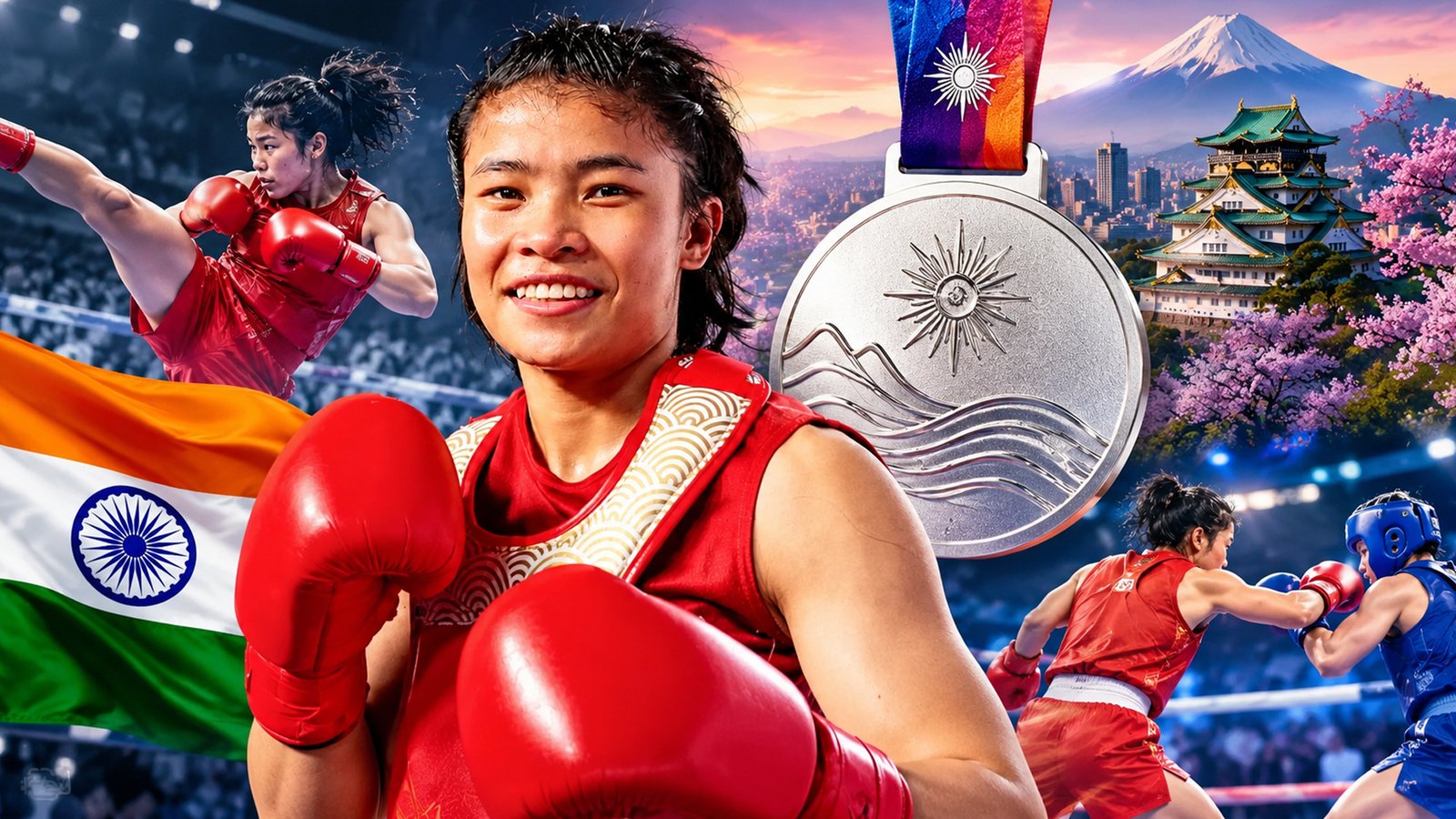
Roshibina Devi’s Asian Games journey took an unexpected turn before it even began. Called into India’s wushu squad at the last moment, the Manipuri fighter arrived in Japan with little time to prepare. She leaves Aichi-Nagoya with another silver medal and a place in Indian sporting history.
Roshibina lost 0-2 to China’s Zhang Xiaoyu in the women’s 60kg Sanda final at the Aichi Prefectural Martial Arts Hall on Thursday. Zhang controlled both rounds and all five judges awarded her the rounds, giving the Chinese fighter the gold medal.
The result gave Roshibina her third consecutive Asian Games medal. She had won bronze at Jakarta 2018 and silver at Hangzhou 2023. Her latest silver makes her the first Indian wushu athlete to win medals at three successive editions of the Asian Games.
The achievement is even more significant given how uncertain her participation was this time.
Roshibina was initially left out of India’s Asian Games squad after losing the selection trial to Divyanshi Choudhary. Divyanshi was later withdrawn from the team after the Wushu Association of India said medical examinations showed a serious ACL injury. The federation then brought Roshibina into the squad, with the Sports Ministry approving the change.
Roshibina said she learned about her inclusion around September 10. That left her with only a short window to get ready for one of the biggest competitions of her career.
“There was a lot of disturbance when I came here for the Asian Games. I did not get much time to prepare,” she said after the final. She also credited her coach Amit Pal for helping her get ready despite the difficult circumstances.
Once the competition started, Roshibina quickly put the uncertainty behind her.
She opened her Asian Games campaign against Bangladesh’s Shika Khatun before beating Macao’s Chu Man Sin 5-0 in the quarterfinal. The victory assured her of a medal and also confirmed her place in the record books.
Roshibina then defeated Indonesia’s Thania Kusumaningtyas 2-0 in the semi-final to reach the gold-medal bout. Her progress meant that she had reached the podium at three Asian Games in a row, something no Indian wushu athlete had achieved before.
The final, however, belonged to Zhang.
The Chinese fighter used her reach and sharp side-kicks to keep Roshibina under pressure. Zhang had also beaten Vietnam’s 2023 world champion Nguyen Thi Thu Thuy on her way to the final, underlining the challenge facing the Indian fighter.
Roshibina tried to defend, throw and find openings, but Zhang remained in control. Both rounds ended with unanimous 5-0 decisions in favour of the Chinese fighter.
There was disappointment after the bout, but also a clear sense that Roshibina’s journey was far from over.
“I have won silver earlier and this time also, I could win only silver. I could not give the gold medal to the Indian people,” she said, reflecting on another runner-up finish.
The 25-year-old has now built one of the most consistent Asian Games records in Indian wushu. Her journey began with bronze in Jakarta in 2018, when she was only 17. Five years later, she moved up to silver in Hangzhou. In Aichi-Nagoya, she repeated that silver finish despite entering the tournament with limited preparation.
Her road to the top has also been shaped by her family and her roots in Manipur. Born in Kwasiphai in Bishnupur district, Roshibina comes from a farming family. Her father, Naorem Damu Singh, sold a piece of land in her early years to help fund her training and travel.
Her rise has since brought major recognition. Roshibina won the Arjuna Award after her successful 2023 season, while the International Wushu Federation named her its Female Sanda Athlete of the Year.
Now, the silver medal carries a different meaning. It is proof of consistency, but also a reminder of the one colour missing from her Asian Games collection.
“I will try my best in the upcoming Games, learn from my mistakes and come back,” she said.
The gold may have slipped away in Japan, but Roshibina has returned to the podium once again. More importantly, she has extended a remarkable Asian Games medal streak and strengthened her place among India’s leading wushu athletes.