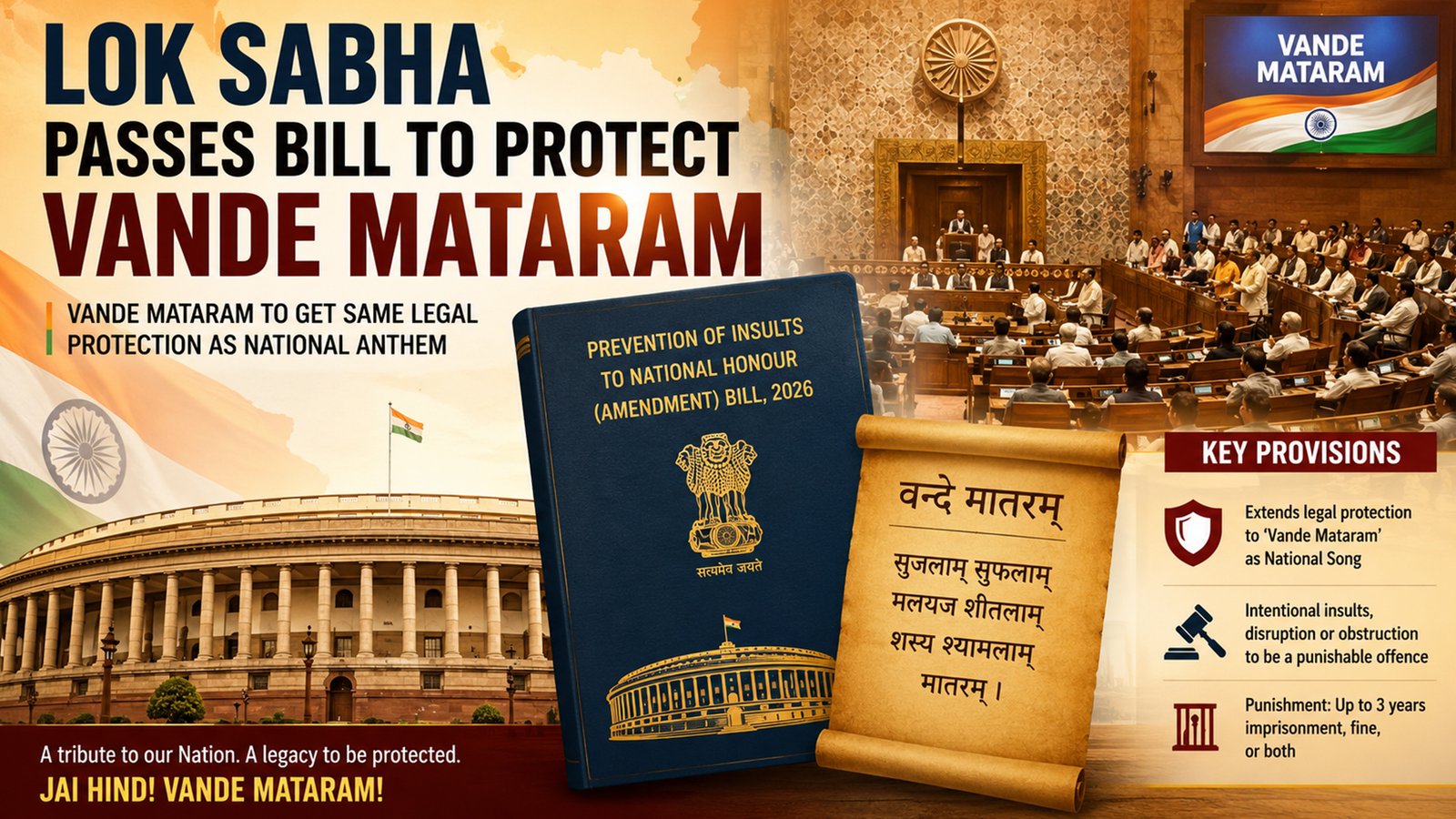
Parliament on Thursday passed a Bill seeking to make deliberate insult to or obstruction of the national song Vande Mataram a punishable offence, bringing it under the legal protection already available to the National Anthem.
The Prevention of Insults to National Honour (Amendment) Bill, 2026 was cleared by the Lok Sabha through a voice vote amid protests and sloganeering by Opposition members. The Rajya Sabha had passed the legislation a day earlier, also through a voice vote. With both Houses approving the Bill, it will now go to the President for assent. It will come into force after the required notification.
The legislation seeks to amend the Prevention of Insults to National Honour Act, 1971, which currently contains provisions dealing with disrespect towards the National Flag, Constitution and National Anthem. It specifically prohibits intentionally preventing the singing of Jana Gana Mana or causing disturbance to an assembly engaged in singing it.
The amendment extends these provisions to Vande Mataram, giving the national song statutory protection similar to that enjoyed by the National Anthem.
Under the existing law, deliberately preventing the singing of the National Anthem or disturbing an assembly engaged in its singing can attract imprisonment of up to three years, a fine, or both. A second or subsequent conviction carries a minimum one-year prison term.
The 2026 amendment extends these provisions to the national song. Once the legislation becomes law, deliberate acts covered by the provision in relation to Vande Mataram could therefore attract similar criminal penalties.
The government has presented the move as an effort to protect a symbol closely associated with India’s freedom struggle and national identity. Minister of State for Home Affairs Nityananda Rai, while replying to the short Lok Sabha debate, said the legislation was intended to give Vande Mataram the respect it deserved.
Rai also linked the legislation to the government’s “Ek Bharat, Shreshtha Bharat” idea and argued for recognition of the complete six-stanza version of the song. He criticised the Congress, saying it had failed to give Vande Mataram adequate respect during its long years in power.
The government has maintained that the Bill is about national honour and is not directed against any particular state, language or ideology.
The Bill, however, became the centre of another sharp political argument in Parliament.
DMK MP K Kanimozhi opposed the legislation and questioned the idea of using criminal law to enforce expressions of patriotism. She argued that the move could affect India’s secular and federal character and accused the government of presenting a political agenda as nationalism.
Kanimozhi also raised the issue of the song’s six stanzas. She pointed to the historical decision to accord official recognition to the first two stanzas and argued that extending the legal framework to the complete song could reopen long-standing cultural and political debates.
She also referred to India’s linguistic and cultural diversity, including the existence of state songs, and questioned whether national identity should be enforced through legislation.
The BJP rejected the Opposition’s criticism. BJP MP Sambit Patra accused the Congress of not giving Vande Mataram the respect it deserved during its decades in power.
The disagreement highlights a larger question surrounding the legislation: whether respect for national symbols should remain primarily a matter of civic responsibility and social convention or whether deliberate acts of disrespect should carry criminal consequences.
The Lok Sabha debate itself was brief, with only two members taking part before the government responded. Opposition amendments were rejected and the Bill was subsequently passed by voice vote.
The passage was followed by further disruption. DMK MP A Raja tore up documents and threw them towards the Well of the House, while Opposition members raised slogans. The Lok Sabha was later adjourned for the day.
The development comes during a particularly turbulent Monsoon Session of Parliament, which has witnessed repeated disruptions over several issues, including the NEET paper leak controversy.
The Vande Mataram legislation is significant because it is the first Bill to be passed by both Houses during the ongoing Monsoon Session.
The immediate next step is Presidential assent. If the President approves the legislation and it is subsequently notified, Vande Mataram will receive formal statutory protection under the national honour law.
The Bill does not simply change the symbolic status of Vande Mataram. Its importance lies in bringing the national song within a criminal-law framework dealing with deliberate insult and obstruction.
That distinction is important. The legislation is aimed at conduct covered by the amended law; the parliamentary debate over whether citizens should sing all six stanzas is a broader political and cultural issue.