The Lok Sabha has passed the Public Examinations (Prevention of Unfair Means) Amendment Bill, 2026, paving the way for tougher action against paper leaks and other forms of examination malpractice. The legislation seeks to strengthen the existing anti-paper leak law by increasing penalties, speeding up investigations and providing for special fast-track courts to deal with offences linked to public examinations.
The Bill was passed on Wednesday after a heated debate in the Lok Sabha, with the Opposition raising concerns over repeated paper leak allegations and the impact of examination failures on students and job aspirants. The legislation was eventually approved by voice vote amid political exchanges and disruptions in the House.
For thousands of students, a paper leak is not simply an examination irregularity. It can wipe out months of preparation, force the cancellation of an examination and create uncertainty about academic or career plans. Families can also face additional expenses when examinations are postponed or conducted again. The government has argued that the proposed amendments are aimed at making such offences more difficult to commit and ensuring that those responsible face serious consequences.
Under the proposed changes, individuals convicted of paper leaks or other unfair means can face imprisonment of between five and 10 years and a fine of up to ₹50 lakh. The legislation takes an even stricter approach towards organised networks involved in examination fraud. Members of organised paper leak syndicates can face a minimum of seven years in prison, with fines going up to ₹10 crore.
The proposed law also provides for the seizure of properties belonging to convicted offenders in appropriate cases. The provision is intended to target the financial interests of organised groups that may treat leaked examination papers as a source of illegal income.
Another important feature of the amendment is its focus on speeding up investigations and trials. The legislation proposes that investigations into offences under the law should be completed within two months. After a charge sheet is filed, cases can be taken up by special fast-track courts designated by state governments or Union Territory administrations.
These courts are expected to conduct proceedings on a day-to-day basis, with trials targeted for completion within three months of the filing of the charge sheet. The government believes that such time-bound procedures will prevent paper leak cases from remaining unresolved for years and strengthen the deterrent effect of the law.
The Centre will also have the power to constitute a special task force when necessary to investigate offences covered by the legislation. This provision is expected to help deal with cases involving multiple states, organised networks or complex examination-related crimes.
The 2026 Bill builds on the Public Examinations (Prevention of Unfair Means) Act, 2024, which was introduced to address cheating, paper leaks and other unfair practices in examinations conducted by central authorities. The existing law covers examinations conducted by agencies and institutions including the Union Public Service Commission, Staff Selection Commission, Railway Recruitment Boards, Institute of Banking Personnel Selection and National Testing Agency, besides examinations conducted by central ministries and notified authorities.
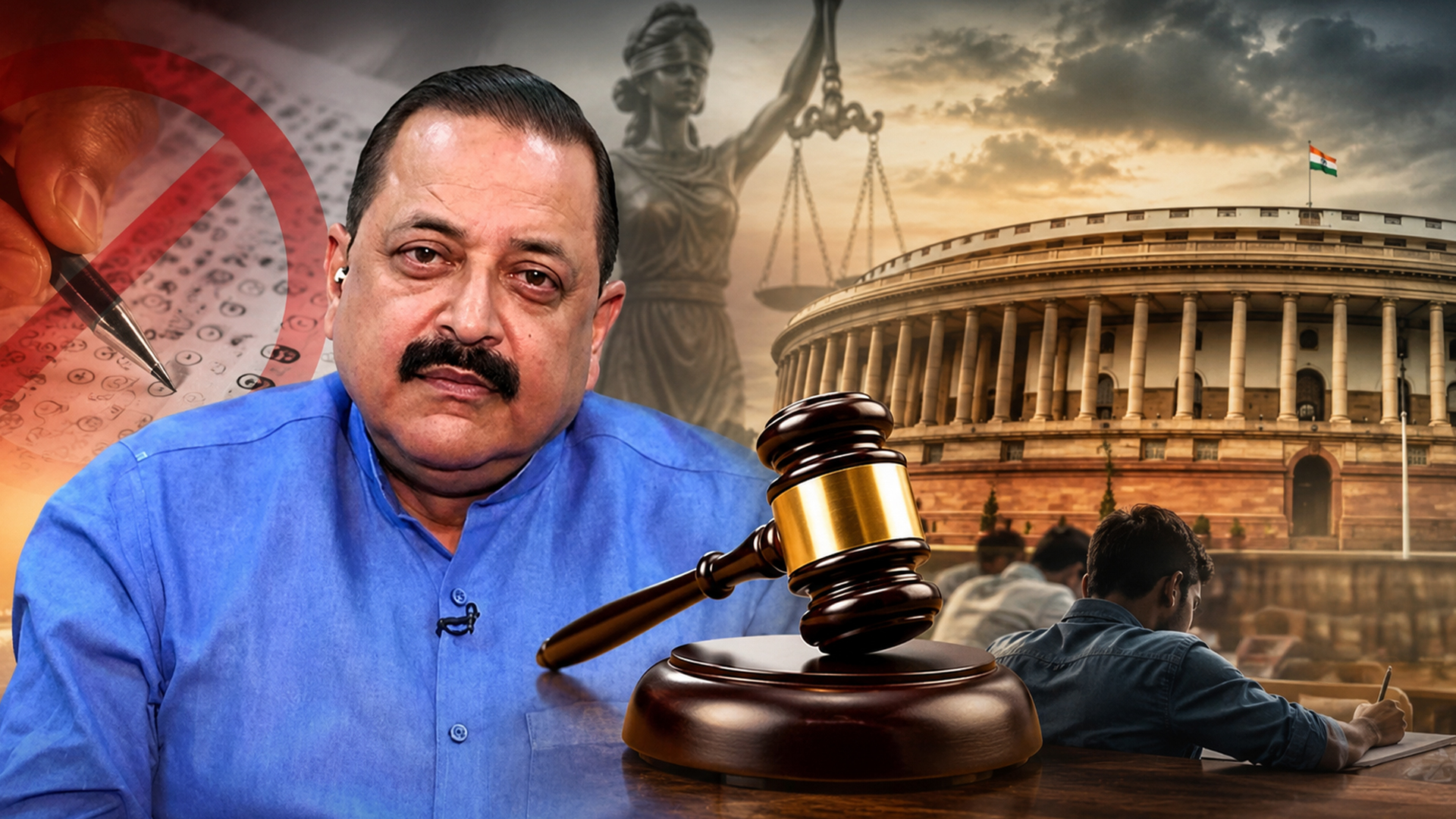
The government has argued that experience since the implementation of the 2024 law has shown the need for stronger provisions. During the parliamentary debate, Minister of State for Personnel, Public Grievances and Pensions Jitendra Singh said the amendments were designed to make the framework more stringent and ensure speedy justice. The government also pointed to cases registered under the existing legislation as evidence of the continuing challenge posed by examination malpractice.
The Opposition, however, used the debate to question the government’s handling of paper leak controversies and student protests. The discussion became particularly contentious after remarks made by Congress leader and Leader of Opposition Rahul Gandhi regarding alleged incidents involving students. BJP members challenged the remarks and demanded clarification, leading to further political exchanges in the House.
Despite the political disagreement, there was broad recognition of the damage caused by examination fraud. India’s public examinations often involve lakhs of candidates competing for a limited number of seats or government jobs. Any compromise in the examination process can therefore affect not only those directly involved but also the credibility of the entire selection system.
The tougher law is expected to send a strong warning to individuals, officials and organised groups involved in leaking question papers or facilitating unfair means. However, experts and stakeholders have repeatedly stressed that stronger punishment must be accompanied by better preventive measures.
Paper leaks can occur at several stages, including question-paper preparation, printing, transportation, storage and distribution. The growing use of digital systems has also created new cybersecurity risks. Ensuring examination integrity therefore requires secure technology, strict access controls, background checks, monitoring systems and greater accountability among agencies and service providers involved in conducting examinations.
The effectiveness of the new legislation will ultimately depend on implementation. Faster investigations and special courts can make a difference only if agencies have the resources and expertise to identify suspects, collect evidence and complete cases within the prescribed timelines.
The Bill has cleared the Lok Sabha and is scheduled to be taken up by the Rajya Sabha on July 30. It will need to clear the Upper House before it can move towards becoming law.
For students and job aspirants, the real measure of the anti-paper leak legislation will not be the severity of the punishment alone. It will be whether examinations can be conducted without leaks, cancellations and uncertainty, giving candidates who prepare honestly the confidence that their efforts will be judged fairly.