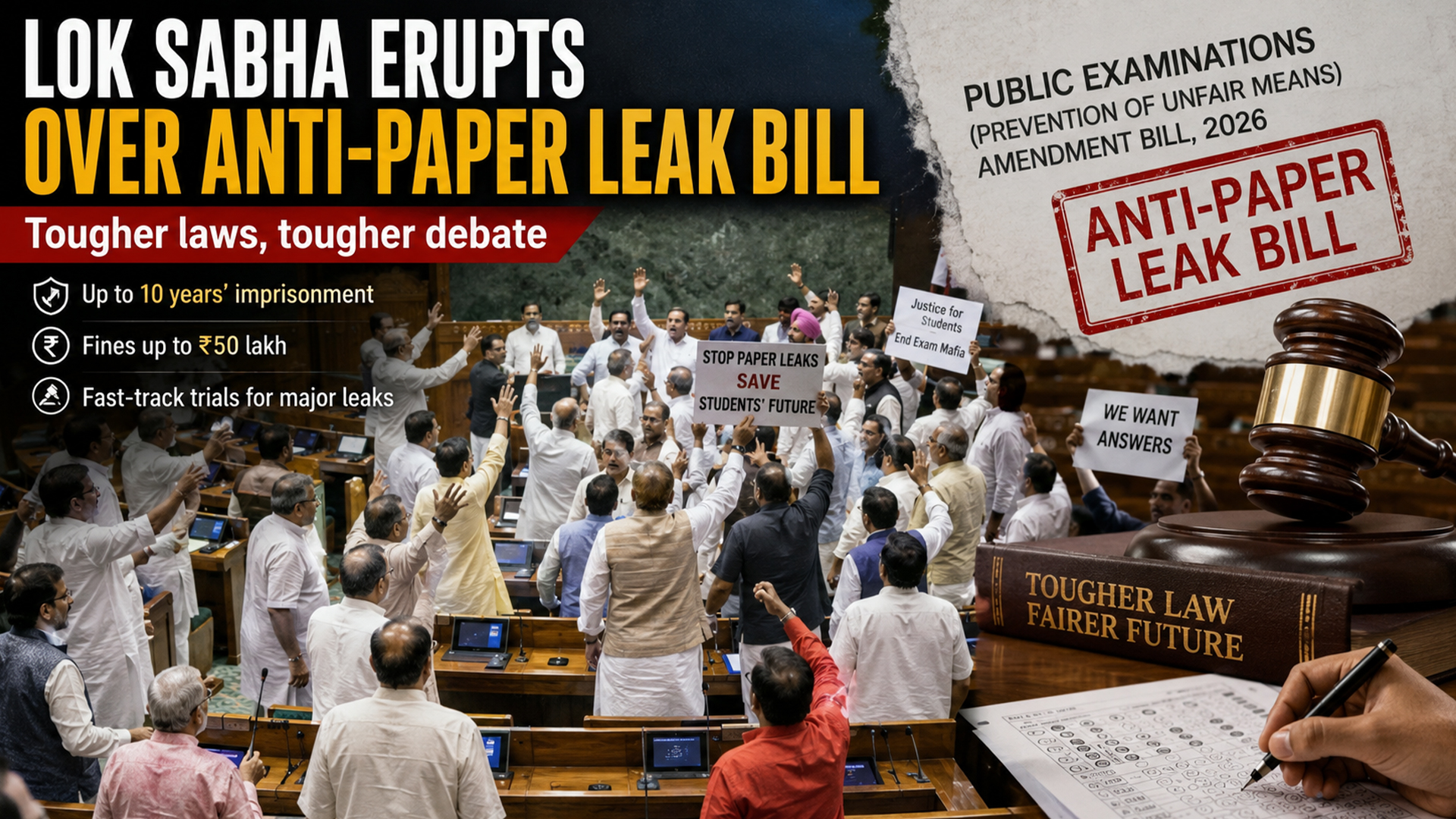
The Lok Sabha witnessed an intense debate on the Public Examinations (Prevention of Unfair Means) Amendment Bill, 2026, with the government pitching it as a decisive step to curb paper leaks and restore confidence in India’s examination system. The Opposition, however, argued that the legislation was an admission that repeated failures had allowed examination fraud to flourish, affecting the future of millions of students.
The discussion took place after Parliament resumed legislative business following days of disruptions during the Monsoon Session. The Anti-Paper Leak Bill was brought forward as one of the government’s key legislative priorities, with lawmakers from both sides agreeing that examination integrity is a matter of national importance, even as they clashed over the Centre’s handling of previous paper leak incidents.
Introducing the Bill, the government said organised criminal networks involved in exam paper leaks had become more sophisticated and required tougher legal action. The proposed amendments seek to strengthen the existing law by enhancing investigation mechanisms, tightening enforcement and ensuring quicker prosecution of those responsible for compromising public examinations. Ministers stressed that the law is aimed at organised rackets and corrupt officials, not students.
Union Minister Jitendra Singh said the legislation was designed to protect the aspirations of honest candidates who spend years preparing for competitive examinations. He maintained that repeated paper leak cases undermine public trust and deprive deserving students of fair opportunities. According to the government, stricter provisions will act as a deterrent while helping investigating agencies dismantle organised cheating syndicates operating across states.
The Opposition, however, questioned the timing of the legislation, arguing that stronger laws should have been introduced before repeated examination scandals disrupted recruitment tests and entrance examinations. Congress MP Priyanka Gandhi Vadra said the very need for a tougher law reflected the government’s inability to safeguard public examinations over the past several years.
She also raised concerns over the treatment of students who protested against paper leaks, alleging that many faced police action while demanding transparency and accountability. She argued that students who had invested years in preparing for examinations deserved justice rather than intimidation, adding that the government must focus equally on preventing leaks and fixing systemic failures within examination bodies.
Several Opposition members echoed similar concerns, saying that merely increasing punishment would not solve the problem unless authorities strengthened examination processes and ensured accountability among officials responsible for conducting tests. They argued that paper leaks have repeatedly shattered the dreams of lakhs of young aspirants preparing for government jobs and higher education, leaving them uncertain about their future.
The debate also witnessed an unusual and lighter moment when members from different parties used Gen Z expressions during their speeches. Words such as “delulu”, “clock it”, “FOMO” and “MIA” echoed through the Lok Sabha as MPs took political digs at one another, drawing laughter from fellow members. The exchange quickly gained attention on social media, with many describing it as one of the most unexpected moments of the parliamentary session.
Despite the sharp exchanges, there was broad agreement across party lines that paper leak cases have become a serious challenge requiring urgent action. Members acknowledged that repeated examination fraud has eroded confidence among students and parents while damaging the credibility of recruitment agencies and educational institutions.
The government rejected the Opposition’s charge that the Bill amounted to an admission of failure. Ministers argued that criminal networks continually evolve their methods and that the legal framework must also be updated to tackle emerging threats. They maintained that the amendments represent a proactive effort to strengthen the integrity of India’s examination system and protect deserving candidates.
Experts believe the success of the Anti-Paper Leak Bill will ultimately depend on effective implementation rather than stricter penalties alone. They say stronger cybersecurity measures, secure transportation of question papers, real-time monitoring, greater accountability within examination authorities and swift prosecution of offenders are equally important to eliminate examination fraud.
For millions of students preparing for competitive examinations, the debate was more than a political contest. It reflected growing public demand for an examination system that is transparent, fair and free from malpractice. As Parliament deliberates on the proposed amendments, students across the country will be watching closely, hoping the new law delivers lasting reforms and ensures that their hard work is never undermined by organised paper leak rackets.