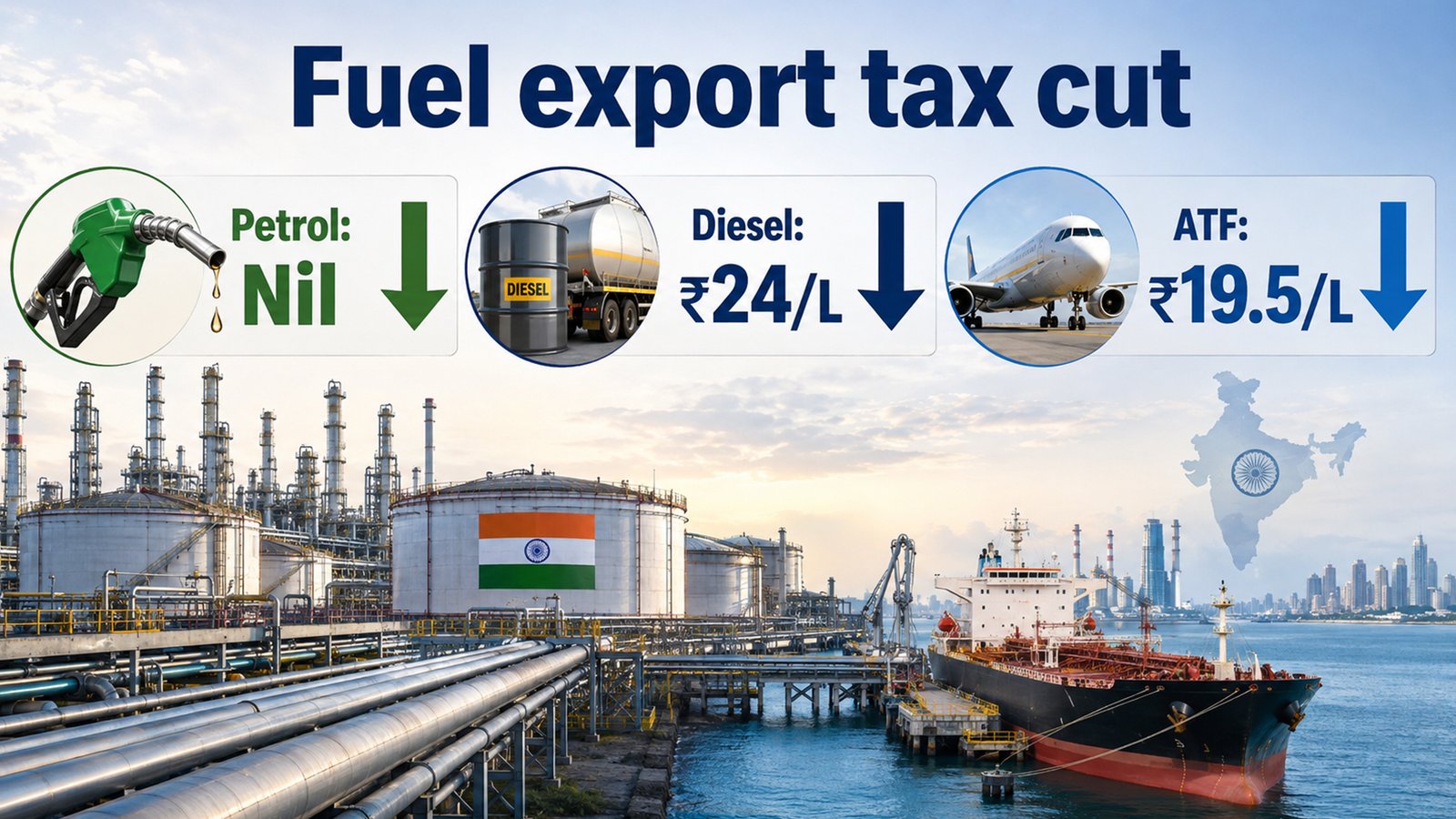
The government has eased the tax burden on petroleum exports, scrapping the windfall levy on petrol and reducing the duties imposed on diesel and aviation turbine fuel (ATF). The revised rates came into effect on August 15 and will apply for the latest fortnightly review period.
Under the new rates, the Special Additional Excise Duty (SAED) on petrol exports has been brought down to zero from ₹3.5 per litre. The levy on diesel exports has been reduced to ₹24 per litre from ₹25.5, while the duty on ATF has been lowered to ₹19.5 per litre from ₹22.
For Indian refiners, the move provides some relief on overseas sales. Lower export levies mean companies can retain a larger share of their export earnings, although the eventual impact on profitability will depend on global fuel prices, refining margins, freight costs and currency movements.
The decision also marks a partial reversal of the sharp increase announced earlier this month. On August 3, the government raised the petrol export duty to ₹3.5 per litre from ₹2.5. The total levy on diesel was increased to ₹25.5 per litre from ₹15.5, while the ATF levy was raised to ₹22 per litre from ₹14.5.
The latest revision does not completely restore diesel and ATF duties to their earlier levels. Instead, it reduces the burden after the August 3 increase, while petrol exporters get a complete removal of the levy.
The government reviews the windfall tax on petroleum products every two weeks. The mechanism allows it to adjust export levies in response to changes in international crude oil prices and petroleum product margins. The latest decision comes as global energy markets continue to face uncertainty from geopolitical tensions and fluctuating crude prices.
The impact is particularly relevant for India’s large refining industry. Indian refiners process crude oil into products including petrol, diesel and ATF, supplying the domestic market while also exporting substantial volumes. The profitability of these exports depends heavily on the gap between international product prices and crude costs.
Export taxes can alter that equation. When the government raises the levy, a greater portion of the export value goes towards taxes, potentially reducing the attractiveness of overseas sales. Lower duties, in contrast, give refiners more flexibility to respond to international demand and favourable margins.
The removal of the petrol export duty is therefore the most significant change in the latest notification. Exporters will no longer have to pay ₹3.5 per litre on petrol shipments during the current review period.
The diesel and ATF reductions are smaller but still provide some improvement in export economics. The diesel levy has been cut by ₹1.50 per litre, while the ATF levy has come down by ₹2.50 per litre.
The move should not, however, be viewed as a direct reduction in domestic fuel prices. The revised rates apply to petroleum products being exported from India. They do not change the retail tax structure for petrol and diesel sold in the domestic market.
That distinction is important for consumers. Petrol and diesel prices at Indian fuel stations are influenced by crude oil prices, refining costs, taxes, dealer margins and the pricing decisions of oil marketing companies. A reduction in export duty does not automatically translate into cheaper fuel at the pump.
The ATF reduction similarly concerns exports and does not directly lower the price of aviation fuel purchased by airlines within India.
The latest move also reflects the government’s attempt to balance two competing priorities. On one side is the need to generate revenue and prevent excessive overseas shipments when domestic fuel availability becomes a concern. On the other is the need to keep India’s refining sector competitive in global markets.
India’s refining capacity has made it an important supplier of refined petroleum products to overseas markets. Refiners therefore remain sensitive to changes in international product prices as well as government levies.
The windfall tax regime itself has been used as a flexible policy instrument. India first introduced the levy in July 2022 after international crude prices surged and refiners and oil producers benefited from unusually high margins. The earlier regime was withdrawn in December 2024 but was reintroduced in March 2026 amid renewed pressure on global oil prices.
The current policy is closely linked to market conditions. The government does not lock the rates for an extended period; instead, it reassesses them every fortnight. This allows changes in crude prices and refined fuel margins to feed into the tax structure relatively quickly.
For the refining industry, this means the tax environment can shift rapidly. The August 15 revision follows a substantial increase only 12 days earlier, demonstrating how quickly the government can recalibrate export duties when market conditions change.
The lower levies could be supportive for refiners with sizeable export exposure, but the benefit should not be viewed in isolation. Companies will continue to be affected by crude procurement costs, international fuel demand, refinery utilisation, shipping expenses and exchange-rate movements.
The bigger business signal is that the government continues to use the windfall tax as a flexible tool rather than a fixed charge. For India’s refiners, the latest cuts offer near-term relief, but the outlook for export profitability will ultimately depend on where global crude prices and refined-product margins move next.