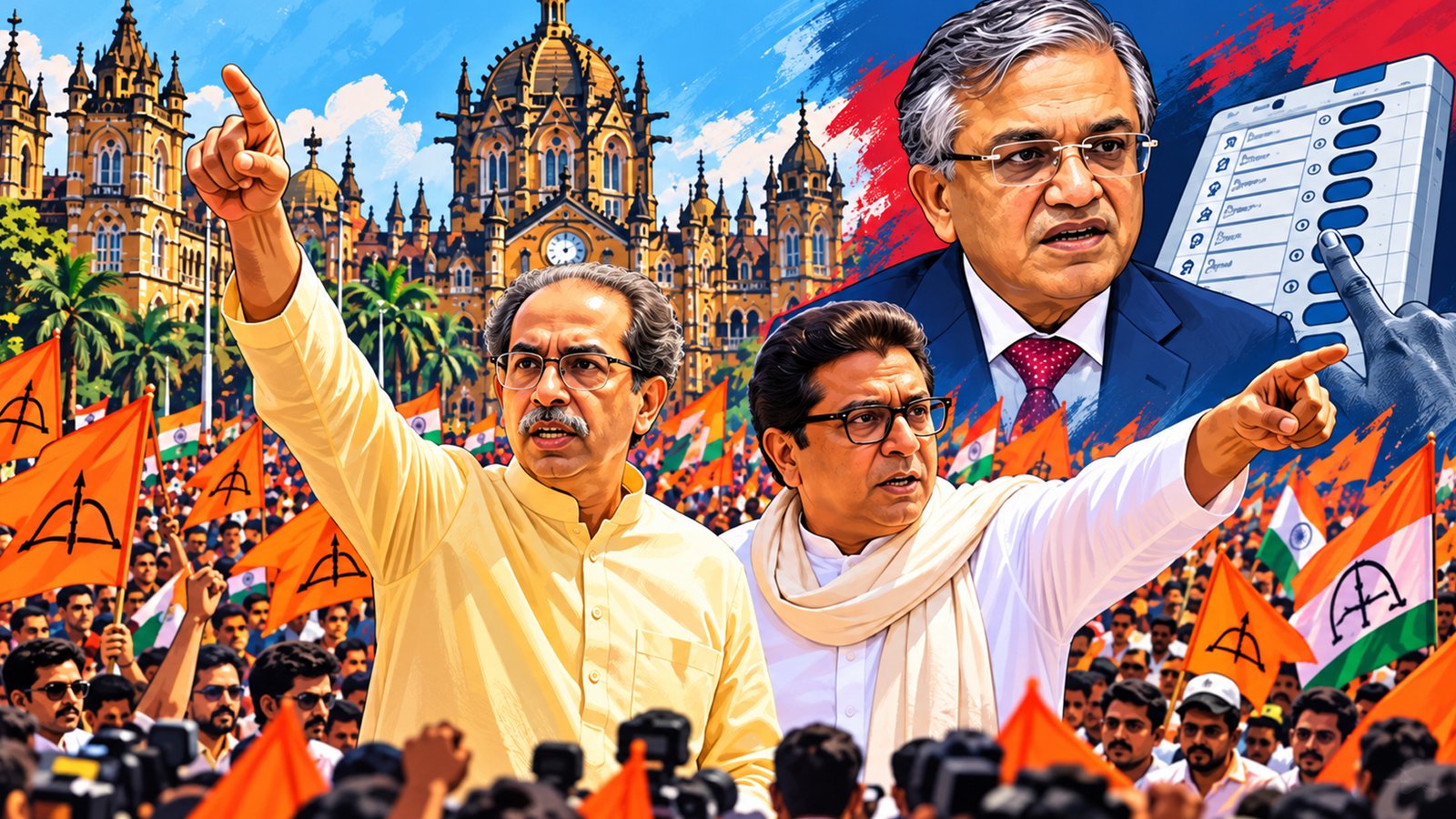
Shiv Sena (UBT) chief Uddhav Thackeray and Maharashtra Navnirman Sena (MNS) chief Raj Thackeray joined hands in Mumbai on Sunday to lead a major Opposition protest against Chief Election Commissioner Gyanesh Kumar, putting electoral reforms and voter-list revisions at the centre of Maharashtra politics.
The “Virat Garjana Morcha” began near Metro Cinema in south Mumbai and moved towards the Brihanmumbai Municipal Corporation headquarters. Leaders of the Congress and Sharad Pawar-led NCP (SP) also participated, turning the march into a broader Opposition mobilisation against the Election Commission of India.
The protesters demanded the resignation of Gyanesh Kumar, cancellation of the Special Intensive Revision (SIR) of electoral rolls in Maharashtra and a return to ballot-paper voting instead of electronic voting machines (EVMs). The Opposition has alleged that the revision process could exclude genuine voters and influence future election outcomes.
The rally also carried political significance because it brought Uddhav and Raj Thackeray together on a common platform after years of political separation. Their appearance together has revived speculation about whether the cousins could work more closely in Maharashtra politics, particularly as electoral issues become a major point of confrontation between the Opposition and the ruling BJP.
Uddhav Thackeray launched a sharp attack on the Election Commission and accused it of compromising the democratic process. He described the battle as one to protect voting rights and alleged that institutions meant to remain independent were being weakened.
He also targeted the BJP, claiming that changes to electoral rolls could benefit the ruling party in upcoming elections. Uddhav alleged that millions of voters had been affected by the SIR exercise and questioned whether the process could be considered fair if genuine voters were removed from the electoral rolls.
The Shiv Sena (UBT) leader also criticised the manner in which the Chief Election Commissioner is appointed and questioned the independence of institutions responsible for conducting elections.
Raj Thackeray focused heavily on EVMs and the voter-list controversy. He said he had been raising concerns about electronic voting and alleged manipulation since 2017-18. He demanded that the SIR process be scrapped and that India return to ballot papers for elections.
Raj also questioned the increase in Maharashtra’s voter numbers between the 2024 Lok Sabha election and the subsequent state Assembly election. He argued that the changes warranted greater transparency and public scrutiny.
The Opposition’s allegations, however, have been rejected by the BJP and the Election Commission. The poll body has defended the voter-roll revision exercise as an effort to identify and remove ineligible, duplicate or otherwise invalid entries rather than to target legitimate voters.
The BJP has also claimingthe Opposition of raising doubts about the electoral process after facing political setbacks and of using the EVM and voter-roll issues to create distrust in democratic institutions.
The political battle is particularly significant in Maharashtra, where the Thackeray cousins remain influential figures despite leading separate political parties. Uddhav heads the Shiv Sena (UBT), while Raj leads the MNS. Their joint appearance has therefore attracted attention beyond the immediate issue of the Election Commission.
The organisers also attempted to give the protest a broader, non-party character. Participants were asked not to carry party flags and instead bring the national tricolour. Congress and NCP (SP) leaders joined the march, reinforcing the Opposition’s effort to present the issue as one concerning electoral transparency rather than a dispute involving a single political party.
The protest comes amid a wider political confrontation over the Special Intensive Revision of electoral rolls. Opposition parties have argued that large-scale deletions from voter lists could disenfranchise eligible citizens, while supporters of the exercise say cleaning electoral rolls is necessary to ensure that only eligible voters remain registered.
The dispute has now moved beyond Maharashtra. Opposition parties in several parts of the country have raised concerns over voter-list revisions and demanded greater transparency from the Election Commission. Protests have also taken place in Delhi, with demonstrators calling for action against the poll panel chief.
The issue of EVMs has added another layer to the political confrontation. While the Election Commission has consistently defended the reliability and security of electronic voting, the Opposition has repeatedly demanded a return to paper ballots, arguing that this would increase public confidence in the electoral process.
Maharashtra Chief Minister Devendra Fadnavis, meanwhile, criticised the Thackeray cousins’ protest, portraying it as an attempt to regain political relevance. The BJP has maintained that the Opposition’s allegations are politically motivated and has rejected claims that the Election Commission is working in favour of the ruling party.
The Mumbai protest therefore carried significance on two fronts. On the surface, it was a demonstration against the Chief Election Commissioner and the SIR exercise. Politically, however, it marked an important moment of coordination among Maharashtra’s Opposition parties and, most notably, a public reunion of Uddhav and Raj Thackeray.
Whether that unity extends beyond the electoral-roll controversy remains uncertain. But the joint appearance has already changed the political conversation in Maharashtra, where the Thackeray cousins’ relationship and the future of Opposition alliances are closely watched.
With voter-list revision, EVMs and electoral transparency likely to remain major political issues, Sunday’s Mumbai mobilisation could become an early indicator of how Maharashtra’s Opposition plans to challenge the BJP in the next electoral battles.