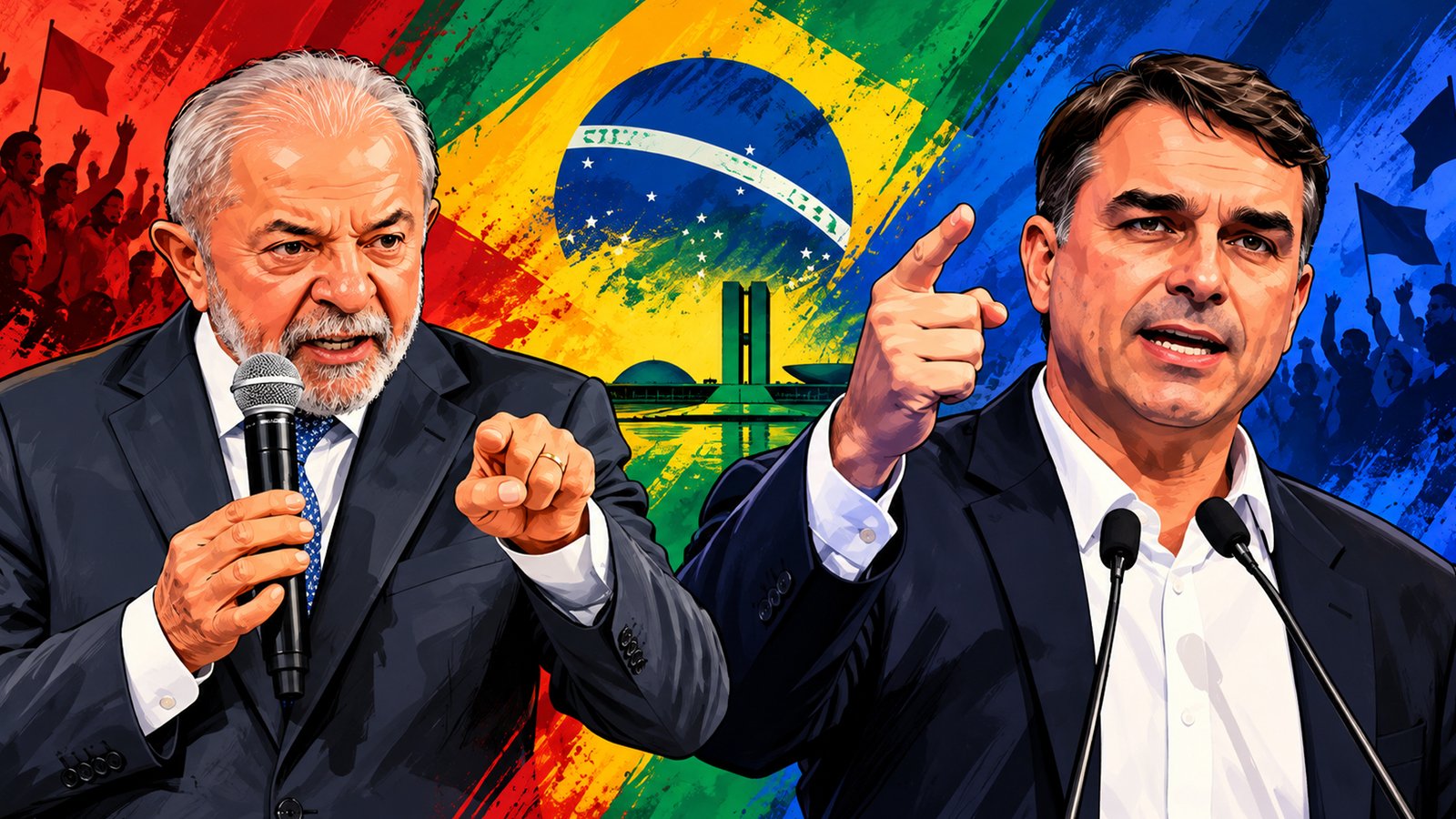
Brazil’s presidential election is heading for a tense second round after right-wing Senator Flávio Bolsonaro finished ahead of President Luiz Inácio Lula da Silva in the first round, overturning expectations of a closer contest.
With almost all votes counted, Bolsonaro secured 47.03% of valid votes, while Lula received 45.16%. Neither candidate crossed the 50% threshold needed for an outright victory, sending the race to a runoff on October 25.
The result gives Bolsonaro an important psychological advantage going into the final stage of the Brazil presidential election. Lula had entered polling day with a narrow lead in several surveys, but Bolsonaro performed strongly enough to finish first and establish himself as the main challenger to the veteran left-wing leader.
The contest now becomes a direct choice between two sharply different political visions. Lula, 80, is seeking another term after returning to power in 2023, while Bolsonaro, 45, is running for president for the first time. Bolsonaro is the son of former President Jair Bolsonaro and has emerged as the leading figure of Brazil’s conservative movement.
The first-round result also shows how deeply divided Brazil remains. The election has been shaped by familiar concerns such as crime, the cost of living, the economy and the direction of the country’s democracy. But the campaign has also carried the weight of the political battle between the Bolsonaro family and Lula, which has dominated Brazilian politics for years.
Bolsonaro’s performance is particularly significant because he exceeded expectations in a race where opinion polls had suggested that Lula could finish first. His campaign now has an opportunity to build on that momentum by attracting voters who backed candidates eliminated in the first round.
Lula faces a different challenge. He must persuade voters who did not support him that his administration offers the more stable path for Brazil. His campaign is also likely to focus heavily on Bolsonaro’s political record and his association with his father, Jair Bolsonaro, who is serving a 27-year prison sentence after being convicted over a failed attempt to overturn the 2022 election result.
Speaking after the first-round result, Lula acknowledged that the outcome was unexpected but remained confident about his chances in the runoff. He argued that voters would have a clearer choice in the second round and suggested that Bolsonaro’s political record would come under greater scrutiny during the campaign.
The numbers underline the closeness of the race. Bolsonaro received more than 56 million votes, while Lula secured nearly 54 million. The gap is substantial enough to give Bolsonaro momentum but not large enough to make the final result predictable.
That makes the next three weeks crucial. Brazil’s political parties and candidates eliminated in the first round will become important as both campaigns try to widen their coalitions. Voters who supported smaller parties or alternative candidates could ultimately decide who wins the presidency.
The runoff will also attract attention beyond Brazil. The country is Latin America’s largest economy and a major player in global agriculture, energy, commodities and environmental policy. Its relationship with the United States could also shift depending on the outcome. Bolsonaro has presented himself as closer to US President Donald Trump, while Lula has taken a more independent approach and has criticised Washington over trade and other economic pressures.
The election comes at a particularly sensitive moment for Brazil, where political divisions remain intense after years of confrontation between supporters of Lula and the Bolsonaro camp. The second round is therefore about more than choosing the next president. It will also test which political movement can build a broader coalition in a country still wrestling with economic pressures, security concerns and deep ideological divisions.
The Brazil election 2026 will now be decided on October 25. The first round has given Bolsonaro the lead, but Lula remains within striking distance. With only two names left on the ballot, Brazil is heading towards a highly competitive final contest in which every vote could matter.