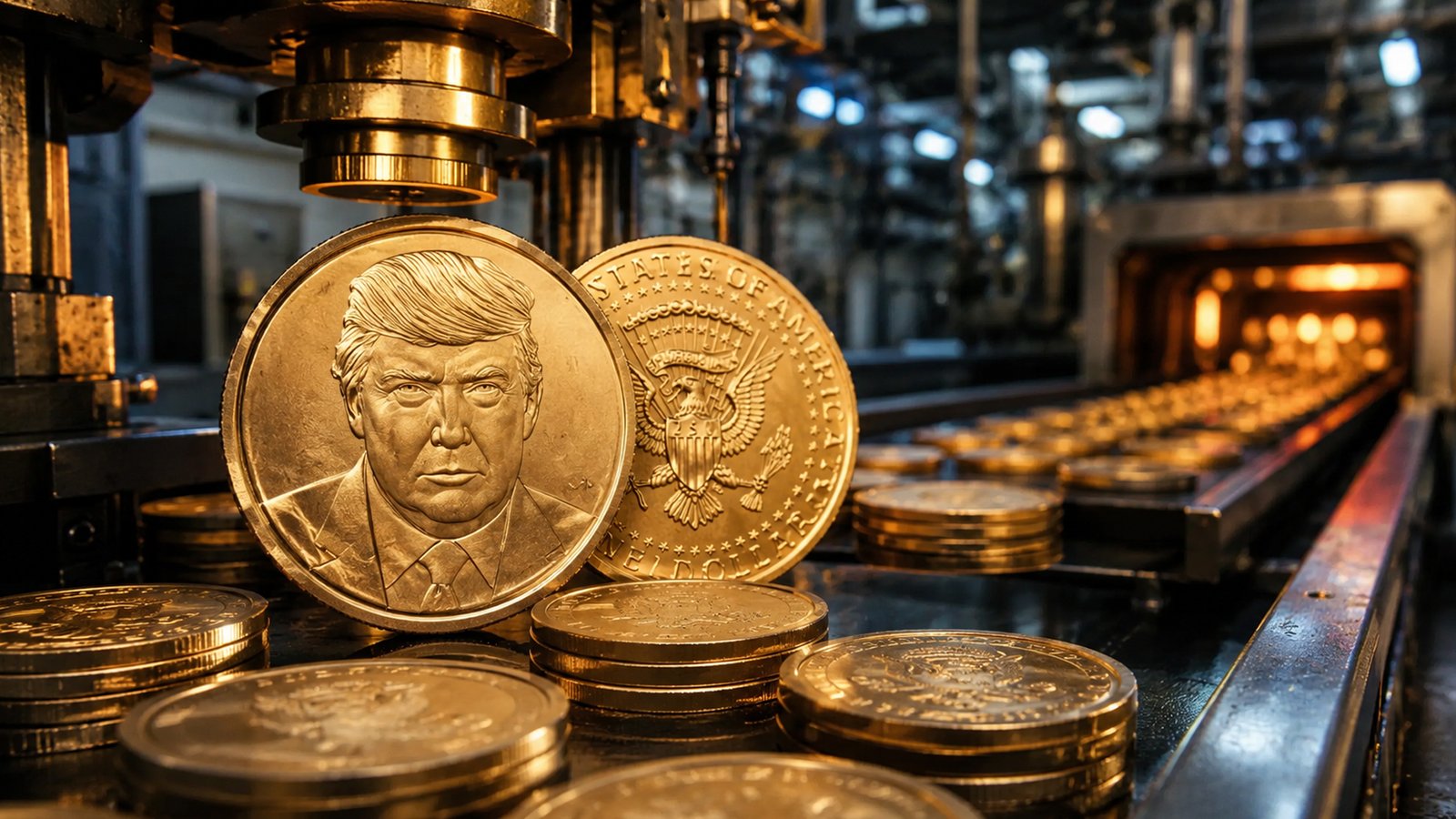
A new $1 coin carrying US President Donald Trump’s face has quickly become one of the most talked-about pieces of American currency. The gold-coloured coin, released by the US Mint on September 2, was introduced as part of celebrations for the United States’ 250th anniversary. Within hours, demand was strong enough to push the first batch into backorder, turning the coin into an instant talking point among collectors and the wider public.
The coin is unusual not simply because of its design, but because Trump is still alive and serving as president. American currency has traditionally avoided putting living people on coins and notes. That long-standing practice has now collided with a special coin authorised for the country’s 250th anniversary.
Ordinary Americans, still are doubtful whether the Trump $1 coin is real money.
The answer is yes. The coin has a face value of $1 and is recognised as legal tender. It can be used like other US coins for eligible payments. However, there is an important catch. Someone buying the coin directly from the US Mint is paying far more than its face value because it is being sold as a collectible item.
The Mint priced a roll containing 25 coins at $61, while a bag containing 100 coins costs $154.50. That means buyers are effectively paying about $2.44 per coin in the roll and $1.55 per coin in the larger bag, even though each coin officially remains worth only $1.
The coin’s gold-like appearance can also be misleading. It is not made of gold. The “golden dollar” description refers to its appearance rather than its precious-metal content.
The front of the coin features Trump’s portrait, along with the words “LIBERTY” and “IN GOD WE TRUST” and the dates “1776 ~ 2026”. The reverse carries the Presidential Seal, including an eagle holding an olive branch and arrows. The number 250 is also incorporated into the design to highlight America’s anniversary.
The design was created by US Mint Chief Engraver Joseph Menna and was based on an official photograph of Trump taken by White House photographer Daniel Torok. The coins were produced at the Philadelphia Mint.
What makes the release particularly sensitive is the question of living presidents on US currency.
Federal law has traditionally restricted the appearance of living individuals on US money. The rule reflects an old American principle that national currency should not be used as a vehicle for personal glorification while someone is still alive and holding office.
The Trump administration, however, has relied on legislation connected with the 250th anniversary to support the coin’s release. The Circulating Collectible Coin Redesign Act of 2020 gave the Treasury authority to create special $1 coins featuring designs connected to the 2026 anniversary.
The legal argument partly rests on how that law is written. The legislation specifically restricts portraits of people on the reverse side of the special coins. Trump’s portrait appears on the front, or obverse, while the reverse carries the Presidential Seal. Supporters of the coin therefore argue that the design fits within the authority provided by Congress.
There is also a historical example that supporters of the coin have pointed to. In 1926, during the 150th anniversary celebrations of American independence, a commemorative coin featured then-President Calvin Coolidge alongside George Washington. Critics, however, note that the earlier coin was commemorative and was not intended to circulate in everyday commerce in the same way as the new Trump dollar.
The unusual design has attracted political criticism as well. Opponents argue that putting a sitting president’s face on currency breaks with American democratic traditions and gives too much prominence to an individual political leader.
The controversy has not stopped buyers from showing interest. The Mint’s initial offering moved quickly, with the 25-coin rolls and 100-coin bags becoming unavailable or going onto backorder soon after the launch. The Mint had also placed limits on purchases during the initial sales period to manage demand.
Collectors have another reason to watch the release. The Mint produced 250,000 coins on July 4 with a special mark commemorating the date. Some of these coins were included in products sold to the public, potentially making them particularly interesting to people interested in US coins, commemorative currency and numismatics.
Despite all the political debate, the practical value of the coin remains simple: it is a $1 coin. Its higher selling price from the Mint reflects its collectible appeal, not a higher monetary value.
Whether people will actually spend the Trump dollar is another matter. Some may hold on to it as a piece of political history, while others could eventually put it into circulation. The Mint has described the coins as circulating-quality pieces, meaning they can potentially turn up in everyday transactions.
The Trump $1 coin therefore sits at an unusual intersection of American politics, currency law and collecting. It celebrates a major national milestone, but it also challenges a long-established convention about presidential portraits.
This could become a memorable addition to American coinage for collectors. While for critics, it represents a troubling departure from tradition. And for the average person who happens to receive one in their change, it will simply be a very unusual-looking dollar — one carrying the face of a president who is still in the White House.