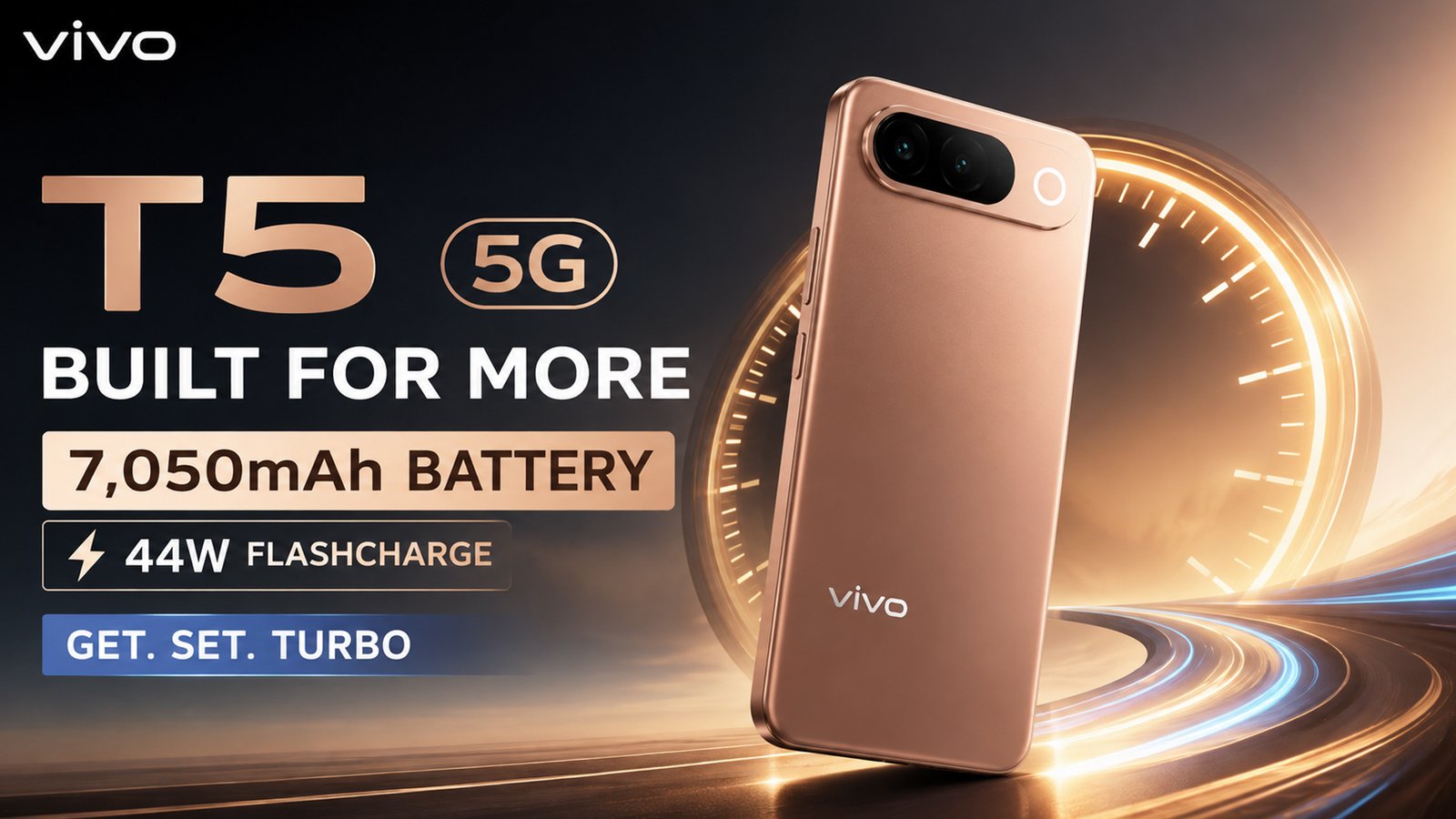
Vivo has launched the T5 5G in India, bringing a large 7,050mAh battery, a high-refresh-rate AMOLED display and a MediaTek Dimensity chipset to the company’s upper mid-range smartphone portfolio. At the same time, Vivo has confirmed key camera specifications of its upcoming X500 series, signalling continued investment in mobile photography at the premium end of the market.
The Vivo T5 5G has been introduced in India with a starting price of ₹34,999. The smartphone will be available in multiple RAM and storage configurations, with the top-end variant priced at ₹49,999.
The company has placed battery capacity at the centre of the T5 5G’s product positioning. Its 7,050mAh battery is designed to provide extended usage between charges, targeting consumers who regularly stream content, play games, use social media and rely on their smartphones throughout the day.
The battery supports 44W FlashCharge technology. Vivo says the device can deliver up to 85 hours of music playback and nearly 35 hours of local video playback under its internal testing conditions. Battery performance in everyday use will vary depending on network conditions, applications and usage patterns.
Vivo has also highlighted the battery’s durability. According to the company, the battery is designed to retain at least 80 per cent of its capacity after 1,600 complete charging cycles. This is intended to support longer-term device use without significant deterioration in battery performance.
The smartphone features a 6.83-inch 1.5K curved AMOLED display with a refresh rate of up to 144Hz. The high refresh rate is aimed at improving screen responsiveness and providing smoother scrolling, animations and gaming.
The display offers a 2800×1260 resolution and can reach a local peak brightness of up to 3,000 nits. Vivo has also focused on keeping the handset relatively slim despite its large battery, with a body thickness of about 7.99mm.
Performance is handled by the MediaTek Dimensity 7500 Turbo processor, manufactured using a 4nm process. The chipset is paired with MediaTek’s NPU 850 for artificial intelligence-related workloads.
Vivo has incorporated a vapour chamber cooling system measuring 3,800mm². The thermal management system is designed to control temperatures during intensive tasks such as gaming, video recording and prolonged smartphone use.
The T5 5G also comes with a 50MP Sony IMX882 primary camera featuring optical image stabilisation. It is accompanied by an 8MP ultra-wide camera, while a 32MP front camera is provided for selfies and video calls.
The camera system supports 4K video recording at 30 frames per second. Optical image stabilisation on the primary sensor is intended to reduce blur and improve stability when capturing images or video while moving.
The device runs OriginOS 6 based on Android 16, bringing Vivo’s latest software interface and AI-powered features. These include tools for writing, summarising, transcription, captions and document-related tasks.
Vivo has also committed to three generations of Android operating system upgrades and five years of security updates for the T5 5G. The longer software-support cycle could appeal to users looking to keep the smartphone for several years.
The handset carries IP68 and IP69 ratings for resistance against dust and water. It has also undergone durability testing designed to assess its performance under demanding conditions.
While the T5 5G is focused on battery life and everyday performance, Vivo is simultaneously preparing its next premium smartphone range with a stronger emphasis on camera technology.
The company has confirmed key imaging specifications for the Vivo X500, which is expected to form part of Vivo’s next-generation flagship lineup.
The X500 will feature a 50MP Sony LYT-828 primary camera with a 1/1.28-inch sensor. The sensor is designed to capture more light and provide improved image quality, particularly in challenging lighting conditions.
The primary camera will also feature advanced stabilisation technology. Vivo has confirmed Zeiss-supported gimbal-level stabilisation and a CIPA 5.5 stabilisation rating, placing image stability among the key features of the upcoming flagship.
The X500 will also feature a 64MP Sony LYT-610 periscope telephoto camera. The telephoto system is designed for long-distance photography and will support 4K video recording at up to 120 frames per second.
Vivo has also confirmed support for a 200mm teleconverter, providing additional reach for subjects at a distance. This could make the X500 particularly relevant for users who prioritise portrait, wildlife, sports and other forms of telephoto photography.
The X500 series is expected to include multiple models, with the Pro and Pro Max versions positioned above the standard X500. Further specifications, including some camera and hardware details, are expected to be revealed closer to the official launch.
The two product developments highlight Vivo’s approach across different smartphone segments. The T5 5G focuses on practical features such as battery capacity, display quality, performance, durability and software support, while the X500 series is being developed to compete in the premium segment through advanced imaging hardware.
The T5 5G enters an increasingly competitive Indian smartphone market, where manufacturers are using larger batteries, faster displays, AI features and improved cameras to differentiate their devices.
Its 7,050mAh battery is the most prominent feature, while the 144Hz AMOLED display, Dimensity 7500 Turbo chipset and 50MP Sony camera strengthen its overall specifications.
At the premium end, Vivo’s focus on large camera sensors, periscope technology and advanced stabilisation reflects the growing importance of smartphone photography in flagship competition.
With the T5 5G expanding Vivo’s presence in the upper mid-range segment and the X500 series preparing to raise the bar for mobile imaging, the company is continuing to build its smartphone portfolio around two major consumer priorities: longer battery life and increasingly sophisticated camera technology.