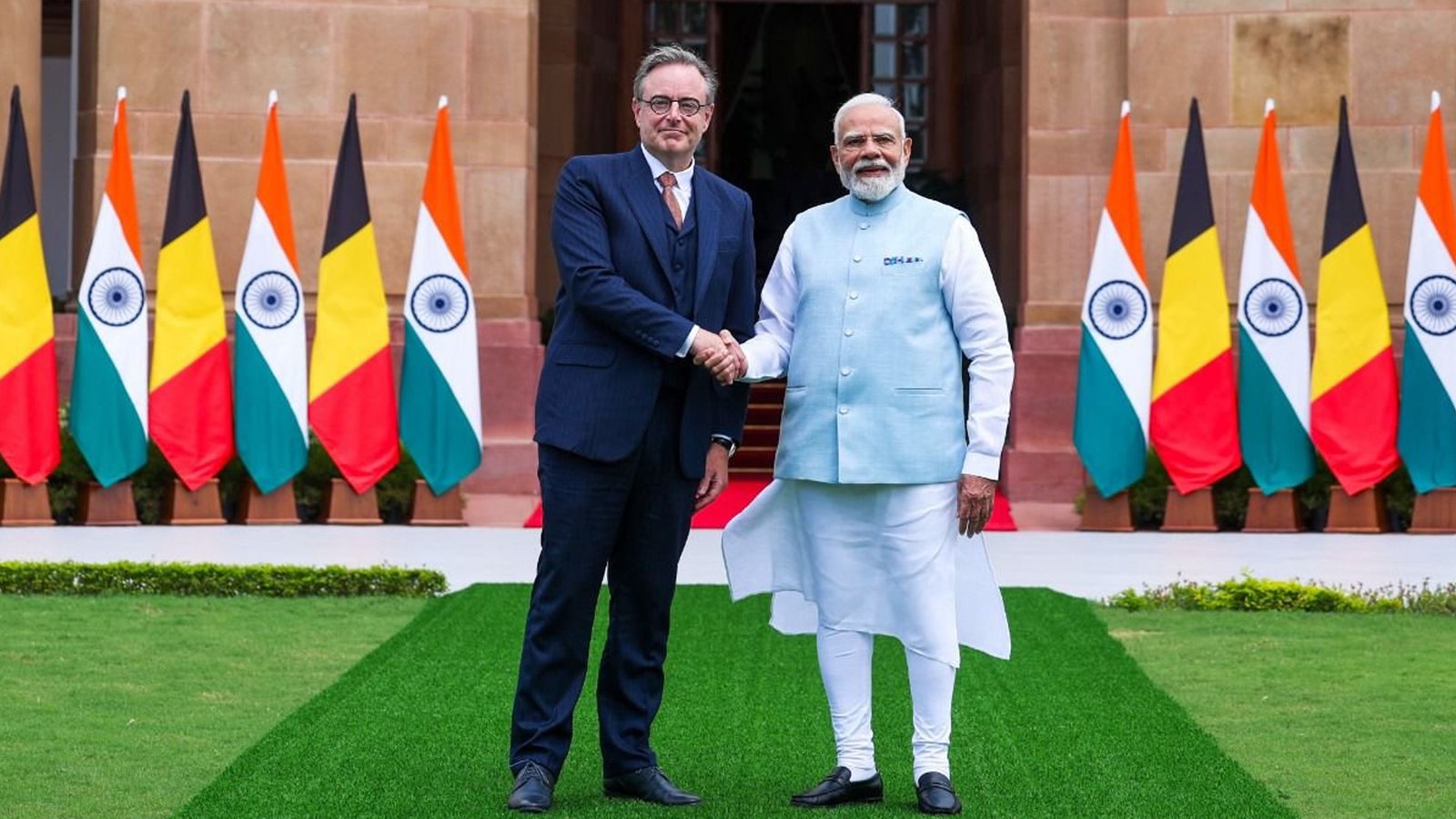
India and Belgium are seeking to take their relationship into a new phase, with Prime Minister Narendra Modi and his Belgian counterpart Bart De Wever placing trade, technology and strategic cooperation at the centre of their discussions during De Wever’s first visit to India.
The Belgian Prime Minister’s three-day visit has produced a 10-point set of outcomes covering areas ranging from defence and critical minerals to semiconductors, clean energy, education and counter-terrorism. The discussions reflect an effort by both sides to move beyond their traditional economic links and build a partnership around emerging sectors.
A key objective is to double bilateral trade over the next five years. India and Belgium already share strong commercial ties, particularly in the diamond industry, but the two governments believe there is considerable room to broaden the economic relationship.
Pharmaceuticals, life sciences, technology, defence manufacturing, logistics, renewable energy and advanced manufacturing have been identified as areas where businesses from both countries can explore new opportunities.
The India-Belgium relationship is also expected to benefit from the recently concluded India-EU Free Trade Agreement. Both sides have welcomed the agreement and stressed the importance of moving towards its implementation. Progress on the India-EU Investment Protection Agreement and Geographical Indications Agreement is also expected to support stronger economic engagement.
The diamond trade remains an important link. Belgium’s Antwerp is a global centre for diamond trading, while India is a major hub for diamond cutting and polishing. De Wever’s visit to the Bharat Diamond Bourse in Mumbai highlights the continuing importance of this sector even as the partnership expands into newer fields.
Defence cooperation is emerging as one of the more significant additions to the bilateral agenda. India and Belgium have agreed to strengthen defence ties through greater exchanges, training, research and industrial cooperation.
A Letter of Intent on defence cooperation is expected to provide a framework for closer engagement between the two countries. India is also planning to appoint a Defence Attaché in Brussels, following Belgium’s decision to post one in New Delhi.
The move could give greater momentum to cooperation between defence companies in both countries. Rather than focusing only on buying equipment, the emphasis is increasingly on research, production and industrial partnerships.
Security cooperation is another area receiving greater attention. Belgium has strongly condemned terrorism and expressed solidarity with India in its fight against terror. The two countries are also working towards stronger cooperation against terrorism, organised crime and cybercrime.
An agreement involving India’s Central Bureau of Investigation and Belgium’s Federal Police is expected to improve information sharing and cooperation in tackling crimes that cross national borders.
Technology is at the heart of the broader partnership. India and Belgium are looking at opportunities in semiconductors, artificial intelligence, startups and other emerging technologies. Research and innovation are expected to connect companies, universities and institutions in both countries.
The focus on talent is equally important. India has invited leading Belgian universities to consider setting up campuses in the country. The move could create new opportunities for students and researchers while building stronger links between education, technology and industry.
Energy cooperation is also being widened. The two countries have identified renewable energy, green hydrogen, solar power, energy storage and offshore wind as potential areas for deeper collaboration. Critical minerals have also entered the strategic conversation as countries seek reliable supply chains for clean-energy and advanced technology industries.
The two leaders have agreed to establish a Strategic Dialogue, giving India and Belgium a regular mechanism to discuss bilateral relations as well as regional and global developments.
Their talks also covered major international issues, including the conflicts in Ukraine and West Asia. Both sides emphasised diplomacy and dialogue as the way forward.
India and Belgium are also looking to make travel between the two countries easier. Discussions around increasing visa-processing capacity and exploring direct air connectivity are aimed at supporting business, tourism, education and people-to-people links.
The closer engagement with India for Belgium comes at a time when European countries are looking to strengthen partnerships with major economies in Asia. For India, Belgium offers an important gateway into European trade, technology and investment networks.
The outcome of De Wever’s visit therefore goes well beyond a set of diplomatic agreements. It points towards a relationship being reshaped around areas that are likely to influence the global economy in the coming years.
Trade and diamonds will continue to remain important, but semiconductors, artificial intelligence, defence, clean energy, critical minerals and skilled talent are increasingly becoming part of the India-Belgium agenda.
The real test will now be implementation. With both governments setting a clear trade target and identifying several new areas of cooperation, the next few years will determine whether the ambitious plans translate into investments, partnerships and projects on the ground.