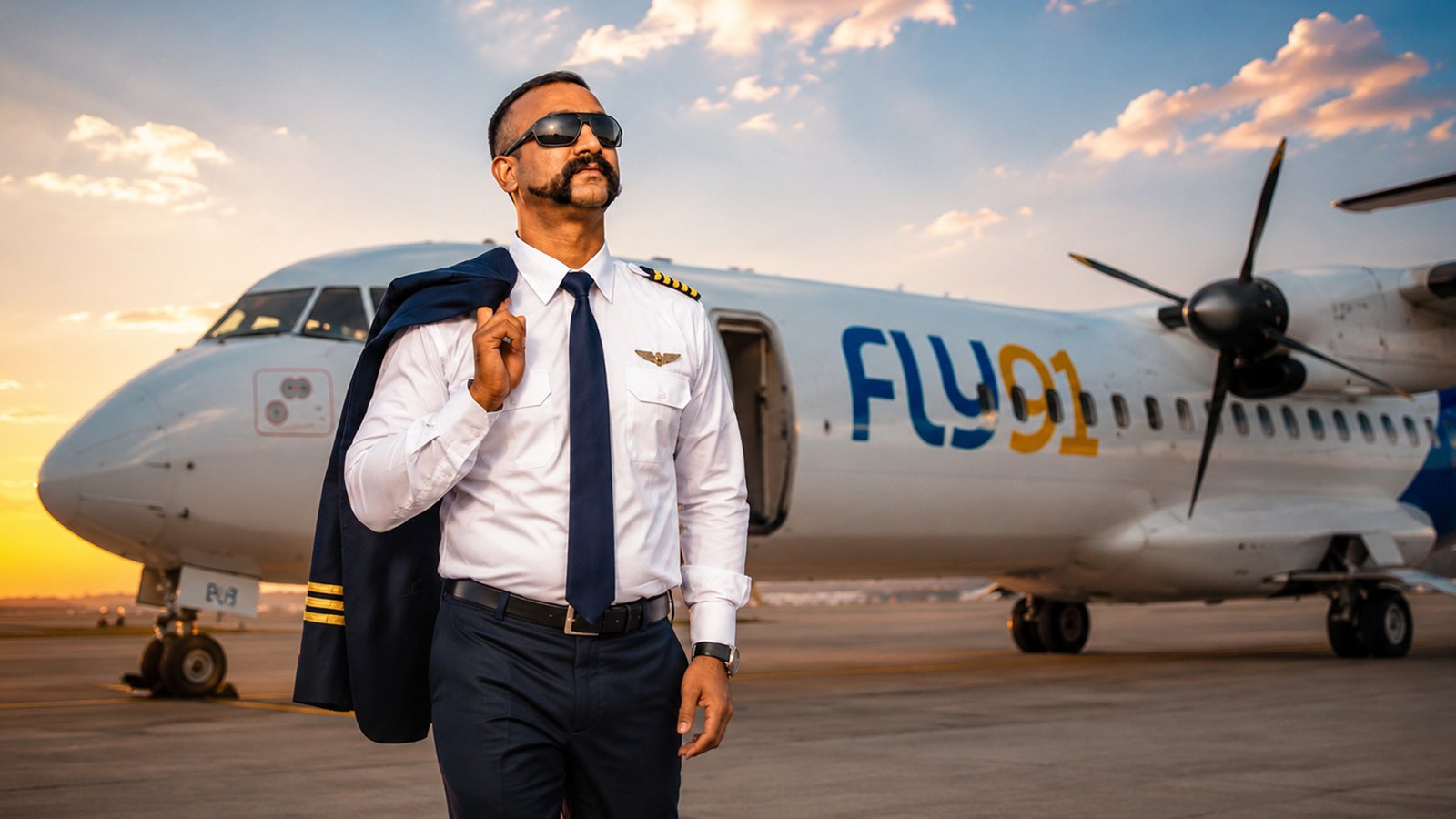
Former Indian Air Force Group Captain and Vir Chakra awardee Abhinandan Varthaman has begun a new chapter in aviation, joining Goa-based regional airline FLY91 as a commercial pilot after nearly 22 years in the IAF.
Varthaman, who became a household name following the 2019 India-Pakistan aerial engagement, has moved from flying fighter jets to passenger aircraft. His transition marks a significant change in his career, but keeps him close to the profession that has defined much of his life — flying.
Reports of his move to FLY91 emerged after he retired from the Indian Air Force. He is now undergoing training to operate the airline’s ATR 72-600 aircraft, a turboprop used for regional passenger services. The transition requires military pilots moving into commercial aviation to meet civil aviation requirements and complete the necessary training and regulatory processes.
Varthaman joined the IAF in 2004 after graduating from the National Defence Academy. He trained as a fighter pilot and went on to fly some of the country’s frontline combat aircraft, including the Sukhoi-30MKI and MiG-21 Bison. Over the years, he rose through the ranks, eventually becoming a Group Captain in 2021.
His name became internationally recognised in February 2019 during the tensions between India and Pakistan following the Balakot air strikes. Varthaman was flying a MiG-21 Bison when Indian and Pakistani aircraft engaged in an aerial confrontation along the Line of Control.
During the encounter, his aircraft was shot down and he ejected over territory controlled by Pakistan. He was subsequently taken into custody and remained there for around 60 hours before being handed back to India.
His conduct during the episode drew widespread attention. After returning to India, Varthaman was awarded the Vir Chakra, one of the country’s wartime gallantry awards, in recognition of his courage during the aerial engagement.
Seven years after the episode that made him a national figure, Varthaman’s latest career move is far removed from combat aviation. Instead of a fighter cockpit, he will now operate aircraft carrying civilian passengers between regional destinations.
The transition from military aviation to commercial flying is not unusual among experienced service pilots. However, it involves adapting to a different operating environment. Fighter pilots are trained for high-performance aircraft, tactical missions and combat situations, while airline pilots work within a highly structured system focused on passenger safety, scheduled operations, crew coordination and commercial aviation regulations.
For Varthaman, his extensive flying experience provides a strong foundation, but moving to an ATR 72-600 means learning a different aircraft and adapting to the operational requirements of a regional airline. FLY91 has begun training him on the aircraft as part of his move into civil aviation.
The timing of his move also comes as India’s regional aviation sector continues to expand. FLY91, based in Goa, operates regional flights connecting smaller cities and emerging aviation markets. The airline has been building its network as demand for air travel grows beyond India’s major metropolitan centres.
The airline is also planning a major expansion. FLY91 has placed an order for 40 ATR 72-600 aircraft in a deal valued at about $1 billion. The order is expected to significantly increase its fleet and strengthen its presence in India’s regional connectivity market.
His journey also highlights how skills developed in the armed forces can translate into civilian careers. Military pilots leave service with thousands of hours of flying experience, extensive training and experience handling demanding situations. They nevertheless have to undergo civil aviation training, examinations, medical checks and aircraft-specific qualification before taking on commercial flying duties.
Varthaman’s transition is therefore more than a change of uniform. It is a move from India’s military aviation system into its rapidly growing commercial aviation industry.
The image associated with him will remain that of the fighter pilot who faced an extraordinary situation in 2019. But his latest career decision offers a different picture — one of an experienced aviator beginning again in a civilian cockpit.
From the MiG-21 Bison to the ATR 72-600, Abhinandan Varthaman’s flying career has entered a new phase. This time, the mission is not combat, but carrying passengers safely across India’s expanding regional air network.