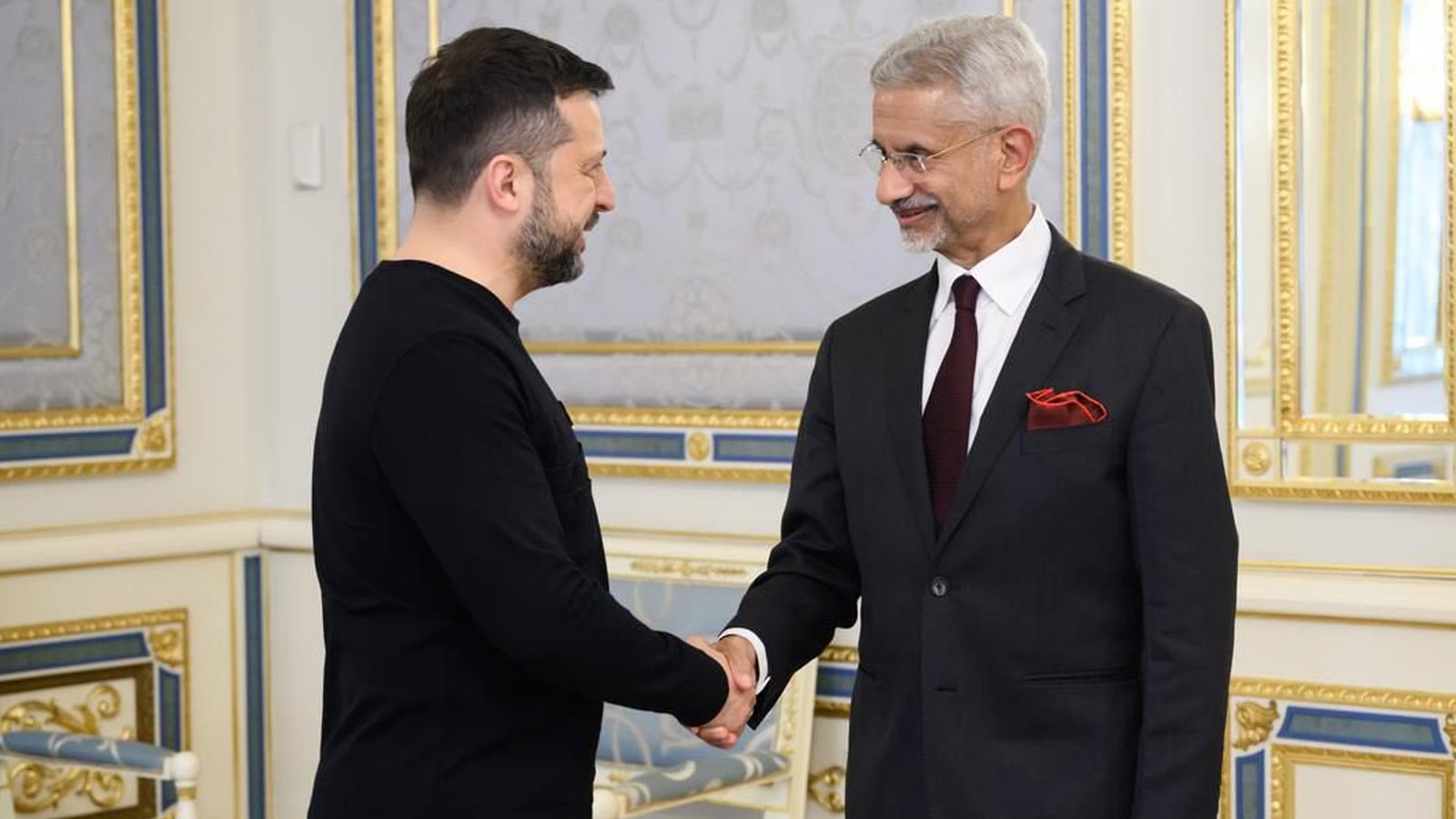
India has offered to support efforts to end the Russia-Ukraine war, with External Affairs Minister S Jaishankar saying that dialogue, diplomacy and negotiations remain the only practical route to peace. The message came during his visit to Kyiv, where he held talks with Ukrainian Foreign Minister Andrii Sybiha and President Volodymyr Zelenskyy.
The visit has given fresh momentum to India-Ukraine relations at a time when the conflict has entered its fifth year and fighting continues to affect civilian life, trade and global supply chains. It also underlined New Delhi’s attempt to maintain communication with both Kyiv and Moscow while protecting its own strategic and economic interests.
Ukraine has welcomed Prime Minister Narendra Modi’s recent appeal for an end to the conflict. Sybiha described India as a global power and said Kyiv was ready for diplomacy. He said Ukraine supported Modi’s call to move away from an “endless war” towards an end to the conflict.
Modi had made the appeal during his meeting with Russian President Vladimir Putin on the sidelines of the Shanghai Cooperation Organisation summit in Bishkek. India has consistently maintained that the Russia-Ukraine conflict cannot be resolved through military action alone and that both sides must return to dialogue.
Jaishankar carried that message to Kyiv, while also making clear that India would not allow external pressure to dictate its energy policy.
The issue of Russian oil remained an important part of the wider discussion. Jaishankar said the war would not end simply because countries stopped buying Russian oil, metals, minerals or fertilisers. He argued that a conflict of this scale would ultimately have to be addressed through political negotiations rather than by targeting individual trade decisions.
India’s position reflects its broader policy of strategic autonomy. New Delhi has maintained significant energy ties with Russia even as Western countries have imposed sanctions aimed at restricting Moscow’s ability to finance the war. India has argued that its priority is to ensure affordable and reliable energy supplies for its population.
Jaishankar also pointed to the wider impact of the global energy situation and the challenge of meeting the requirements of 1.4 billion people. At the same time, he said India respected Ukraine’s position and expected other countries to respect India’s own perspective.
The minister’s remarks were significant because they came directly from Kyiv, where India has faced criticism over its continued purchase of Russian crude. Rather than framing the disagreement as a confrontation, Jaishankar sought to keep the focus on diplomacy and the larger objective of ending the war.
During his meeting with Zelenskyy, the two sides discussed ways to advance peace efforts as well as strengthen bilateral cooperation. Zelenskyy thanked India for its stated commitment to ending the conflict and said the current moment should be about peace rather than war.
The talks also focused on security in the Black Sea, an increasingly important issue for India. Attacks and disruptions involving commercial shipping have raised concerns about the safety of seafarers and the movement of food and other essential commodities.
Ukraine has been particularly concerned about the impact of attacks on its ports and shipping routes. Any prolonged disruption to Black Sea navigation can have consequences well beyond the immediate conflict, particularly for global food security and commodity markets.
Jaishankar said attacks on commercial vessels had also affected Indian seafarers and created wider problems for countries across the Global South. Rising pressure on fuel, fertiliser and food supplies can quickly translate into higher costs for developing economies.
The safety of Indian nationals has added another layer to New Delhi’s concerns. The visit came shortly after an Indian national was killed in Kyiv following a Russian strike. Ukraine has also highlighted the risks faced by Indian seafarers in the Black Sea region.
Despite the difficult geopolitical backdrop, India and Ukraine used the visit to discuss areas where bilateral ties could expand. Trade, investment, infrastructure, energy, agriculture, pharmaceuticals, digital technology, education and mechanical engineering were among the areas discussed.
Ukraine is also looking to Indian companies to participate in its reconstruction once conditions allow. The Ukrainian side has said bilateral trade is currently around $2.6 billion, leaving considerable room for growth. Discussions are expected to continue through the Intergovernmental Ukrainian-Indian Commission.
India has also continued its humanitarian engagement with Ukraine. Jaishankar said New Delhi had sent 19 consignments of humanitarian assistance, including medicines, generators and medical equipment. This has allowed India to maintain a humanitarian dimension to its engagement even while preserving its longstanding relationship with Russia.
Jaishankar’s Kyiv visit is particularly notable because it is the first standalone bilateral visit to Ukraine by an Indian External Affairs Minister. His trip to Ukraine and Poland from September 3 to 5 comes as Europe’s security environment continues to change and pressure grows on countries to take clearer positions on the war.
New Delhi has relationships with Russia, Ukraine, the United States and European countries, giving it room to engage with different sides of the conflict.
Whether India can eventually play a larger role in peace efforts will depend largely on the willingness of Russia and Ukraine to negotiate. For now, Kyiv’s positive response to Modi’s appeal and Jaishankar’s offer of assistance indicate that India sees diplomacy as the most realistic way forward.
The message from Kyiv was therefore less about taking sides and more about keeping the door to dialogue open. As the war continues to impose costs on energy markets, food supplies, shipping and economies worldwide, India is positioning itself as a country willing to contribute to peace efforts while continuing to safeguard its own national interests.