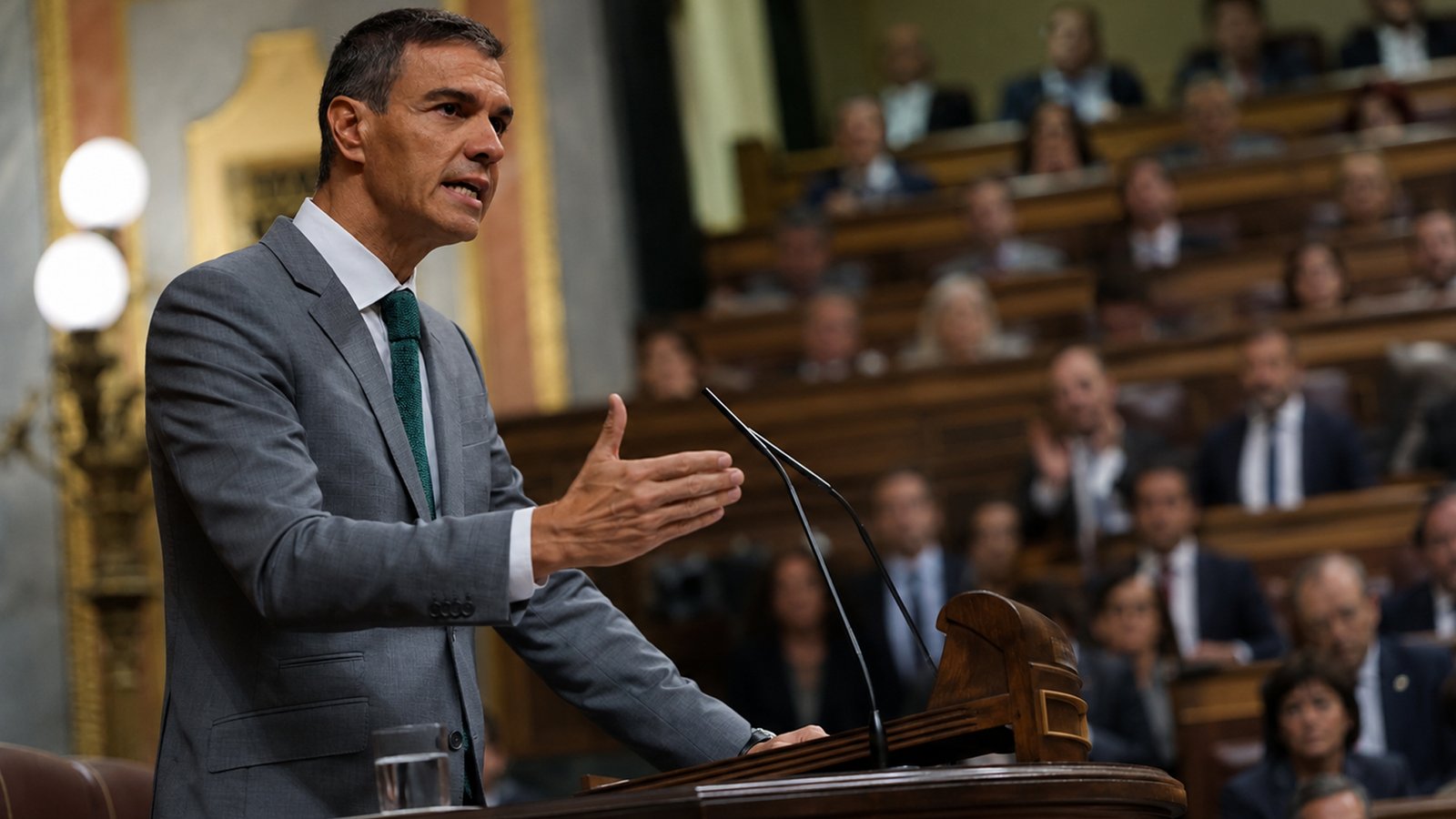
Spain’s Prime Minister Pedro Sánchez has rejected allegations that Morocco deliberately organised the mass movement of migrants into the Spanish territory of Ceuta, saying his government has found no solid evidence linking Moroccan authorities to the operation.
Sánchez made the statement in parliament on Thursday as pressure mounted over the Ceuta migrant crisis, which has become a major political and humanitarian issue for his government. More than 70,000 people crossed from Morocco into Ceuta during the unprecedented border rush in late July.
The prime minister’s comments came shortly after a Spanish police report raised questions about the role played by Moroccan security forces. The report suggested that the mass crossing may not have been a spontaneous movement but a coordinated effort designed to overwhelm the border.
Sánchez, however, said the available information did not support such a conclusion.
The statement has not ended the controversy. Instead, it has intensified questions over what happened during the critical hours of the border breach and whether Spain was adequately prepared for such a large movement of people.
What happened at the Ceuta border?
The crisis unfolded on July 30 and 31, when tens of thousands of migrants crossed from Morocco into Ceuta by land and sea.
Ceuta is a small Spanish territory on the North African coast, surrounded by Morocco and separated from mainland Spain by the Strait of Gibraltar. Its location makes it one of the European Union’s most sensitive external borders.
The scale of the crossing caught Spanish authorities off guard. Thousands of people arrived within a short period, placing enormous pressure on local authorities, accommodation centres and emergency services.
The humanitarian consequences were severe. According to the latest figures cited by Spanish authorities, 141 people died during the crisis, including migrants who drowned while attempting to reach Ceuta.
The incident has since developed into a wider debate over border security, irregular migration, humanitarian protection and Spain’s relationship with Morocco.
Questions over Moroccan security forces
A police report has become central to the political dispute.
According to reports, Moroccan security forces displayed unusual passivity during the period when the crossings peaked. Sánchez acknowledged that Moroccan forces allowed the border to be crossed for about 10 hours on July 30.
However, he questioned whether this was deliberate or the result of inaction and an inability to control the situation.
Some migrants reportedly said Moroccan authorities directed or assisted people moving towards the border. Video footage and other accounts have also been cited as evidence of unusual activity by Moroccan personnel. But the available evidence has not established that Morocco’s government ordered or organised the mass crossing.
Morocco has rejected accusations that it deliberately facilitated the movement.
The Spanish government has also pointed to several other factors, including misinformation circulating on social media, human traffickers and confusion surrounding a Spanish court ruling on immigration procedures.
Political storm in Spain
The border crisis has become a major challenge for Sánchez.
Thousands of people took part in protests across Spain on Wednesday, with demonstrators criticising the government’s handling of the crisis and calling for Sánchez to resign. Opposition parties have accused the government of failing to protect Ceuta and of withholding information about Morocco’s possible involvement.
Sánchez defended his government’s response, arguing that Spain faced an extraordinary situation in which security forces had to balance border protection with the need to prevent further deaths.
He also rejected calls for a blanket approach to returning migrants, stressing that Spain must continue to respect legal and humanitarian obligations.
The government has said it will strengthen facilities and resources in Ceuta to deal with future migration emergencies. The issue is particularly pressing because many migrants who entered during the July crisis remain in the territory, including a significant number of minors.
Morocco remains a crucial partner
Despite the dispute, Sánchez has stressed the importance of maintaining cooperation with Morocco.
Most of those who entered Ceuta were subsequently returned to Morocco, with Spanish authorities saying cooperation from Rabat was essential to carrying out the returns. The government has therefore been reluctant to make a direct accusation against Morocco without stronger evidence.
The issue is particularly sensitive because Ceuta and the neighbouring Spanish territory of Melilla have long been points of tension between Madrid and Rabat.
Morocco does not recognise Spanish sovereignty over the two territories and has repeatedly asserted claims over them. Recent comments by Moroccan officials about Ceuta and Melilla have added another layer of tension to the current dispute.
Spain has summoned Morocco’s ambassador over those remarks, while Sánchez has continued to argue that diplomatic cooperation remains necessary.
A wider European concern
The Ceuta crisis is not only a Spanish problem. The territory represents one of the European Union’s external borders, making the mass crossing a wider EU migration and border-security issue.
The episode has raised concerns about how quickly a large-scale movement of migrants can overwhelm a European border and how much responsibility neighbouring countries should share in preventing irregular crossings.
The immediate challenge for Sánchez, is to restore confidence among residents of Ceuta while managing the humanitarian needs of migrants and maintaining working relations with Morocco.
The prime minister has promised greater transparency over the reports surrounding the incident. But the central question remains unresolved: whether Morocco deliberately allowed the border to be overwhelmed or whether the unprecedented movement resulted from a combination of misinformation, trafficking networks and a failure to contain the situation.
Sánchez insists that Spain should follow the evidence rather than make accusations without proof. The political fallout, however, is likely to continue as investigators, opposition parties and the public seek clearer answers about one of Spain’s most serious migration crises in recent years.