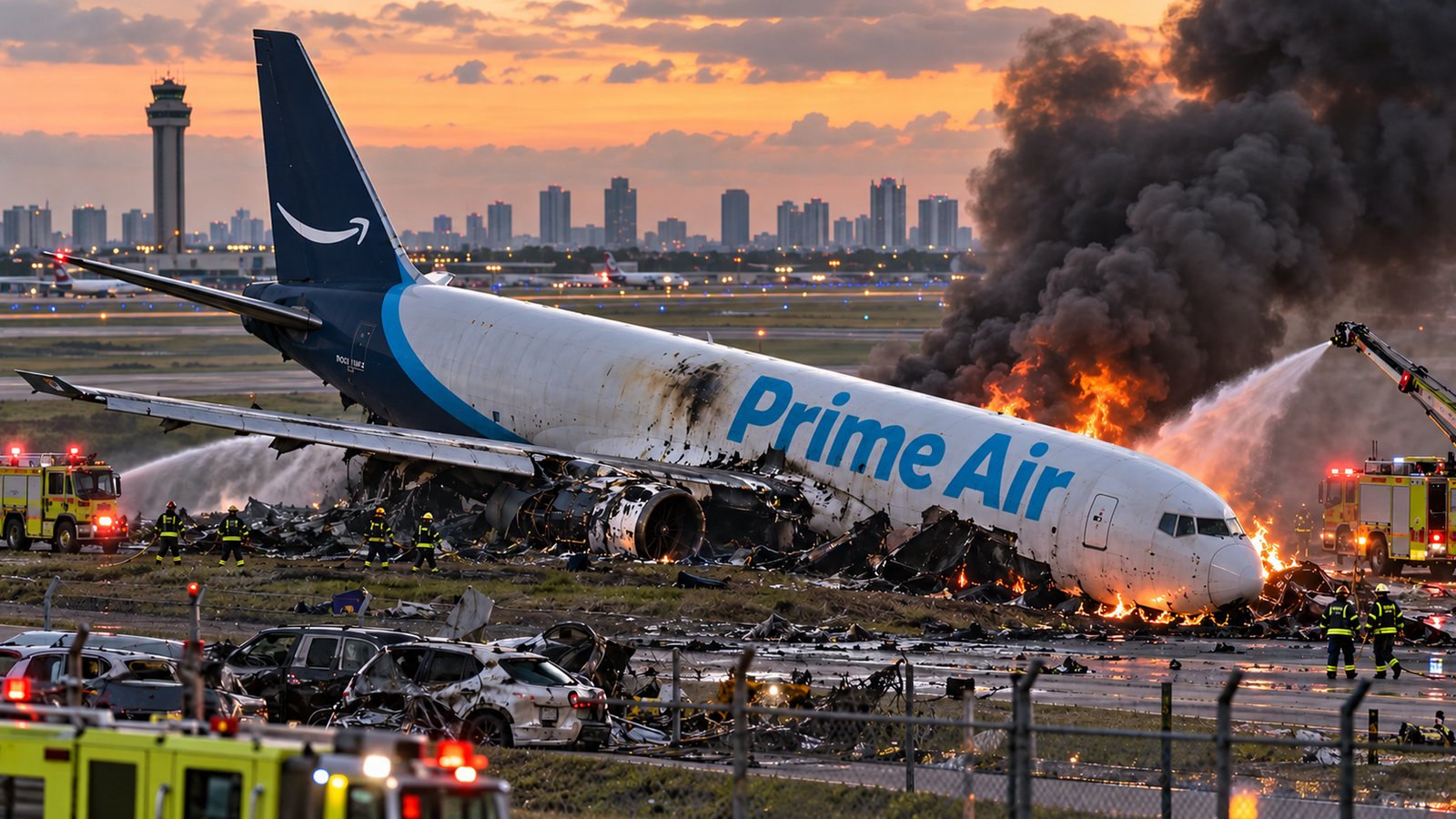
At least five people were killed and five others injured after an Amazon cargo plane crashed at Miami International Airport in Florida on Sunday, turning a routine landing into a deadly accident that brought operations at one of the busiest airports in the United States to a halt.
The Boeing 767-300 cargo aircraft, operated for Amazon by North Carolina-based 21 Air, was arriving from San Juan, Puerto Rico, when it overran the runway shortly after 2 pm local time. The aircraft crossed the end of the runway, struck several vehicles on a nearby road and caught fire. Three of the injured were in critical condition, while two others were hospitalised with less serious injuries.
The crash sent thick black smoke into the sky and triggered a large emergency response. More than 60 Miami-Dade Fire Rescue units were deployed, with more than 200 emergency personnel involved in firefighting and rescue operations. Crews faced intense flames, a fuel leak and people trapped in vehicles around the crash site.
The pilot and co-pilot were initially trapped inside the aircraft’s cockpit. Firefighters worked to reach them as flames continued to burn around the plane. Rescue teams also had to free people trapped in vehicles, including at least one person who was found beneath a vehicle.
The exact circumstances surrounding the Miami airport plane crash remain unclear. The National Transportation Safety Board (NTSB) has sent investigators to the scene, while the Federal Aviation Administration (FAA) is also examining the accident.
Investigators are expected to study the aircraft’s approach and landing, runway conditions, weather and the plane’s performance in the final moments before the crash. Thunderstorms and wind gusts of up to about 30 mph were reported in the area around the time of the accident, although authorities have not said that weather caused the crash.
Early flight-tracking information has also drawn attention to the aircraft’s speed as it left the runway. Flight-tracking data indicated that the Boeing 767 was still travelling at roughly 112 knots, or about 129 mph, when it ran beyond the usable runway area. It then crossed a road used by workers and businesses surrounding the airport before hitting vehicles and coming to rest near an Amazon warehouse.
Aviation experts are likely to examine whether the aircraft touched down within the designated landing zone and whether there was enough runway remaining for the crew to safely abort the landing. Questions have also been raised about the aircraft appearing to remain airborne over part of the runway before touchdown.
Another issue investigators may examine is the absence of an Engineered Materials Arrestor System (EMAS) at the end of the runway. Such systems use lightweight, crushable material to slow aircraft that run beyond the runway. The Federal Aviation Administration says similar systems have helped prevent loss of life in previous runway overrun incidents.
The accident caused widespread disruption at Miami International Airport, with all runways and taxiways temporarily closed following the crash. More than 160 flights were cancelled and nearly 325 delayed by late Sunday, according to flight-tracking data cited by the Associated Press. Some flights were diverted to Orlando International Airport, more than 200 miles away.
The disruption was particularly significant because Miami is a major international aviation hub, handling large numbers of passenger and cargo flights every day. Authorities warned travellers to expect delays and cancellations while emergency teams secured the crash site and investigators began their work.
The aircraft involved was more than three decades old. The Boeing 767 was originally built as a passenger aircraft and spent more than two decades operating with different airlines before being converted into a cargo aircraft in 2015. It was flying as part of Amazon’s air freight network, although the flight itself was operated by 21 Air.
Amazon expressed condolences following the accident and said it would cooperate with authorities investigating the crash. The company said its focus was on supporting those affected by the incident and working with officials to understand what happened.
This crash also brought the dangers of aviation accidents close to the ground. Unlike many aircraft accidents that occur away from populated areas, this cargo plane crash unfolded as the aircraft left airport property and entered an area used by workers and vehicles.
The investigation will now seek to establish a precise sequence of events — from the aircraft’s approach to its touchdown, runway overrun, collision with vehicles and the fire that followed. Investigators will examine flight data, cockpit recordings, aircraft maintenance records and weather information as they work to determine whether the accident was caused by mechanical problems, operational decisions, weather conditions or a combination of factors.
For now, the confirmed toll stands at five dead and five injured. As authorities continue identifying victims and assessing the damage, the focus remains on the families affected by the Miami airport crash, the recovery operation and finding answers about why the Amazon cargo aircraft failed to stop before reaching the end of the runway.