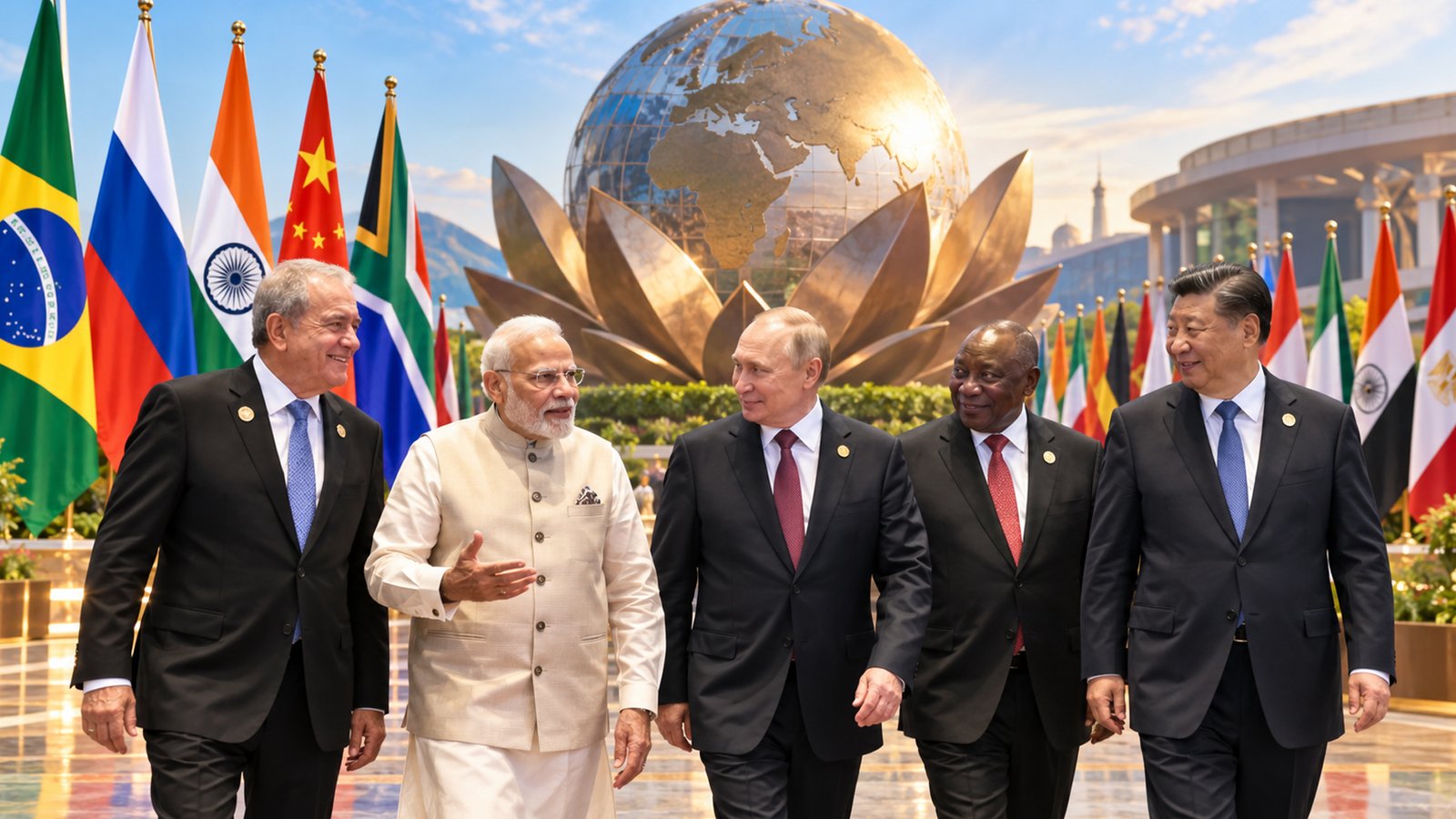
Prime Minister Narendra Modi has called for an ambitious new agenda for BRICS for the next 20 years, arguing that the grouping must strengthen its own functioning while also pushing for changes in global institutions. His message comes as the expanded BRICS bloc seeks to translate its growing economic weight into greater influence over global trade, finance and international decision-making.
Speaking at the 18th BRICS Summit in New Delhi, Modi said the grouping had entered a “coming of age” phase after two decades. He said the next 20 years should begin with improving how BRICS itself functions and should go alongside a clear direction for reforming global institutions.
The Prime Minister also made a strong pitch for a greater role for the Global South in shaping international rules. He said reforms to institutions such as the United Nations Security Council could no longer be delayed and argued that developing countries need a more representative voice in global governance.
The push for institutional reform is closely linked to BRICS’ growing economic importance. The expanded grouping now accounts for around half of the world’s population and about 40% of global GDP, according to figures highlighted by Modi. Its members also account for a significant share of global trade, giving the bloc considerable potential to influence investment, supply chains and financial flows.
India’s 2026 BRICS chairship has placed business and economic cooperation high on the agenda. Commerce and Industry Minister Piyush Goyal has called for deeper, more resilient and balanced intra-BRICS trade, with member countries urged to open markets, simplify regulations and make it easier for companies to operate across borders.
Goyal has also pushed for BRICS countries to link their payment systems and increase the use of national currencies in trade. Such a move could reduce transaction costs and dependence on the US dollar while making cross-border payments easier for businesses.
PM Modi has taken the business agenda a step further. At the BRICS Business Forum, he urged the BRICS Business Council to identify the bloc’s top 10 trade barriers and prepare a report on removing them. He also proposed supporting 100 BRICS startups every year so they can expand into other member markets and creating 1,000 new business partnerships.
The targets are aimed at moving BRICS beyond broad declarations and towards measurable economic outcomes. PM Modi said progress on these goals should be reviewed every year, signalling India’s preference for a more results-oriented approach to BRICS economic cooperation.
Supply-chain resilience is another major priority. External Affairs Minister S Jaishankar said stronger economic activity and economic security within BRICS could contribute to greater self-reliance. He stressed the need to diversify commercial relationships, strengthen business ties and create resilient supply networks.
The objective is straightforward: make it easier for companies in BRICS countries to find partners, enter new markets and connect with suppliers. This has become more important as geopolitical tensions, conflicts and disruptions to shipping routes continue to affect global commerce.
Energy security has also emerged as a major part of the economic discussion. Russia has offered to contribute to global energy and food security, while India continues to seek stable energy supplies amid heightened geopolitical tensions. Russian President Vladimir Putin has also highlighted the importance of reliable logistics corridors, including the North-South Transport Corridor and the Arctic route.
India-Russia economic ties received additional attention during Modi’s bilateral meeting with Putin on the sidelines of the summit. The two leaders reviewed cooperation in trade, energy, defence, space, infrastructure and other sectors. They also discussed implementation of the Programme for Economic Cooperation 2030. Putin invited Modi to Russia for the next India-Russia Annual Summit, an invitation the Prime Minister accepted.
The India-Russia relationship is particularly important from a business perspective because of its links to energy, fertilisers, critical minerals, nuclear power and industrial cooperation. The two countries are also looking at ways to expand bilateral trade and diversify the relationship beyond crude oil and defence.
India’s engagement with China is another major economic factor at the summit. Chinese President Xi Jinping arrived in New Delhi on Saturday, his first visit to India in seven years. His meeting with Modi is being closely watched because the two countries are attempting to stabilise relations after years of tensions following the 2020 border clash.
The economic stakes are substantial. China remains a major source of machinery, electronics, chemicals and other industrial inputs for India. At the same time, India has continued to seek better market access for its exports and greater balance in bilateral trade. The Modi-Xi engagement therefore has implications not only for border relations but also for investment, supply chains and business ties.
The summit is taking place against a difficult global backdrop. The Ukraine war, conflicts in West Asia, trade tensions and disruptions to energy and shipping routes are putting pressure on companies and governments worldwide. BRICS countries are seeking greater economic resilience while also attempting to coordinate positions on global governance.
The bloc, however, faces its own challenge: its members have very different political systems, economic interests and foreign-policy priorities. Reaching agreement on issues such as conflicts, sanctions, currencies and global institutional reform can be difficult.
Even so, India is attempting to position BRICS as a practical economic platform rather than simply a political grouping. Trade facilitation, local-currency settlements, digital payments, startups, supply chains, energy security and investment are increasingly becoming central to the agenda.
The proposed 20-year roadmap could therefore shape how BRICS operates in the global economy. Modi’s message is that the bloc’s growing size must translate into greater economic cooperation and a stronger voice for emerging economies.