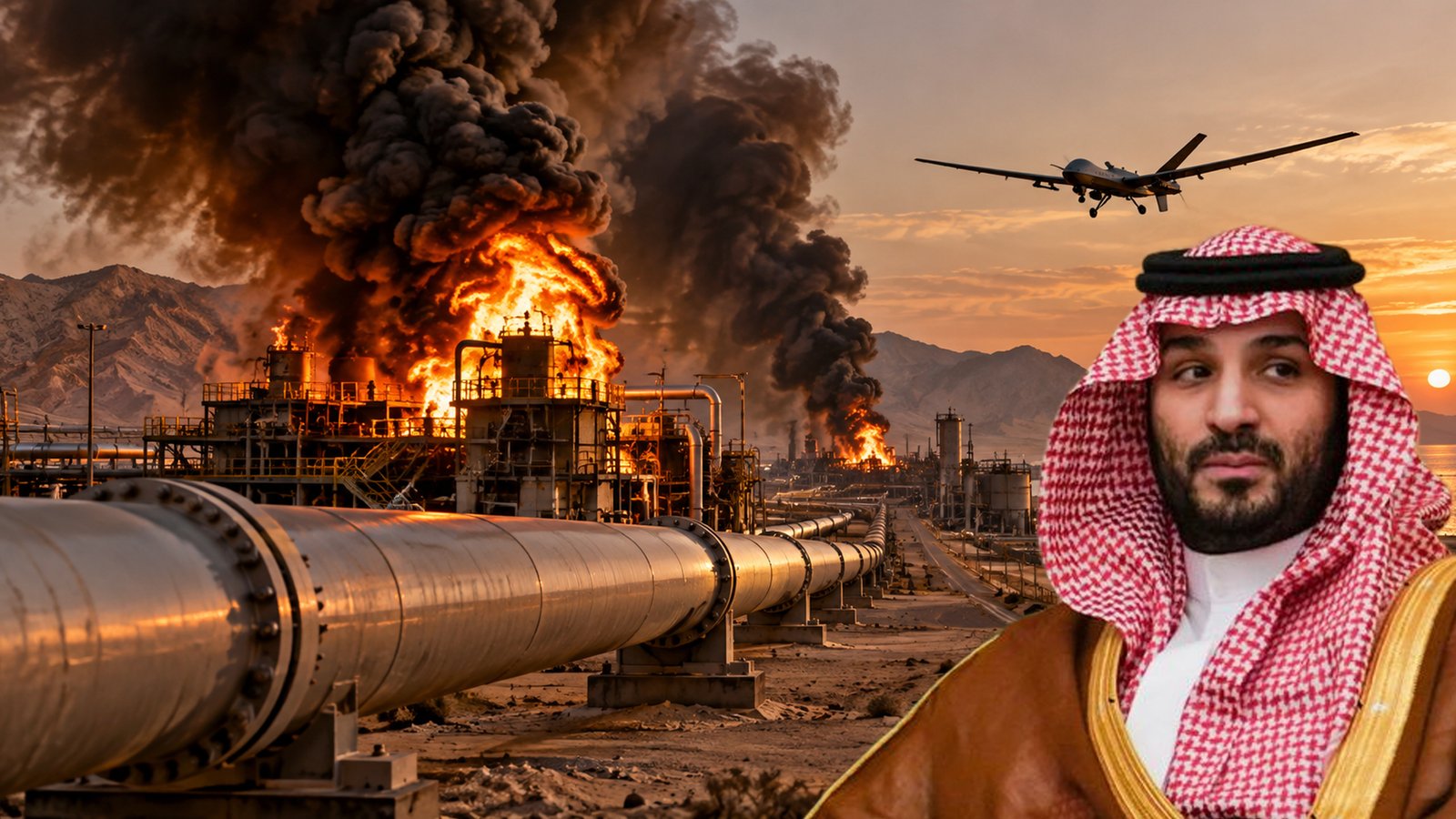
Saudi Arabia has temporarily shut down a major oil pipeline after drone attacks damaged parts of the network, adding another threat to energy supplies at a time when key routes across West Asia are already under severe pressure.
The East-West oil pipeline, also known as Petroline, was targeted by several drones in Saudi Arabia’s Riyadh and Madinah regions. The attacks caused some damage and left several people injured, according to Saudi authorities. Emergency and technical teams were sent to secure the pipeline and assess the situation.
Saudi Arabia said the drones were launched from Iraq. Riyadh strongly condemned the attack but has decided not to retaliate immediately after Iraq’s prime minister asked for time to investigate the incident and prevent further attacks from Iraqi territory.
The Saudi government said it reserves the right to take necessary measures to protect its territory, people and critical infrastructure. Iraq has also condemned the attack and launched an investigation into those responsible.
The pipeline is particularly important because Saudi Arabia has been relying more heavily on it since disruptions to shipping through the Strait of Hormuz. The roughly 1,200-kilometre network carries crude from Saudi Arabia’s oil-producing east to the Red Sea port of Yanbu.
Its location gives Saudi Arabia an alternative route to send oil to international markets without relying entirely on the Strait of Hormuz. The pipeline can transport up to around 7 million barrels of crude a day, with about 5 million barrels a day available for exports.
That makes the shutdown significant for global oil markets. Saudi Arabia has been using the pipeline to move millions of barrels of crude towards the Red Sea as the regional conflict has disrupted traditional shipping routes.
The latest attack comes as another critical route faces growing risks.
In Yemen, Iran-aligned Houthi forces have captured the Red Sea port of Mokha and taken control of Mayun Island, also known as Perim Island, near the Bab el-Mandeb Strait. The island sits at the southern entrance to the Red Sea and has a strategically important position overlooking maritime traffic.
The Bab el-Mandeb is one of the world’s most important shipping chokepoints. It connects the Red Sea with the Gulf of Aden and provides a major route between Europe and Asia.
The Houthi advance has therefore created a difficult situation for Saudi Arabia. The kingdom is dealing with an attack on a key oil pipeline on one side, while a major maritime route used to move oil and other goods faces growing security concerns on the other.
The Red Sea has already seen a sharp fall in commercial shipping because of previous Houthi attacks. AP reported that shipping through the region had fallen by about 60%, with many vessels choosing longer routes around Africa to avoid the danger.
A prolonged disruption could make transporting crude and other goods more expensive. Longer journeys mean higher fuel bills, insurance costs and freight charges, eventually adding pressure to businesses and consumers in countries that depend heavily on imported energy.
The developments are particularly important for Asian economies. Saudi Arabia is a major oil supplier to countries across Asia, and any sustained disruption to its export routes could affect crude availability and prices.
Oil prices have already moved sharply higher amid the wider regional conflict, with Brent crude trading above $100 a barrel as traders assess risks to production, pipelines and shipping routes. The latest attacks could add further volatility if the pipeline remains offline for an extended period.
The situation also shows why the geography of West Asia matters so much to the global economy. A relatively small number of waterways and infrastructure networks carry enormous volumes of oil and other goods. Any disruption at one point can quickly put pressure on alternative routes.
Saudi Arabia’s East-West pipeline was designed partly to reduce the country’s dependence on the Strait of Hormuz. Yet the latest developments show that even an alternative route can become vulnerable when the regional conflict spreads across borders.
The Houthi capture of Mayun Island adds another layer to those concerns. Control of the island gives the group a strategically important position near the Bab el-Mandeb, although the Houthis have said they do not intend to target all international commercial shipping.
Saudi Arabia has responded to the wider Houthi offensive with military action, while the fighting in Yemen has intensified after years of relative calm following the 2022 UN-brokered truce. The Houthi advance along the Red Sea coast has raised fears that Yemen could again slide into a much broader conflict.
The immediate concern for oil markets is how long the East-West pipeline will remain shut and whether the damage can be repaired quickly. Saudi authorities have not given a timeline for its restart.
Markets will also be watching developments around the Bab el-Mandeb and the Red Sea. Any further attacks on oil infrastructure or commercial vessels could increase pressure on already stretched supply chains.
What began as a series of regional military developments is therefore becoming an increasingly important global economic issue. Saudi Arabia is trying to keep its oil moving while protecting vital infrastructure, shipping companies are looking for safer routes, and oil-importing nations are watching prices closely.
The biggest question now is whether the latest attacks remain limited or become part of a wider campaign against the energy and shipping networks that connect the Middle East to the rest of the world.