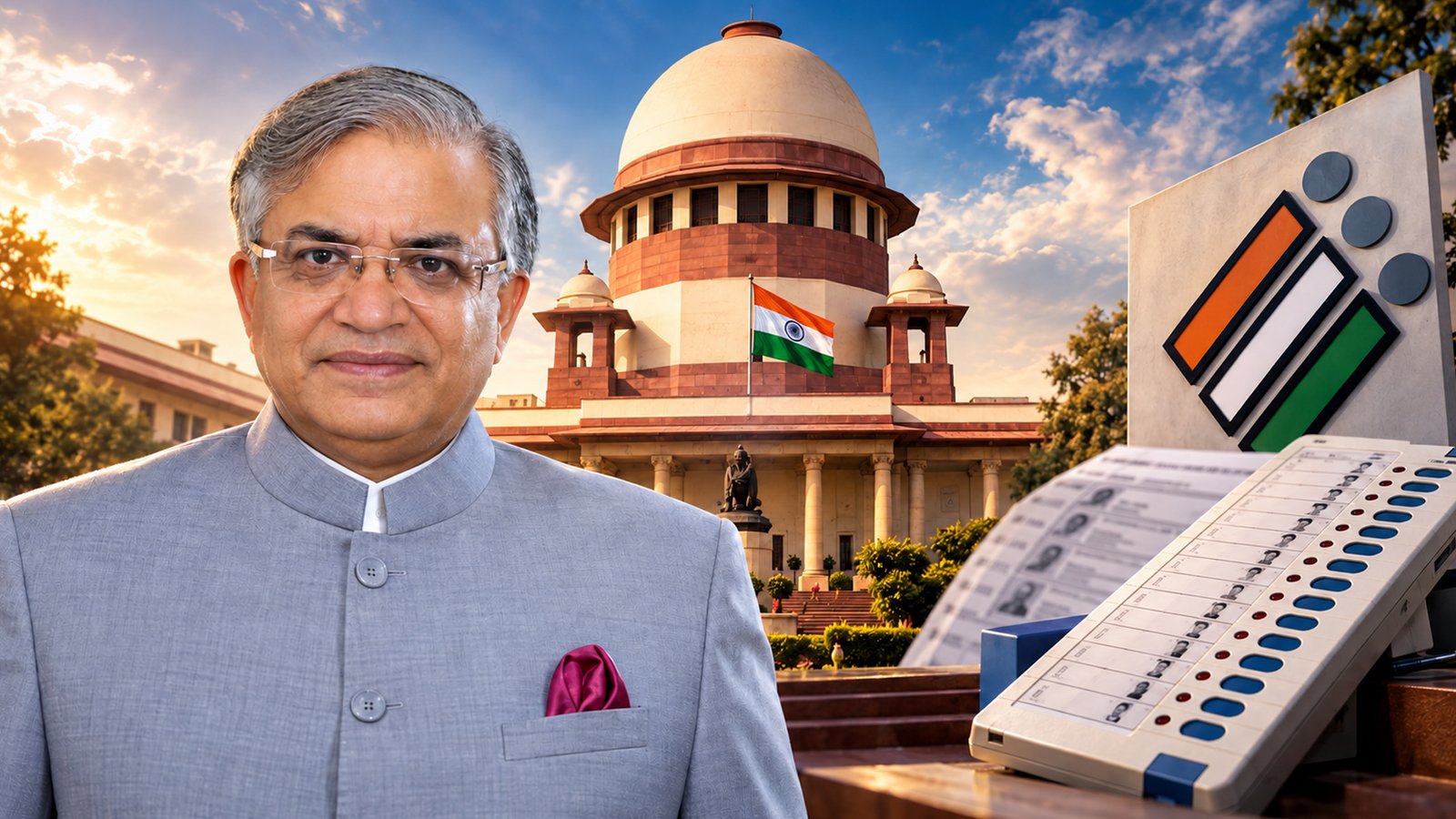
The Supreme Court has agreed to hear next week a petition seeking the suspension of Chief Election Commissioner Gyanesh Kumar and questioning how decisions have been taken by the Election Commission of India (ECI).
The petition raises questions about the constitutional role of the Election Commission and whether the Chief Election Commissioner can exercise powers that are vested in the poll panel as a collective body. The matter was mentioned before a bench headed by Chief Justice of India Surya Kant, along with Justices Joymalya Bagchi and V. Mohana.
The petition has been filed by Rakesh Kumar Singh. It alleges that several decisions were taken in the name of the Election Commission without the approval of the other two Election Commissioners, Sukhbir Singh Sandhu and Vivek Joshi.
According to the petition, the two Election Commissioners raised objections to at least 14 decisions between October 2025 and August 2026. The allegations include concerns over the circulation of agendas and minutes, changes to electoral-roll procedures and other actions taken in the name of the ECI.
The allegations remain contested. The Chief Election Commissioner has maintained that decisions relating to the Special Intensive Revision (SIR) of electoral rolls were taken unanimously by all members of the Commission.
Constitutional powers at the centre
A key issue before the Supreme Court will be the interpretation of Article 324 of the Constitution, which gives the Election Commission superintendence, direction and control over elections.
The petition argues that these powers belong to the Election Commission as a multi-member constitutional body and not individually to the CEC. It points to Article 324, which provides for the CEC and other Election Commissioners, while describing the CEC as the chairperson of the Commission.
The plea also relies on Section 18 of the Chief Election Commissioner and Other Election Commissioners Act, 2023. The provision says the Commission’s business should, as far as possible, be conducted unanimously. If members disagree, the matter is to be decided according to the majority view.
The petitioner has therefore sought a writ of quo warranto, asking the court to examine the authority under which the CEC allegedly exercised powers said to belong collectively to the Commission.
The petition also challenges actions connected with the Special Intensive Revision of electoral rolls. It seeks a declaration that decisions and consequential steps taken without the required authority should be treated as invalid.
SIR brings electoral process under scrutiny
The case comes amid a wider dispute over the Election Commission’s Special Intensive Revision exercise, which involves reviewing and updating electoral rolls.
The revision has generated political debate over the verification of voters and the treatment of names on electoral rolls. Opposition parties have questioned the process, while the Election Commission has defended its actions and the need to maintain accurate voter lists.
The Supreme Court’s decision to list the fresh petition next week does not amount to a finding against the CEC or the Election Commission. The court will first examine the legal questions raised by the petitioner and the constitutional framework governing the poll panel.
The case could bring greater attention to how decisions are recorded and implemented within a multi-member Election Commission. It may also clarify the relationship between the CEC’s role as chairperson and the collective authority of the Commission.
What the Supreme Court may examine
The hearing is expected to focus on whether the alleged decisions were taken in accordance with the constitutional structure of the ECI and the 2023 law governing the functioning of its members.
The court may also consider the legal basis for challenging the CEC’s continuation in office and whether the relief sought by the petitioner can be granted through judicial proceedings.
The immediate issue is therefore not simply the suspension request. It is also about how a constitutional institution responsible for conducting elections exercises its powers.
The Supreme Court’s consideration of the plea comes at a sensitive time for India’s electoral system, with voter-roll revision and the functioning of the Election Commission attracting increased public and political attention.
The hearing next week could provide an early indication of how the court views the legal questions surrounding collective decision-making within the poll panel. Any detailed ruling could have wider implications for the functioning of the Election Commission and the interpretation of its constitutional powers.