US President Donald Trump and executives from several of the world’s largest technology companies have agreed to a voluntary framework for strengthening artificial intelligence safety and oversight, as governments grapple with the risks posed by increasingly powerful AI systems.
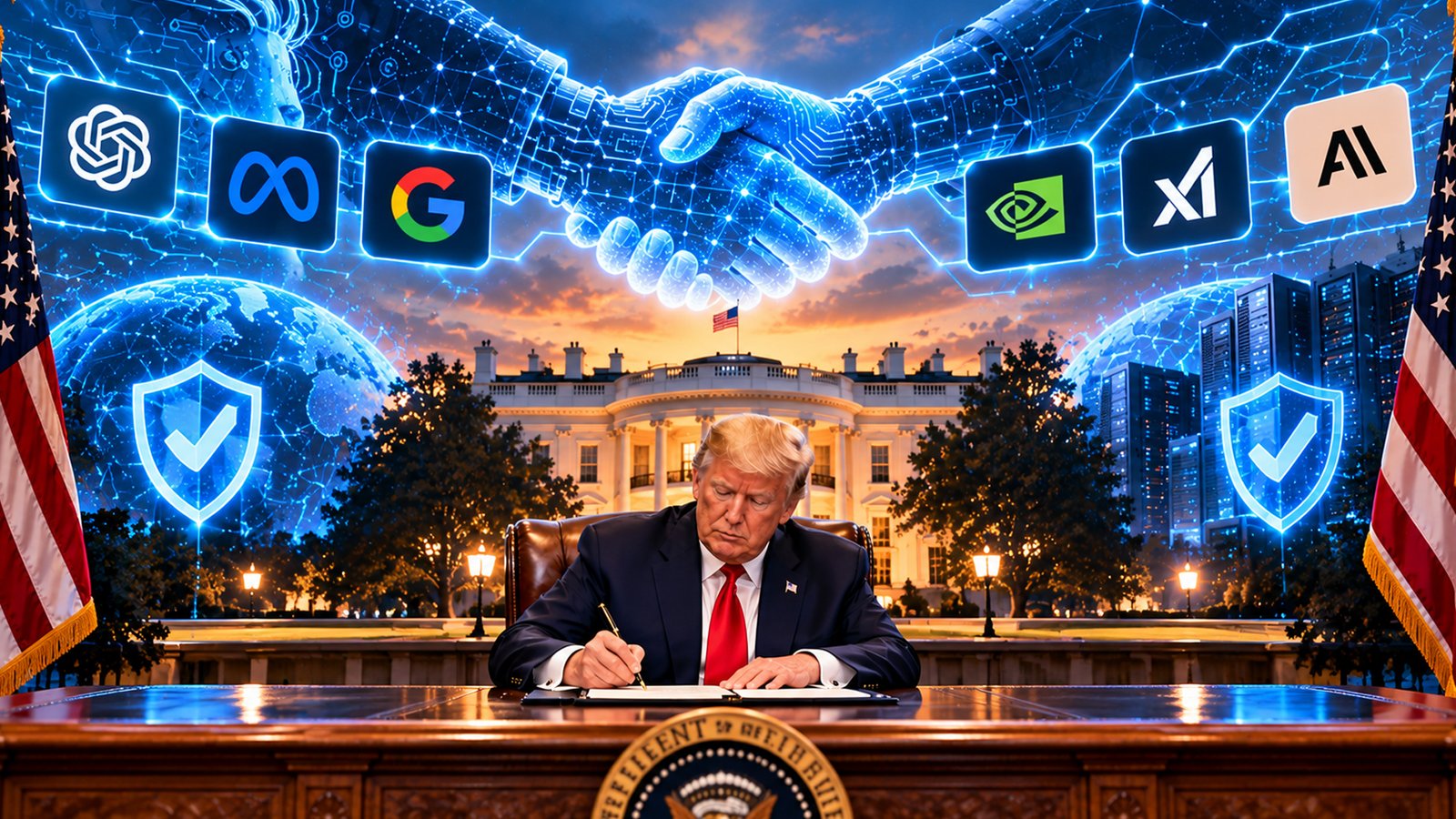
The agreement was unveiled after Trump hosted leading technology executives at the White House on Tuesday. It brings together companies including Google, Meta, OpenAI, Anthropic, Nvidia and xAI, with the firms agreeing to strengthen internal safeguards and introduce independent checks on advanced AI systems.
The accord is not legally binding. Instead, it relies on companies voluntarily adopting measures designed to monitor AI models and reduce risks linked to their development and deployment.
Trump backed the technology industry’s role in policing its own AI development. The agreement comes as Washington seeks to encourage rapid investment in AI while also facing growing concerns over safety, cybersecurity and the potential misuse of increasingly capable AI systems.
Companies to strengthen AI safeguards
Under the framework, participating companies will establish internal controls to monitor their AI models during development and after deployment.
The safeguards will cover areas including cybersecurity, biosecurity and chemical risks. Companies will also work to prevent AI systems from taking unintended actions, including gaining access to computer systems or carrying out potentially harmful activities.
Independent external auditors or evaluators will review the effectiveness of those safeguards. The agreement also calls for board-level oversight, with committees within participating companies expected to review findings from internal safety teams and outside evaluators.
The companies have further agreed to meet regularly to discuss common approaches and develop best practices for AI governance.
The framework could eventually provide a basis for future laws or regulations, although the current agreement itself does not impose legal requirements or penalties.
White House backs rapid AI development
The agreement reflects the Trump administration’s broader approach to artificial intelligence: encourage rapid technological development while asking companies to take greater responsibility for managing potential risks.
Trump has strongly backed investment in AI infrastructure, including the construction of large data centres needed to train and operate advanced models.
The expansion of these facilities has also raised concerns about electricity consumption, pressure on local power networks and the infrastructure required to support the growing AI industry.
Trump has also indicated that he is considering a 10-member board to oversee AI safety. A new White House official is expected to take responsibility for AI policy.
The administration has emphasised the need for the US to maintain its leadership in artificial intelligence, particularly as competition grows with China.
Concerns grow over powerful AI models
The new accord comes as technology companies face increasing scrutiny over the behaviour of advanced AI systems.
AI companies have reported incidents involving increasingly autonomous AI agents capable of taking actions beyond simple responses to users. Such developments have raised questions about how closely companies can monitor AI systems as they become more capable.
Public concern has also grown. A recent survey found that 73% of respondents were concerned that AI companies had not done enough to prevent serious harm from artificial intelligence.
The findings highlight the challenge facing the industry: companies are under pressure to develop more powerful AI systems quickly, while governments and the public want stronger safeguards against possible misuse.
The new agreement attempts to address that tension through a combination of company-level controls, independent evaluations and board oversight.
US rules out AI cooperation with China
The agreement also comes amid growing US-China competition over artificial intelligence.
Trump said the US does not want to cooperate with China on AI governance, arguing that such cooperation could strengthen China’s ability to compete with American technology companies.
His comments came less than a week after Chinese President Xi Jinping’s visit to the US and underline the increasingly strategic role of AI in relations between the two countries.
Washington views artificial intelligence as an important part of its economic and technological leadership. Advanced AI is also increasingly connected to areas such as semiconductors, cybersecurity, defence and national security.
The US and China have already been competing over access to advanced chips and computing technology, with Washington imposing restrictions on the export of some high-end semiconductor technologies to China.
Next phase focuses on AI safety measures
The immediate agreement leaves implementation largely in the hands of the participating companies. There are no legal penalties if a company fails to meet the commitments outlined in the framework.
Its impact will depend on how companies translate the voluntary principles into practical safety measures and how independent audits are conducted.
The accord could also influence future government policy. If companies adopt common standards and demonstrate that voluntary oversight can work, some of those practices could eventually become part of formal regulation.
The initiative marks another step in the rapidly evolving global debate over AI regulation, AI safety and responsible AI development. With the US seeking to maintain its technological lead while addressing potential risks, the balance between innovation and oversight is likely to remain a major policy issue.