The Election Commission of India (ECI) has ordered a special drive to identify and re-enrol eligible voters who were left out of the electoral rolls during or after the Special Intensive Revision (SIR), giving them another opportunity to have their names included.
The exercise will be conducted in 20 states and Union Territories where SIR has already been completed. The move comes amid continuing scrutiny of large-scale deletions from electoral rolls during the revision process.
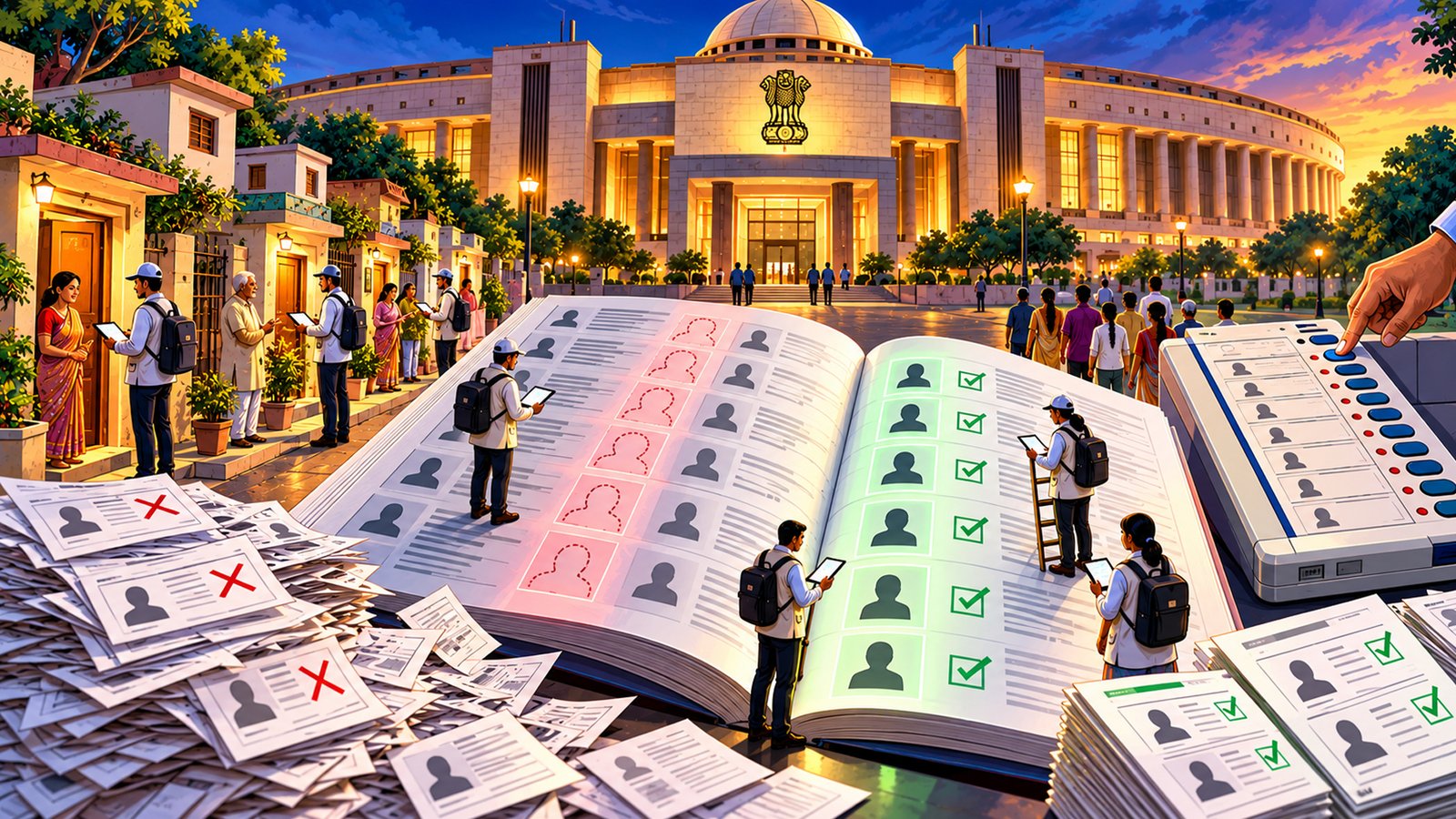
Under the latest instructions, Booth Level Officers (BLOs) will compare the current electoral rolls with the rolls that existed before SIR. They will prepare lists of voters whose names appeared on the earlier rolls but are missing from the latest version.
BLOs will then visit the homes of these voters to establish their current status and facilitate re-enrolment wherever the person is found eligible. The Election Commission has asked BLOs to cover around 20 to 25 such electors a week, with the exercise expected to take about a month.
The house-to-house exercise will not be limited to people whose names disappeared during SIR. BLOs have also been instructed to identify young and first-time eligible voters and help them complete the enrolment process.
The Election Commission has directed officials to use Form 6 for inclusion in the electoral roll. Importantly, the special SIR-related declaration that had been attached to Form 6 will not apply once the SIR process is over in a state or Union Territory. Instead, the regular forms under the Registration of Electors Rules, 1960, will be used.
This change addresses one of the concerns that emerged during the SIR exercise. Form 6 is traditionally used for new enrolment, raising questions about why people who had previously been registered voters should have to use the same route after their names were deleted.
Former Chief Election Commissioner S.Y. Quraishi has questioned this approach, arguing that a voter who has already voted in previous elections cannot accurately describe themselves as a first-time applicant. The issue has also come up before the Bombay High Court’s Goa bench in connection with the functioning of the Election Commission’s ECINET software.
The Election Commission, however, has maintained that voter enrolment is a continuous process and that anyone whose name has been left out can apply for inclusion. Its latest instructions are intended to make that process more accessible instead of requiring eligible voters to discover the omission and approach election officials themselves.
The scale of the exercise has drawn attention because around 13 crore names were removed from draft electoral rolls during SIR across 30 states and Union Territories. The figure represents total deletions from draft rolls and does not mean that all those people were eligible voters who were wrongly removed. Electoral authorities have said the revision also sought to remove names of deceased persons, people who had shifted residence, duplicate entries and others who were no longer eligible.
The latest initiative is therefore focused specifically on identifying eligible people who may have been left out.
Political parties will also be brought into the exercise. After the house-to-house verification, Electoral Registration Officers (EROs) will share booth-wise lists of identified voters with representatives of recognised political parties. The parties can then assist in identifying eligible electors who need to be enrolled.
Goa provides an early example of the process. The state had identified 97 voters whose names were missing from the final roll despite earlier being found eligible by election officials. The Election Commission said 81 of them had already submitted Form 6 by September 26. More recent reporting said 88 had been enrolled, while six people were living abroad and three had Portuguese citizenship, illustrating why individual cases require verification rather than automatic restoration.
The Election Commission has also introduced other measures to deal with concerns arising from SIR. In its September 26 meeting, it directed BLOs to visit people who received notices over unmapped names or logical discrepancies and collect documents from their homes. Such voters generally do not have to appear personally for hearings unless an Electoral Registration Officer considers one necessary.
District authorities have additionally been asked to establish help desks and hold special camps for groups that may find the enrolment process difficult, including homeless people, labourers and people living in night shelters.
The ECI has extended the deadline for claims and objections in Delhi to October 30, with disposal allowed until November 30. In Maharashtra, where SIR is still under way, the deadline for claims and objections has been extended to October 12, while disposal has been extended to November 10.
The special drive comes at a politically sensitive moment, with opposition parties and civil society groups questioning the scale and process of voter deletions. The Election Commission has defended SIR as an exercise to maintain accurate electoral rolls while reiterating that eligible citizens should not lose their voting rights because of an omission.
The immediate task now shifts to the ground level. BLOs will have to identify missing names, contact voters, verify eligibility and help complete enrolment applications.
The deletion during SIR does not permanently prevent inclusion of voters names in the electoral roll. Eligible citizens can seek enrolment through the continuous updation process, while the special drive is intended to ensure that election officials actively reach those who may otherwise remain outside the rolls.
The effectiveness of the exercise will ultimately depend on how thoroughly officials identify genuine omissions and how quickly applications are processed.