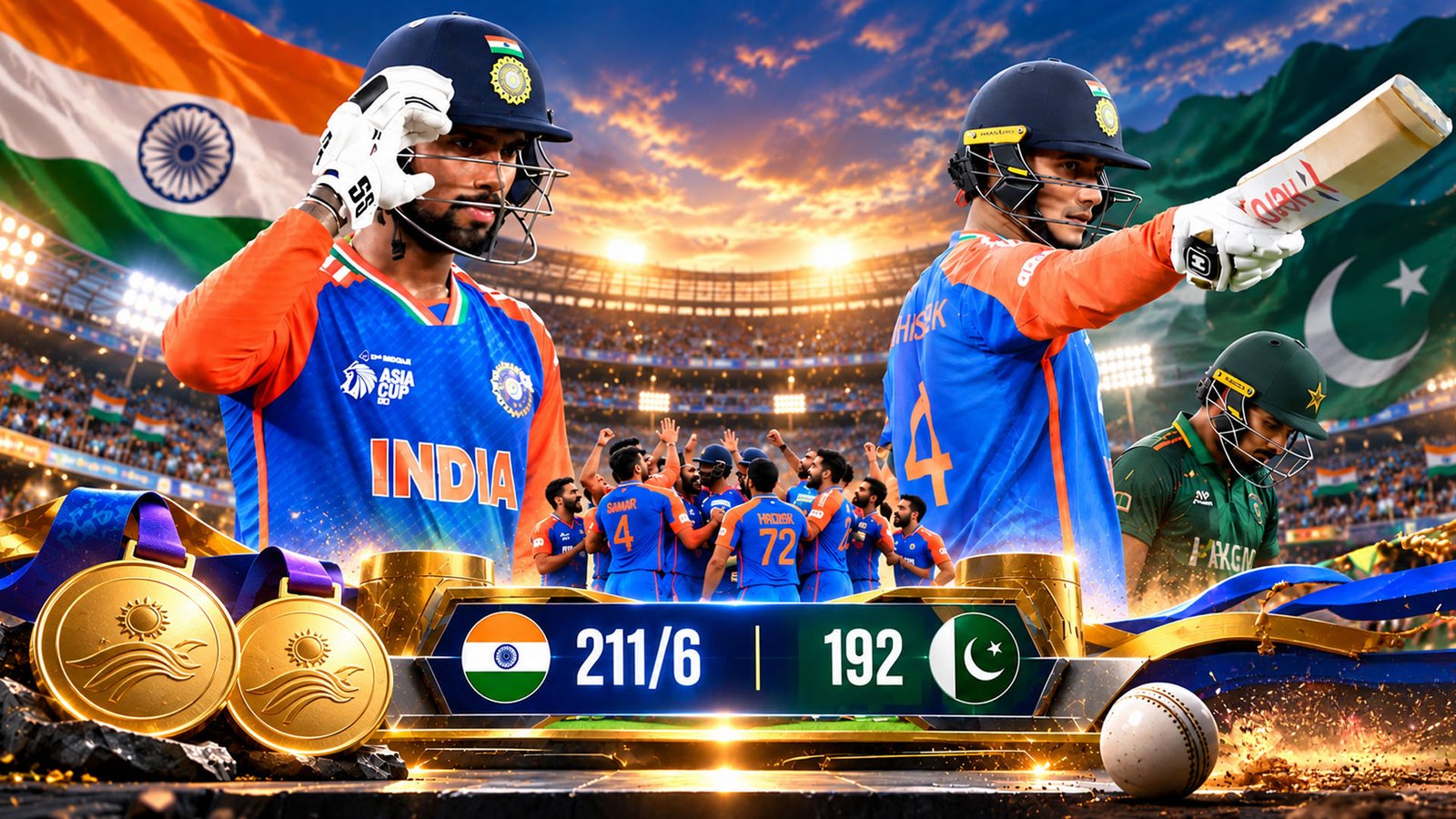
India held their nerve in a tense finish against Pakistan to win the men’s T20 cricket gold medal at the 2026 Asian Games in Japan. A 61-run assault from Abhishek Sharma, an unbeaten 51 from Tilak Varma and a disciplined bowling effort helped India beat Pakistan by 19 runs in a high-scoring final at Korogi Sports Park in Nisshin on Saturday.
India posted 211/6 after choosing to bat first, setting Pakistan a target of 212. Pakistan appeared capable of chasing it down when Hasan Nawaz produced a spectacular 96 from 51 balls, but India kept finding important wickets at crucial moments. Pakistan eventually finished at 192/6, leaving India with a second successive Asian Games cricket gold after their title-winning campaign in Hangzhou in 2023.
The victory also completed a golden double for Indian cricket at the Asian Games. The women’s team had earlier defeated Sri Lanka by 147 runs to retain its own gold medal, meaning India collected both cricket titles in the 2026 competition.
India’s innings began with a burst of attacking cricket. Abhishek Sharma took the initiative from the opening overs, repeatedly finding the boundary and putting Pakistan’s bowlers under pressure. He reached his half-century from only 20 balls before finishing with 61 from 28 deliveries, including three fours and seven sixes.
His approach gave India early momentum and helped the team reach 81/2 during the Powerplay. Ishan Kishan contributed 20, while captain Shreyas Iyer scored 21, but Pakistan gradually pulled things back as the middle overs progressed. India’s scoring rate dipped and the possibility of a total around the 190-mark began to emerge.
That was when Tilak Varma took control of the closing stages.
Tilak stayed unbeaten on 51 from just 22 balls, combining clean hitting with calculated aggression. Shivam Dube added 27 from 15 deliveries, and the pair put on 62 runs in five overs. Their partnership pushed India beyond 200 and produced the highest total of the men’s Asian Games tournament.
The challenge for India was to make those runs count. Pakistan’s chase began poorly, with the team slipping to 39/3 by the seventh over. India’s spinners created pressure, while Dube also provided a crucial breakthrough.
Pakistan, however, found an unlikely hero in Nawaz.
The right-hander transformed the chase with a fearless innings that kept the final alive almost until the last delivery. He reached his fifty from 28 balls and continued attacking as the required run rate climbed. His 96 included five fours and seven sixes, while Saim Ayub’s 29 helped him build an 87-run fourth-wicket partnership.
That partnership changed the mood of the contest. India had looked firmly in control after the early wickets, but Nawaz began finding gaps and clearing the boundary with increasing regularity. Pakistan’s target, which had appeared distant, suddenly became achievable.
India responded by leaning on its experienced bowlers and keeping the pressure on. Axar Patel, Washington Sundar and Dube each finished with two wickets. Washington’s 18th over was particularly important, as he dismissed Abdul Samad and conceded only eight runs, leaving Pakistan with an increasingly difficult equation.
Dube was handed the final over with Pakistan needing 33 runs. A boundary and a wide briefly gave Pakistan hope, but Dube recovered with a well-directed yorker. Nawaz then fell to the final delivery, caught behind by Sanju Samson, ending an outstanding individual effort and Pakistan’s chase.
The final scoreline — India 211/6, Pakistan 192/6 — reflected how closely the contest swung between the two teams. India’s early batting aggression gave it the platform, Tilak and Dube supplied the late acceleration, and the bowlers survived Pakistan’s strongest challenge.
Nawaz’s 96 was one of the defining performances of the match even though it came in a losing cause. He was only four runs away from a century when the final ball ended his innings. Saad Masood remained unbeaten on 12 from five deliveries, but the target had moved beyond Pakistan’s reach.
The result gives India another significant T20 title and reinforces the depth of its current white-ball setup. Different players carried the team through different phases: Abhishek provided the explosive start, Tilak handled the finishing role and Dube contributed with both bat and ball.
It was also a final in which Pakistan refused to disappear from the contest. After losing early wickets, the team rebuilt through Nawaz and Ayub and carried the chase deep into the final over. India’s ability to respond under that pressure ultimately decided the gold medal.
Pakistan take home the silver, while Sri Lanka secured the men’s bronze after defeating Bangladesh in the third-place playoff. India, meanwhile, leave the Asian Games with both cricket gold medals and another chapter added to their growing T20 success.
The final may be remembered for the headline numbers — 211, 192 and a 19-run margin — but its most compelling feature was the changing momentum. Abhishek set the tone, Tilak finished the job with the bat, Nawaz almost turned the chase around, and India’s bowlers found enough composure to close the door.
In a contest carrying the weight of an India-Pakistan final, India once again walked away with the gold.