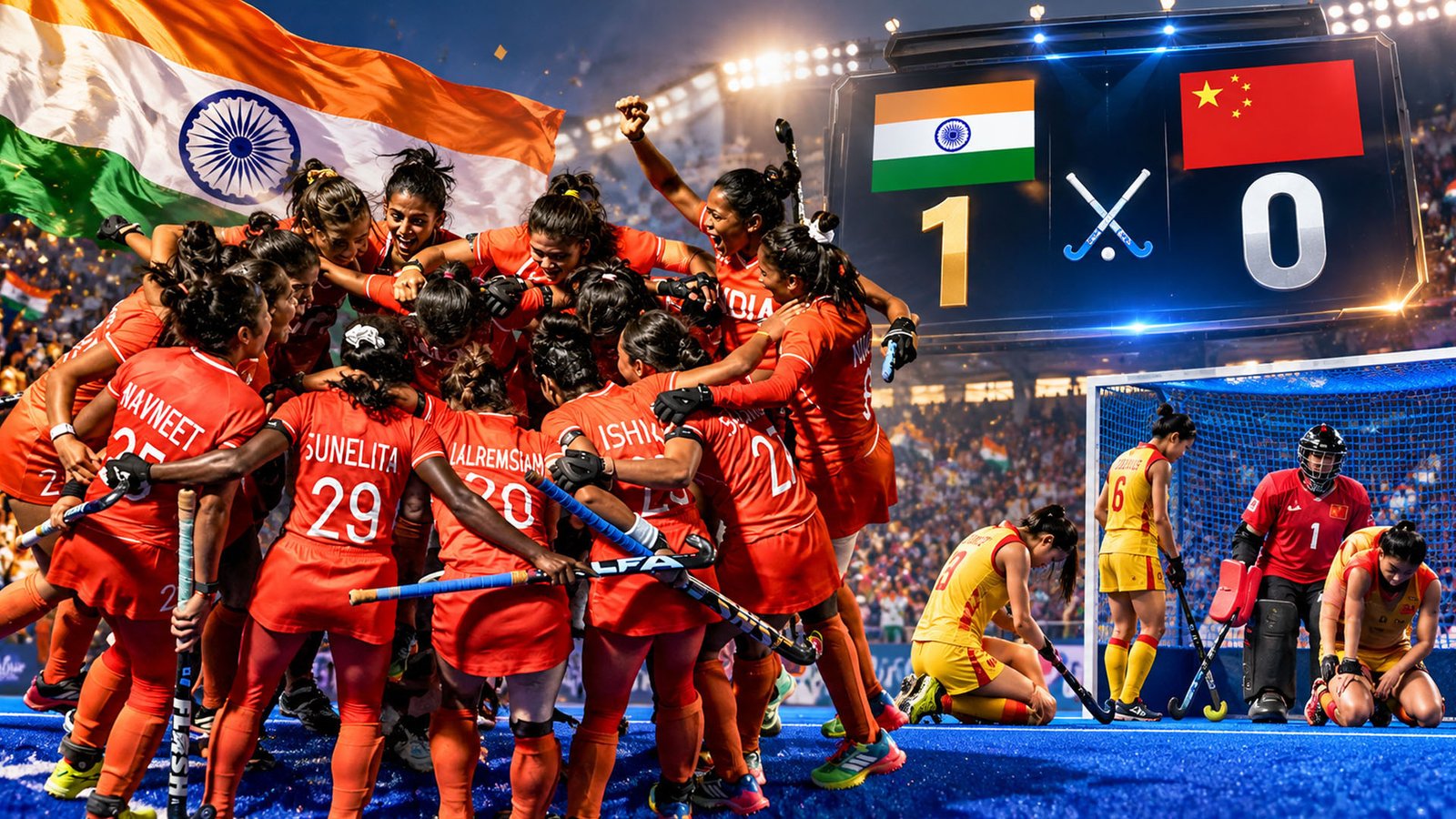
India’s women’s hockey team finally ended a 44-year wait for Asian Games gold with a hard-fought 1-0 victory over China in the final at Aichi-Nagoya, Japan, on Friday. The historic win delivered India’s second women’s hockey gold at the Asian Games and secured a direct qualification spot for the 2028 Los Angeles Olympics.
The decisive moment came early in the match. Lalremsiami struck in the 10th minute with a superb reverse-stick effort after Sakshi Rana created the opening inside the circle. The goal proved enough to settle a tense final and gave India a title it had been chasing for more than four decades.
The occasion was even more special for Lalremsiami, who was making her 200th appearance for India at senior international level. Reaching the milestone on the biggest stage and then scoring the match-winning goal turned the evening into a memorable chapter in her international career.
China, the defending Asian Games champions, were not prepared to surrender their title easily. After falling behind, they increased the pressure and repeatedly tested the Indian defence. India had to spend long periods without the ball, relying on discipline and quick defensive reactions to protect its advantage.
One of the biggest moments came when China earned a penalty stroke. Savita Punia stood between China and an equaliser and responded brilliantly, diving to make the save. Her intervention kept India’s lead intact at a crucial stage of the final.
The Indian defence then had to absorb wave after wave of Chinese attacks. Players closed down spaces, blocked attempts and worked collectively to prevent China from finding a clear route to goal. The narrow scoreline made every defensive challenge important, but India stayed composed until the final whistle.
The gold ended a long wait that had included several near misses. India last won the women’s hockey title at the Asian Games in 1982. The team subsequently reached the final in 1998 and 2018 but had to settle for silver on both occasions.
This time, India made sure the story ended differently.
The victory also capped an unbeaten Asian Games campaign. India won all its pool matches before defeating South Korea 2-0 in the semi-final. Ishika opened the scoring in that game, while captain Salima Tete added another goal in the final quarter to send India into the title clash.
The final demanded a different approach. India had to defend an early lead rather than chase the game, and the players showed patience as China attempted to regain control. The team’s ability to stay organised under sustained pressure ultimately proved decisive.
The Asian Games title also changes India’s road to the next Olympics. By winning gold, the women’s hockey team has secured direct qualification for the 2028 Los Angeles Olympics. That gives the players a clear route into the next Olympic cycle without having to navigate a separate qualification tournament.
The qualification is particularly significant after India’s women’s hockey team missed the Paris 2024 Olympics. The players now have a confirmed place at Los Angeles and valuable time to prepare for the tournament.
Lalremsiami’s performance added a personal milestone to the team’s historic achievement. The 26-year-old has been an important part of India’s international hockey programme and has already collected major honours with the national team. Her 200th senior appearance and match-winning goal against China will stand among the defining moments of her career.
The celebrations were followed by financial rewards. Hockey India announced ₹11 lakh for each player and ₹5.5 lakh for every member of the support staff following the Asian Games triumph.
The Odisha government announced a similar reward on Saturday, offering ₹11 lakh to each player and ₹5.5 lakh to every member of the support staff. The announcement underlined the state’s long-standing connection with Indian hockey.
Odisha has supported the national men’s and women’s hockey teams since 2018 and has committed to continuing its sponsorship of the senior and junior teams through 2036. The state has also developed a strong hockey culture and infrastructure over the years.
The Asian Games victory reflects the steady progress of Indian women’s hockey on the international stage. The team has increasingly competed against the strongest sides in Asia and beyond, while younger players have continued to emerge alongside experienced campaigners.
The 1-0 scoreline may look narrow, but India’s victory was built on much more than one goal. Lalremsiami provided the attacking spark, Savita delivered when the pressure was at its highest, and the defence maintained its discipline for the remainder of the match.
The next challenge will be to build on this success. With Olympic qualification secured, India can now turn its attention towards the long preparation cycle leading to Los Angeles.
After 44 years, however, the immediate feeling is one of celebration. Lalremsiami’s strike has given Indian women’s hockey another Asian Games gold and a place at the 2028 Olympics, while ending one of the longest title waits in Indian sport.