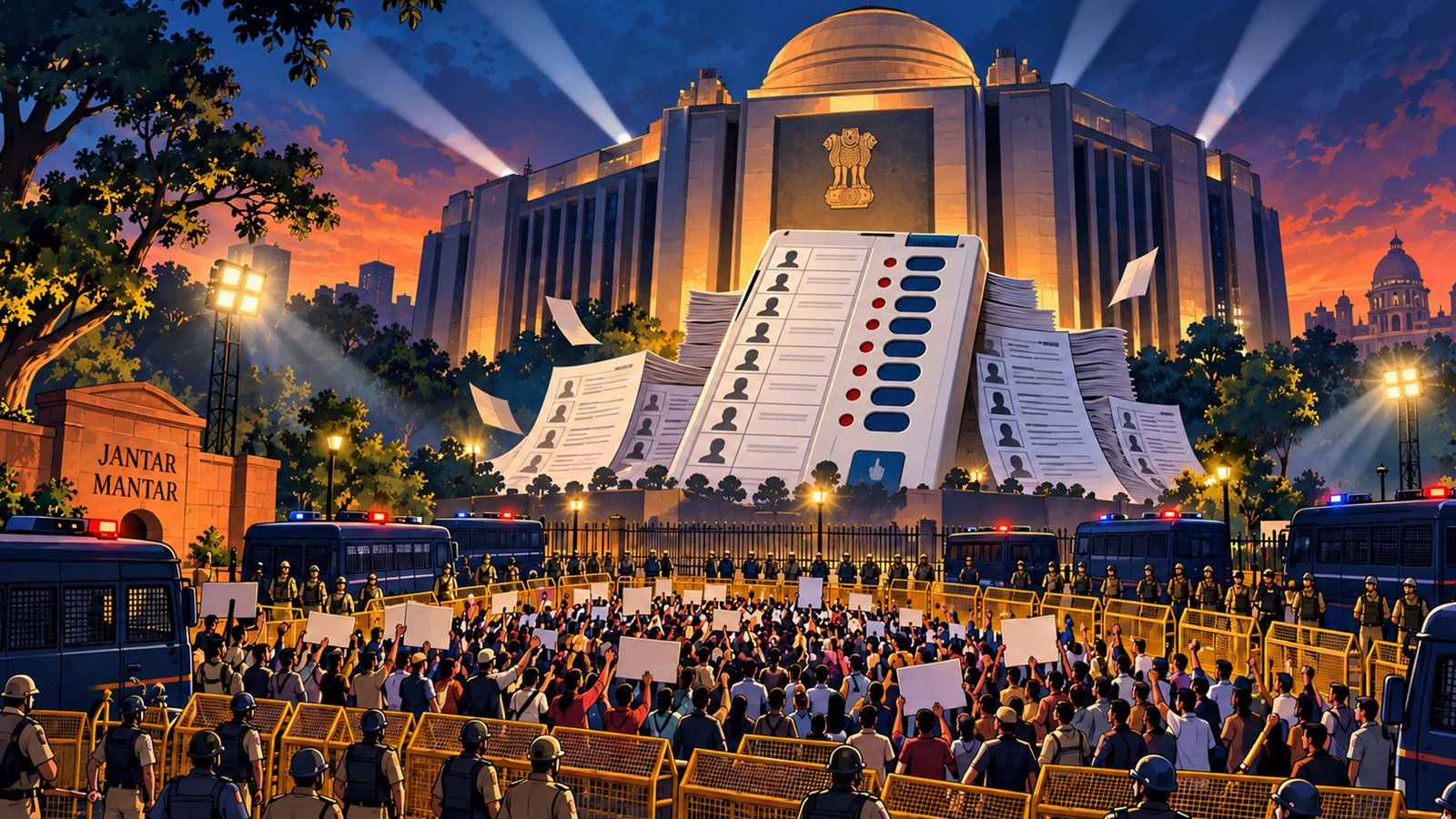
Nearly 1,000 people were detained in Delhi as police stopped a planned protest at Jantar Mantar demanding the resignation of Chief Election Commissioner Gyanesh Kumar over concerns surrounding the Special Intensive Revision (SIR) of electoral rolls.
The protest, involving political parties, student groups and civil society activists, was planned to highlight allegations that eligible voters had been removed from electoral rolls during the revision exercise. Protesters also accused the Election Commission of failing to adequately protect voters’ rights and demanded greater transparency in the SIR process.
Delhi Police said the gathering had not been permitted and that prohibitory orders were already in force in the New Delhi district. These restrictions prohibit unauthorised assemblies, demonstrations and processions.
Police deployed a large security force across central Delhi ahead of the planned demonstration. Barricades were placed around Jantar Mantar and roads leading to the protest site, while police and paramilitary personnel were positioned at key locations.
Police initially detained more than 700 protesters, but the number later increased to nearly 1,000 as the security operation expanded across central Delhi.
Several prominent political leaders were among those detained. They included AAP leaders Atishi, Saurabh Bharadwaj, Sanjay Singh, Kuldeep Kumar, Jarnail Singh and Sanjeev Jha. RJD Rajya Sabha MP Manoj Jha, CPI MP P Sandosh Kumar, Indian Youth Congress president Uday Bhanu Chib and activist Yogendra Yadav were also detained.
The protest was supported by several political and student organisations, including the Aam Aadmi Party, All India Students’ Association, Students’ Federation of India, National Students’ Union of India and Indian Youth Congress.
Protesters had sought to gather at Jantar Mantar, but police prevented them from reaching the designated area. Demonstrators instead assembled at different points around central Delhi, including Patel Chowk and Ashoka Road.
The police action came amid a wider political controversy over the SIR exercise. The Election Commission has defended the revision as necessary to maintain accurate electoral rolls and remove names of deceased people, duplicate entries and voters who have permanently shifted away from their registered addresses.
Opposition parties and civil society groups, however, have raised concerns about the possibility of genuine voters being removed from electoral rolls. They have questioned whether the verification process could inadvertently exclude people who are eligible to vote.
The timing of the protest was significant because the Election Commission has separately ordered a special drive to identify eligible voters who may have been left out during SIR. Booth Level Officers have been instructed to compare earlier electoral rolls with the latest lists, identify missing voters and visit their homes to facilitate re-enrolment.
The new drive has been presented by the poll panel as an additional safeguard to ensure that eligible citizens are not denied their voting rights because their names were omitted during the revision.
Police said they had prepared for a potentially large gathering, with intelligence suggesting that around 4,000 to 5,000 people could reach central Delhi. Around 5,000 police and paramilitary personnel were deployed, while drones were used to monitor sensitive areas.
The security measures affected traffic and public movement in parts of the capital. Several roads around the protest zone were barricaded or diverted, while access to some Delhi Metro stations was temporarily restricted. Some protesters were transported to police stations in different parts of the city.
Minor clashes were reported at some locations as police attempted to prevent protesters from gathering. Videos of alleged police action against demonstrators also circulated on social media, though officials said the circumstances surrounding such footage were being examined.
The protest has now resulted in legal action as well. Delhi Police registered three FIRs in connection with the demonstrations. The cases were filed at Parliament Street and Connaught Place police stations and include provisions of the Bharatiya Nyaya Sanhita relating to disobedience of an order issued by a public servant.
The controversy is not limited to Delhi. A separate protest was held in Mumbai, where demonstrators gathered at Shivaji Park and called for Kumar’s resignation. Organisers have threatened another demonstration at Jantar Mantar if their demand is not addressed.
The dispute over SIR has become one of the most prominent political issues surrounding India’s electoral process. Critics argue that the scale of voter deletions requires stronger safeguards to ensure that genuine electors are not excluded. The Election Commission, meanwhile, has maintained that electoral-roll revision is essential to preserve the integrity of elections.
The poll panel has also emphasised that deletion from a revised roll does not permanently prevent an eligible citizen from being enrolled again. Voters whose names are missing can apply for inclusion through the prescribed process.
The detention of nearly 1,000 protesters adds another layer to the growing confrontation between opposition groups and the Election Commission. The continuing SIR debate is likely to remain focused on keeping electoral rolls accurate while ensuring that no eligible voter is denied the right to vote.