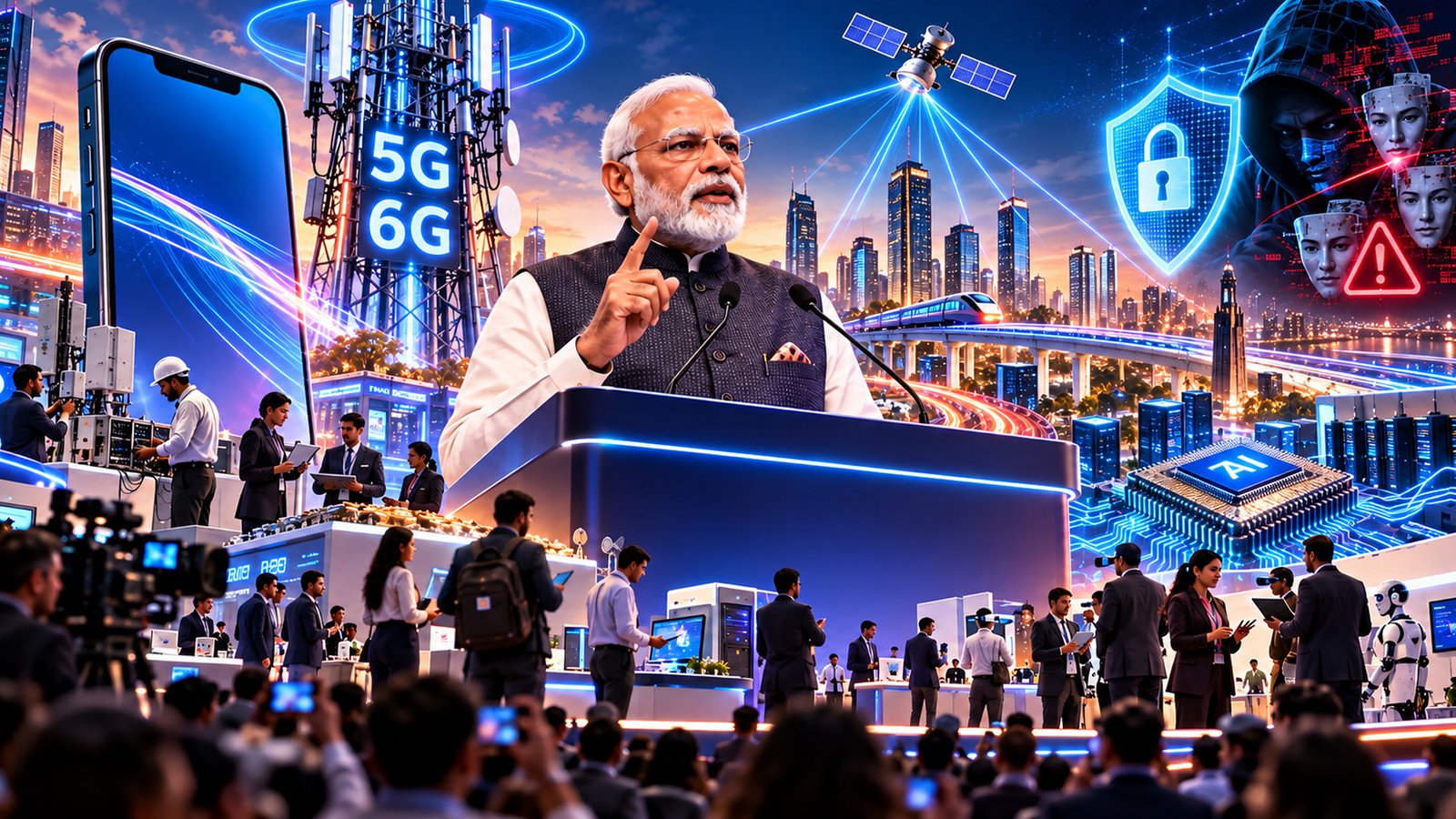
Prime Minister Narendra Modi has called for a global framework to tackle cyber fraud and deepfakes, saying digital technology can reach its full potential only when people trust the systems they use. Addressing the 10th edition of the India Mobile Congress (IMC) in New Delhi on October 8, he urged governments, technology companies, telecom operators and financial institutions to work together to prevent online scams.
He said cybercrime no longer respects national borders. Fraudsters can operate from one country, use digital networks in another and target victims thousands of kilometres away. The growing threat of deepfakes, which use artificial intelligence (AI) to create convincing but manipulated images, videos and audio, makes the challenge more complex.
He called on the Global System for Mobile Communications Association (GSMA) and telecom operators worldwide to develop a mechanism that can identify and stop fraudulent activity before it reaches users. India, he said, was ready to share its experience in tackling cybercrime and contribute to international efforts.
The message at IMC 2026 was clear: expanding connectivity must go hand in hand with stronger cybersecurity, digital inclusion and responsible technology development.
Digital trust becomes a priority
As mobile phones become central to banking, shopping, education and government services, the consequences of digital fraud are growing. A fake call or message can lead to financial loss, identity theft or the misuse of personal information. Deepfake content can also be used to impersonate public figures, spread misinformation and manipulate unsuspecting users.
PM Modi stressed that people should be able to trust calls, messages, online transactions and the networks carrying their data. Preventing fraud, he argued, requires more than individual caution. Governments, telecom companies, digital platforms and financial institutions must coordinate their efforts to identify suspicious activity and close gaps that criminals exploit.
The proposed global approach reflects the cross-border nature of modern cybercrime. Different countries have different laws and enforcement systems, while fraudulent operations often involve multiple jurisdictions. Greater cooperation could help authorities and companies respond more effectively to emerging threats.
India’s digital transformation
Alongside cybersecurity, Modi highlighted India’s progress in expanding mobile connectivity and making digital services more accessible. He said the country had moved from being largely a consumer of technology towards becoming a creator of products, designs and intellectual property.
Mobile phones, he noted, have evolved beyond communication devices. They now support digital payments, online learning, entertainment, content creation and access to public services. Affordable internet and expanding telecom infrastructure have helped bring these opportunities to people in smaller towns, villages and remote areas.
The government has positioned Digital India as a key driver of this transformation. Wider connectivity and digital public infrastructure have made it easier for people to access services without travelling long distances or waiting for physical paperwork.
The Direct Benefit Transfer (DBT) system was one example highlighted by the Prime Minister. According to the government, it has enabled the transfer of nearly ₹50 lakh crore directly to beneficiaries and helped prevent about ₹5 lakh crore in potential leakages. The system uses digital channels to deliver government benefits, reducing intermediaries in the process.
India’s expanding mobile ecosystem has also changed how people consume and create content. Smartphones increasingly serve as gaming devices, recording studios and tools for regional-language creators. Faster networks have opened new opportunities for businesses, educators and entrepreneurs to reach wider audiences.
5G expansion and domestic manufacturing
India’s telecom growth has been supported by the rapid rollout of 5G networks. Government figures cited at the event put the number of 5G base stations across the country at more than 5.5 lakh, while internet speeds have increased significantly since 2022.
The next phase, according to Communications Minister Jyotiraditya Scindia, is to connect one billion 5G users by 2030 and position India as a leader in global digital innovation. Achieving that ambition will require continued investment in network infrastructure, devices and emerging technologies.
Domestic manufacturing is another important part of the strategy. Modi said India was working towards producing not only finished technology products but also the designs and intellectual property behind them. Greater local capability in telecom equipment, electronics and semiconductors could reduce dependence on imports and strengthen Indian companies in international markets.
Telecom reforms and changes to the regulatory environment are also intended to support investment and infrastructure expansion. The government’s broader objective is to create an ecosystem where startups, manufacturers, telecom operators and established technology firms can develop and scale new solutions.
India Mobile Congress looks ahead
Held at Yashobhoomi in New Delhi from October 7 to 10, IMC 2026 brought together policymakers, telecom operators, technology companies, startups and investors. Its theme, Scale Without Boundaries, reflected India’s ambitions in digital connectivity, innovation and technology-led growth.
The event covered areas including 5G and 6G, artificial intelligence, semiconductors, cybersecurity, quantum communication and electronics manufacturing. It also explored emerging applications in smart mobility, industrial robotics and transport technology.
India’s digital expansion has created new opportunities for consumers and businesses, but its long-term success will depend on more than faster networks. Secure transactions, reliable communications, wider access and public confidence will be equally important.
PM Modi’s call for a global framework against cyber fraud places digital trust at the centre of that agenda. As India seeks to become a major technology creator, the challenge will be to ensure that innovation reaches more people while keeping their money, identities and data safe.