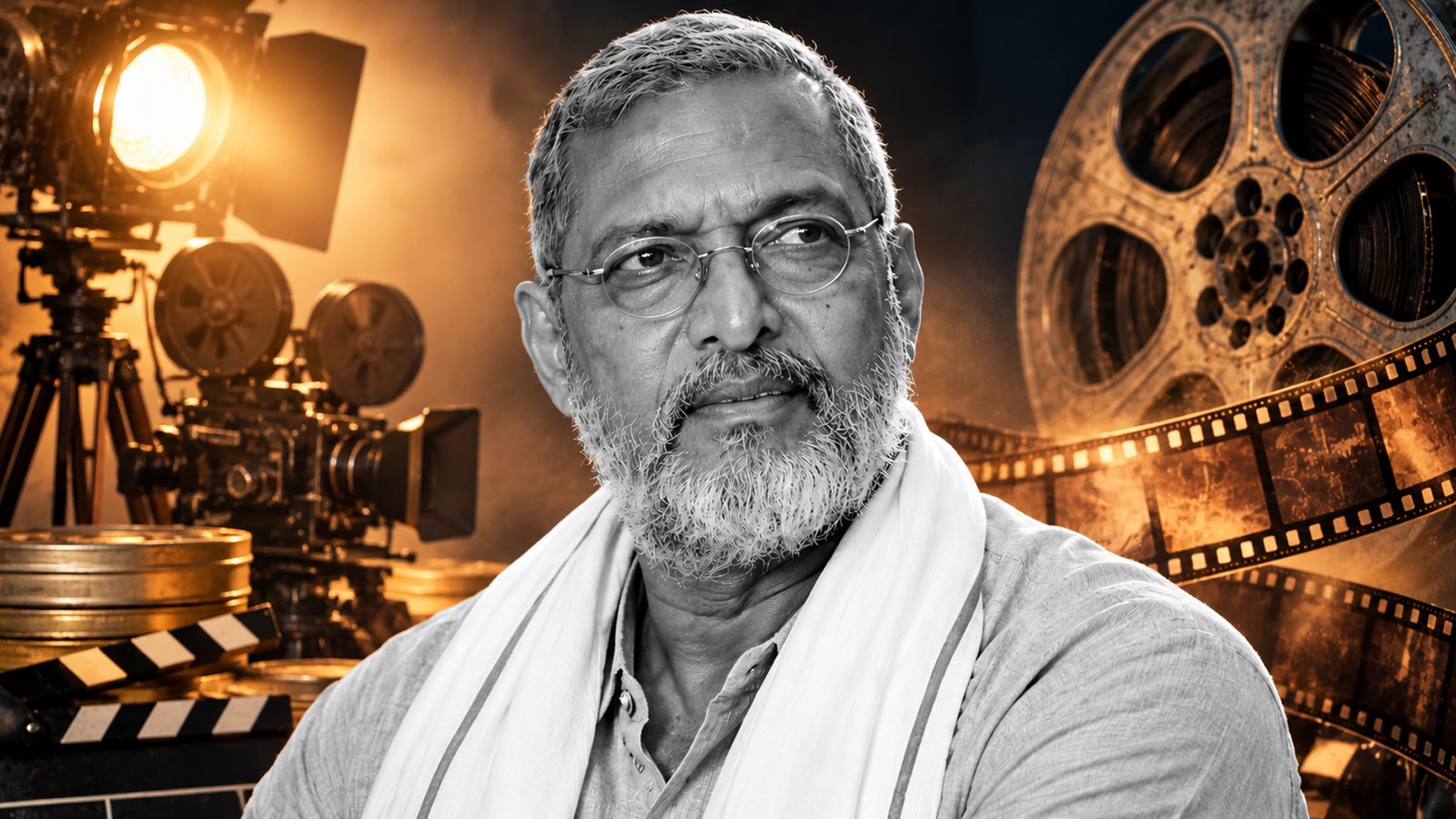
Veteran actor leaves behind powerful performances and lasting legacy of service to farmers and families
Veteran actor Nana Patekar, one of the most recognisable and intense performers in Indian cinema, died on Thursday at the age of 75 after suffering a cardiac arrest at his residence in Goa.
Patekar was found unconscious at his home in Dona Paula in the early hours of October 8 and was rushed to Manipal Hospital. Doctors attempted cardiopulmonary resuscitation (CPR) for around 45 minutes but could not revive him. He was declared dead at about 5.20 am. His death was registered as a medico-legal case as he was brought dead to hospital after being found unconscious at his Goa residence.
His son, Malhar Patekar, confirmed the death. The actor’s mortal remains are being taken to Pune, where his last rites will be conducted at his farmhouse in Donje with full state honours.
Maharashtra Cultural Affairs Minister Ashish Shelar announced the state funeral, citing Patekar’s contribution to Marathi theatre and Marathi and Hindi cinema. His cremation is scheduled for Thursday evening, with people expected to be allowed to pay their last respects before the final rites.
A career built on intensity
Born Vishwanath Patekar in Maharashtra, Nana Patekar began his career in Marathi theatre before making his film debut with Gaman in 1978. His early work established him as an actor who could bring unusual intensity and emotional depth to his characters.
His major breakthrough came with Parinda in 1989, in which his portrayal of a volatile gangster won him the National Film Award for Best Supporting Actor. He went on to build a remarkably diverse filmography, moving comfortably between serious drama, action, comedy and socially driven cinema.
Films such as Prahaar, Tirangaa, Krantiveer, Khamoshi: The Musical, Agni Sakshi, Rajneeti and Welcome showcased different sides of his acting. His performance in Krantiveer earned him the National Film Award for Best Actor, while his work across Hindi and Marathi cinema brought him several other major honours.
Patekar won three National Film Awards during his career and was awarded the Padma Shri for his contribution to the arts. His work in Marathi theatre remained an important part of his artistic identity even as he became a major name in Hindi cinema.
His distinctive voice, forceful dialogue delivery and ability to portray flawed, complicated characters made him stand apart from conventional Bollywood stars. He could be intimidating on screen, but his performances also carried vulnerability and humanity.
A different kind of legacy
Away from films, Patekar became equally known for his social work.
His association with the Naam Foundation, which he co-founded with actor Makarand Anaspure, grew out of the severe agrarian crisis in Maharashtra. In 2015, farmer suicides and crop losses in regions such as Marathwada drew national attention.
Patekar was deeply affected after seeing television reports about families of farmers who had died by suicide. He had been saving money to buy a luxury car but instead decided to use the money to help struggling farming families.
What began as an effort to support a limited number of families eventually became a much larger social initiative. The Naam Foundation worked on farmer welfare, water conservation, disaster relief and support for families affected by farmer suicides.
Over the years, the organisation supported millions of farmers and thousands of families affected by disasters. It also helped widows of farmers who had died by suicide, providing financial assistance and support to help families rebuild their lives.
That work became an important part of Patekar’s public identity. His concern was not limited to financial aid. He repeatedly spoke about the deeper problems facing farmers and the need for sustainable solutions, particularly in rural Maharashtra.
Tributes pour in
Patekar’s death has prompted tributes from across India’s political, cultural and film communities.
President Droupadi Murmu, Vice President C. P. Radhakrishnan and Prime Minister Narendra Modi expressed condolences, remembering his contribution to Hindi and Marathi cinema. Modi described Patekar as a versatile artist whose creativity left a lasting mark on Indian cinema.
Actors and colleagues have also remembered him for his authenticity and powerful screen presence. Akshay Kumar described Patekar as a rare performer who never needed to overplay a scene to command attention.
For audiences, Nana Patekar’s legacy will live through characters that remain deeply etched in Indian cinema. But his story extends beyond the screen.
He leaves behind not only a celebrated body of work but also an enduring record of social service. From theatre stages and film sets to drought-hit villages and farmers’ families, Patekar built a public life that combined art with action.
His final journey to his Pune farmhouse, where he will be accorded full state honours, will mark the end of a remarkable chapter in Indian cinema — and the beginning of a lasting remembrance shaped by both his performances and the lives he helped touch.