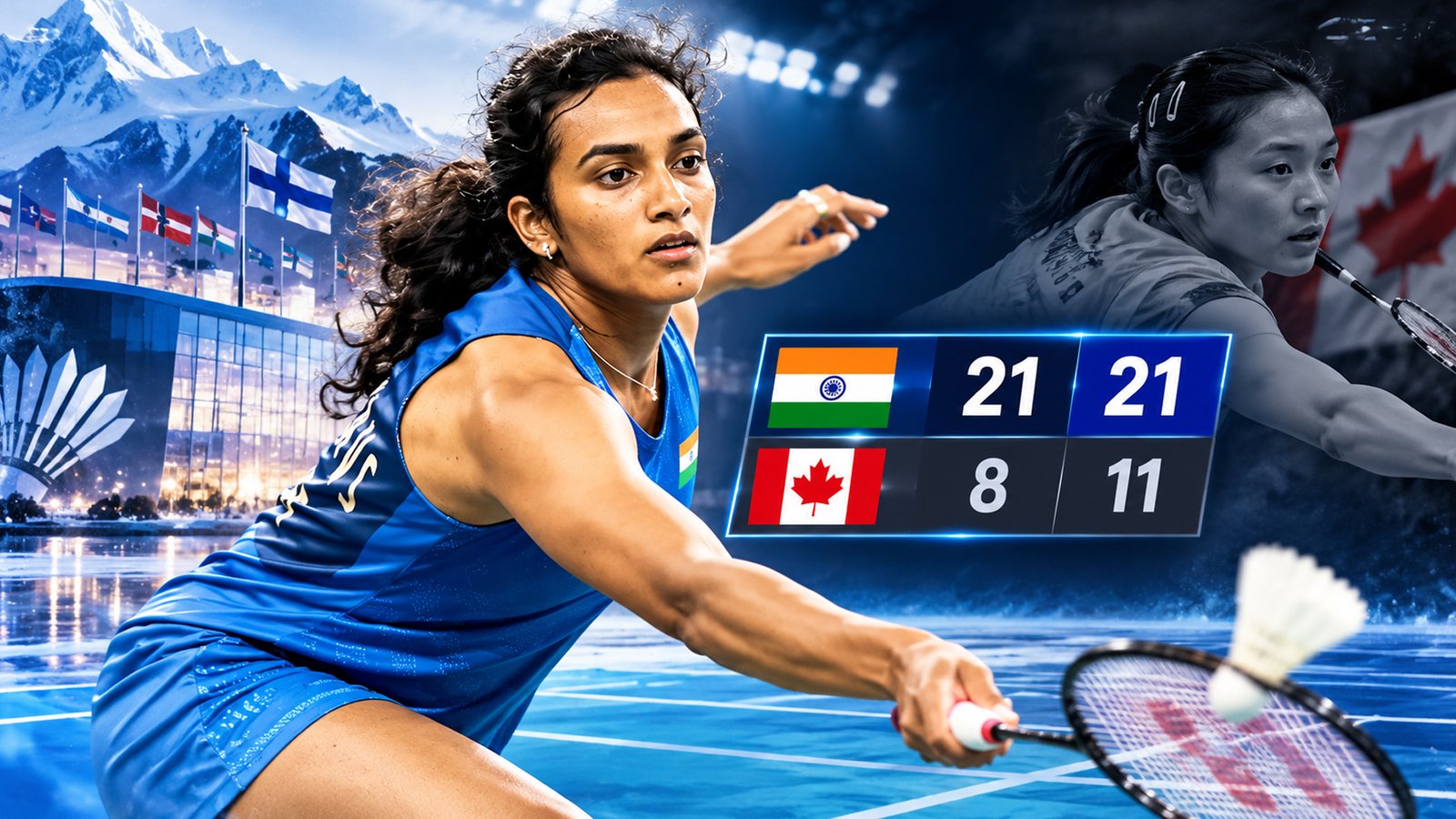
PV Sindhu began her Arctic Open 2026 campaign in confident fashion, giving India a bright start at the BWF World Tour Super 500 tournament in Vantaa, Finland. The two-time Olympic medallist comfortably defeated Canada’s Wen Yu Zhang in straight games to move into the second round.
The sixth-seeded Sindhu needed only 28 minutes to complete a 21-8, 21-11 victory. She controlled the contest from the opening rally, using her experience and court coverage to prevent Zhang, who came through qualifying, from settling into the match.
The win comes at an important point in Sindhu’s season. She entered the Arctic Open after reaching the quarter-finals at the 2026 Asian Games, where her campaign ended without a medal. The Indian star will now look to build momentum in Finland after a strong run at the Japan Open earlier this year.
Sindhu’s next opponent will be Japan’s Riko Gunji. The Japanese player came through a three-game contest against Chinese Taipei’s Lin Hsiang Ti, winning 21-16, 19-21, 21-16.
Sindhu was not the only Indian woman to progress. Young shuttler Tanvi Sharma also moved into the second round after beating Chinese Taipei’s Chiu Pin-Chian 21-15, 21-17. Her victory added another positive note to India’s women’s singles campaign.
The rest of the women’s singles results, however, reflected the competitive nature of the Arctic Open.
Unnati Hooda suffered a narrow defeat against China’s Han Qianxi. After losing the opening game 16-21, Hooda fought back to take the second 21-15, but could not finish the comeback. Han eventually edged the Indian 24-22 in a tense deciding game.
Ashmita Chaliha also came close to progressing. The Indian pushed seventh seed Line Christophersen of Denmark into a deciding game after winning the second 21-14, but Christophersen held her nerve to take the third 26-24.
Malvika Bansod, who made it through qualifying, also saw her campaign end in the first round of the main draw. She lost 18-21, 13-21 to Scotland’s Kirsty Gilmour.
Isharani Baruah faced an equally difficult assignment against top seed Ratchanok Intanon of Thailand and went down 10-21, 15-21.
India’s men’s singles campaign also had contrasting results. Tharun Mannepalli and Rounak Chouhan had earlier secured places in the main draw through qualifying victories, providing opportunities for the younger generation to make an impression at the Super 500 level. Mannepalli defeated Belgium’s second-seeded Julien Carraggi 21-12, 19-21, 21-13, while Chouhan overcame Israel’s Daniil Dubovenko 18-21, 21-17, 21-19.
The main draw, however, proved tougher for India’s established names. HS Prannoy was beaten 10-21, 9-21 by fourth seed Anders Antonsen of Denmark. Kidambi Srikanth also exited in the opening round after losing to China’s Bu Yunze.
One of India’s biggest positives came in men’s doubles, where Krishna Prasad Garaga and Pruthvi Krishnamurthy Roy produced a notable upset. The Indian pair defeated fifth seeds He Ji Ting and Ren Xiang Yu of China 10-21, 21-18, 22-20 in a dramatic three-game battle.
The comeback was particularly impressive after the Indians dropped the opening game. They recovered to level the match before edging a tight deciding game 22-20, securing their place in the second round.
The result gives the Indian men’s doubles pair a chance to build confidence against some of the strongest combinations on the BWF World Tour.
The Arctic Open carries a USD 500,000 prize purse and is an important stop on the international badminton calendar. With several leading players competing, the tournament provides Indian shuttlers an opportunity to test themselves against elite opposition and regain momentum after the Asian Games.
The tournament offers a particularly important chance to turn a strong start into a deeper run. Her experience remains one of India’s biggest assets, but the emergence of players such as Tanvi Sharma, Mannepalli and Chouhan adds a younger dimension to the national challenge.
The mixed opening results also underline the depth and difficulty of the competition. While some Indian players were eliminated after close battles, others have moved forward with opportunities to make a bigger impact.