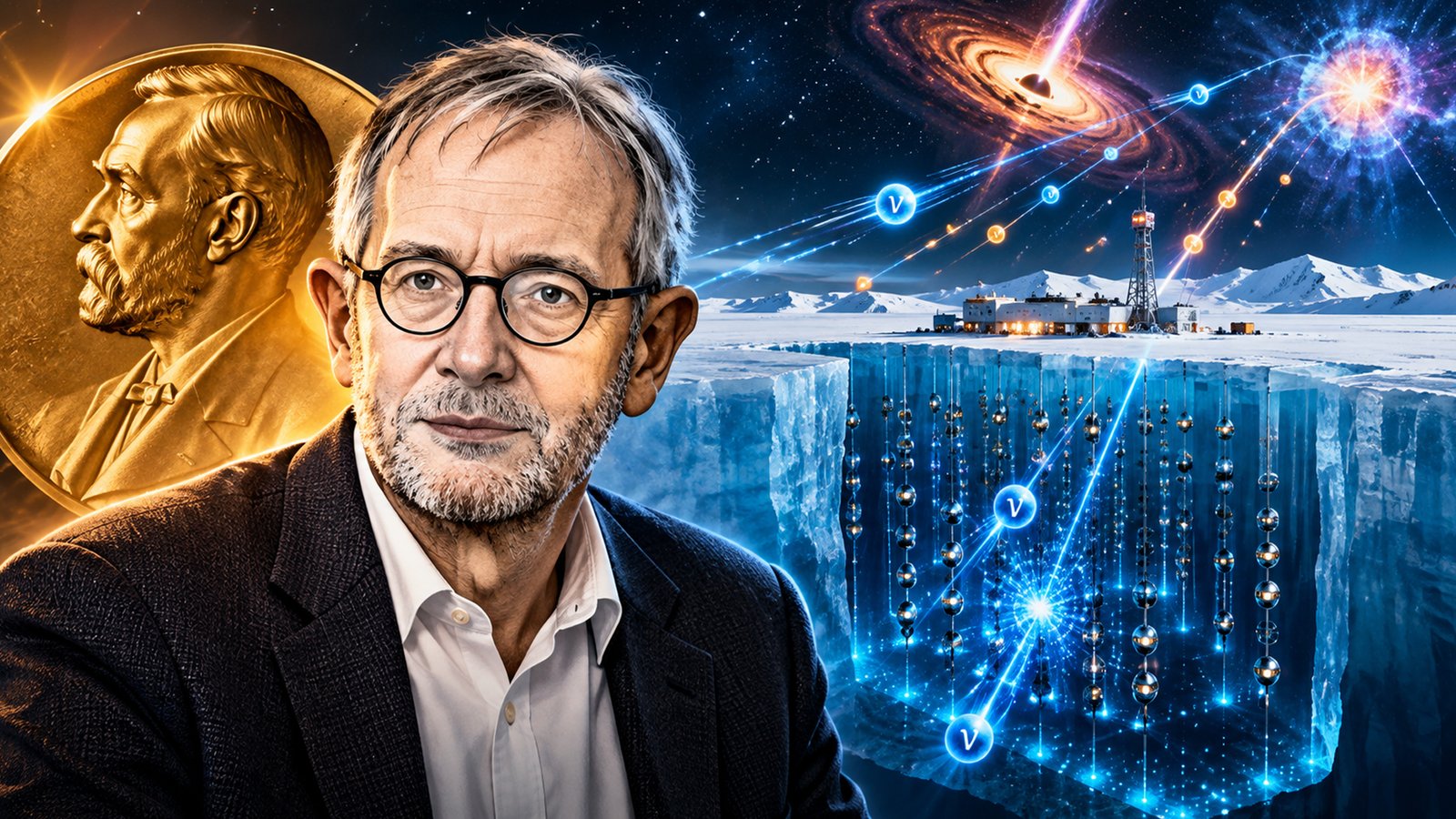
Belgian-American physicist Francis Halzen has won the 2026 Nobel Prize in Physics for his decisive contributions to the IceCube Neutrino Observatory and the discovery of high-energy neutrinos originating from violent events in the universe.
The Royal Swedish Academy of Sciences announced the award on October 6, recognising decades of work that transformed a seemingly ordinary material — Antarctic ice — into one of the world’s most remarkable instruments for studying deep space.
Halzen, a professor at the University of Wisconsin-Madison, pioneered the idea of using the vast, clear ice beneath the South Pole to detect neutrinos, tiny subatomic particles that are among the most elusive objects known to physics.
Neutrinos carry no electric charge and interact extraordinarily weakly with matter. Billions pass through the human body every second without being noticed. Most travel through the Earth almost as if it were not there, making them exceptionally difficult to detect.
That difficulty was precisely what made Halzen’s idea so important.
Instead of trying to build a conventional telescope, Halzen proposed turning the ice itself into a giant detector. When a high-energy neutrino happens to collide with an atomic nucleus in the ice, the interaction can produce a faint flash of blue light. Thousands of sensitive optical sensors buried deep beneath the Antarctic surface can detect that flash and help scientists determine where the particle came from.
The result is the IceCube Neutrino Observatory, an enormous scientific installation embedded in roughly a cubic kilometre of Antarctic ice. Its scale is necessary because high-energy cosmic neutrinos are extremely rare.
The South Pole proved to be an unusually suitable location. The deep glacial ice is remarkably clear, while the remote environment creates conditions with relatively little background interference. The region is also geologically stable, helping scientists operate a detector of extraordinary size beneath the surface.
IceCube eventually delivered the breakthrough Halzen and his colleagues had been seeking. In 2013, researchers announced the first clear detection of high-energy neutrinos coming from beyond our Solar System. The discovery opened a new way of studying the universe.
Traditional astronomy largely relies on electromagnetic radiation such as visible light, radio waves, X-rays and gamma rays. Gravitational-wave observatories later added another way of observing violent cosmic events.
Neutrinos offer a different kind of messenger.
Because they interact so weakly with matter, they can travel enormous distances without being absorbed or significantly deflected. They can therefore carry information from regions of space that conventional telescopes may struggle to observe.
Scientists believe high-energy astrophysical neutrinos can be produced in some of the most extreme environments in the cosmos, including powerful cosmic explosions and regions associated with black holes and other energetic objects. Their detection gives researchers clues about the engines that accelerate particles to extraordinary energies.
The discovery has helped establish neutrino astronomy as a growing field of astrophysics. Scientists can now combine neutrino observations with information from telescopes and gravitational-wave detectors to build a more complete picture of cosmic events.
That matters because some of the universe’s most energetic phenomena remain poorly understood. Knowing that a high-energy neutrino has arrived from a particular direction can help researchers identify the cosmic source responsible and investigate the physical processes taking place there.
Halzen’s achievement also reflects the unusual scale of modern scientific collaboration. IceCube was developed through an international network of researchers and engineers, with scientists from numerous countries contributing to the project.
The observatory continues to collect data, meaning the Nobel recognition is not simply a celebration of a completed experiment. It also highlights a research programme that remains active and is expected to produce more discoveries about cosmic particles and the extreme universe.
The significance of IceCube extends beyond neutrinos themselves. The project demonstrates how scientists can use an environment that initially appears hostile to research — the frozen landscape of Antarctica — as a powerful scientific tool.
The idea required patience, engineering and a willingness to pursue a particle that is famously difficult to catch. Halzen’s work showed that the right detector, placed in the right environment and built on a sufficiently large scale, could make the invisible visible.
The Nobel Prize in Physics will now bring wider attention to that achievement. Halzen will receive the award during the Nobel Prize ceremony in Stockholm in December, along with the other 2026 laureates.
The recognition also points towards the next chapter in neutrino research. Scientists are continuing to develop larger and more sensitive detectors, hoping to identify more sources of high-energy neutrinos and understand how the universe accelerates particles to extreme energies.
A discovery that began with the simple question of whether Antarctic ice could catch an almost undetectable particle has therefore changed how scientists look at the cosmos.
The 2026 Nobel Prize in Physics celebrates that change — and the remarkable idea that beneath the ice at the bottom of the world, scientists found a new way to listen to the universe.