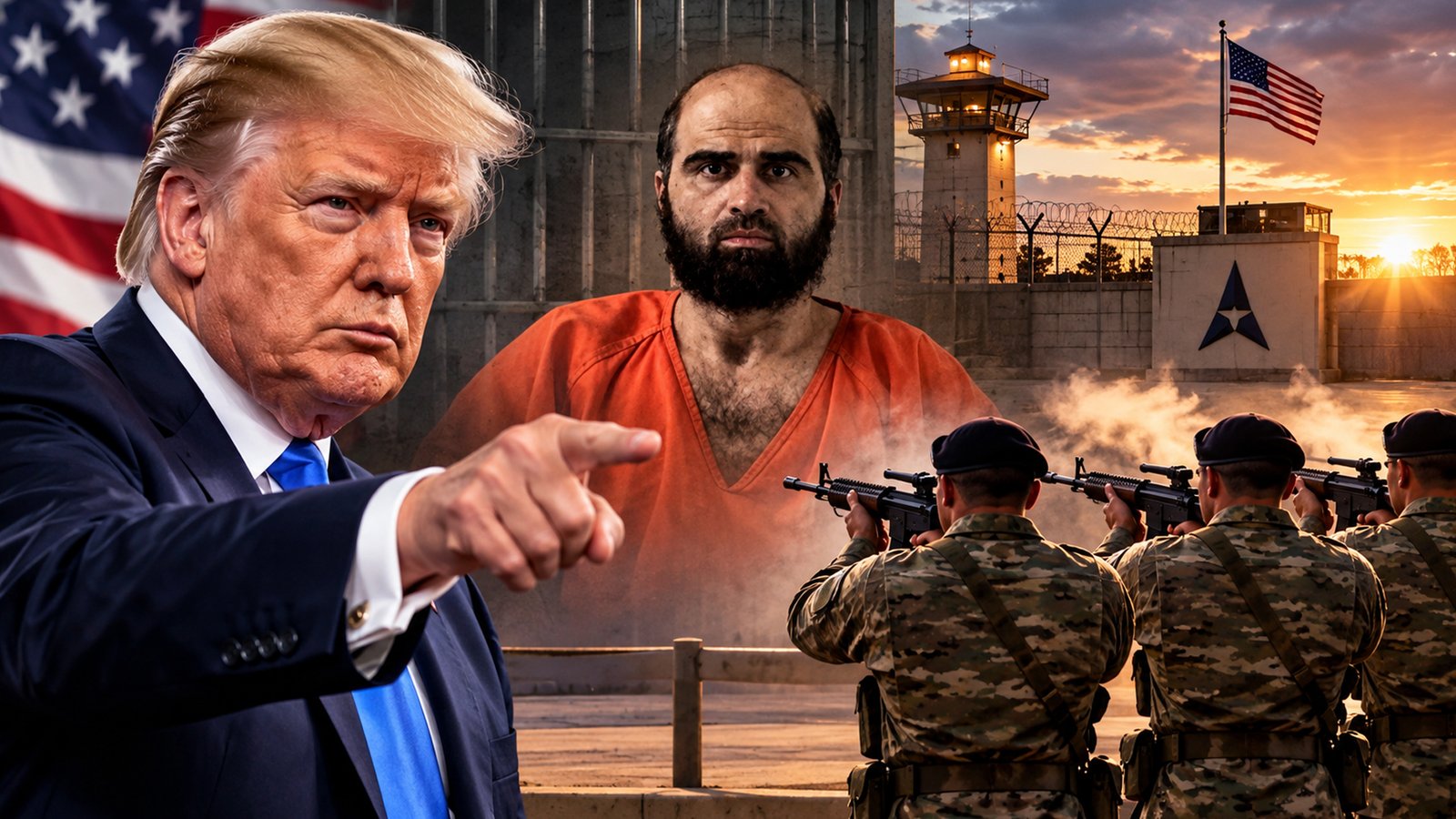
US President Donald Trump has approved the execution of former Army Major Nidal Malik Hasan by firing squad for the 2009 Fort Hood shooting that killed 13 people and wounded 32 others. The US Army has now scheduled the execution for December 3, 2026, at Fort Hood, Texas.
The decision brings one of the longest-running military death penalty cases in the United States closer to its final stage. If carried out as scheduled, Hasan’s execution would be the first US military execution since 1961 and the first military firing-squad execution since 1945.
Hasan was an Army psychiatrist when he opened fire inside a medical facility at Fort Hood on November 5, 2009. The attack targeted soldiers who were preparing for deployment to Iraq and Afghanistan. Thirteen people were killed and 32 were wounded.
The shooting became one of the deadliest attacks on a US military installation. Hasan was shot and partially paralysed by a civilian police officer who responded to the scene.
His court-martial took place several years later. In 2013, a military jury found Hasan guilty of 13 counts of premeditated murder and 32 counts of attempted premeditated murder. He was sentenced to death. The Army’s own records confirm that the death sentence was automatically subjected to military appeals.
Hasan largely represented himself during the trial and did little to challenge the prosecution’s case. He acknowledged that he was responsible for the shooting and argued that his actions were intended to prevent US troops from being deployed to Afghanistan and taking part in combat against Muslims.
Investigators and prosecutors also presented evidence about Hasan’s opposition to the wars in Iraq and Afghanistan and his contacts with Anwar al-Awlaki, the US-born radical cleric and al-Qaeda propagandist who was later killed in a US drone strike in Yemen.
The US government has treated the case as an act of terrorism, while the military court’s convictions focused on murder and attempted murder under military law.
Hasan’s death sentence went through years of appeals. The US Army Court of Criminal Appeals upheld the sentence in 2020, followed by the US Court of Appeals for the Armed Forces in 2023. The US Supreme Court rejected Hasan’s final petition in March 2025, leaving the military death sentence intact.
The next major step came in September 2025, when then-Defense Secretary Pete Hegseth sought presidential approval to carry out the sentence. Trump has now authorised the execution, with Hegseth recommending the firing-squad method.
The method itself makes the case particularly unusual. Military executions are extremely rare in the United States. The last person executed by the US military was Army Private John Bennett, who was hanged at Fort Leavenworth, Kansas, in April 1961.
The last known US military firing-squad execution took place in 1945, when a serviceman was executed by musketry. A firing squad has therefore not been used by the US military for more than eight decades.
Trump’s administration has also expanded the range of execution methods available in the federal system. Firing squads, electrocution and nitrogen or gas-based methods have gained renewed attention amid continuing difficulties surrounding lethal-injection drugs and procedures.
The use of a firing squad has consequently become part of a wider debate over the death penalty in the United States. Supporters argue that capital punishment provides accountability for the most serious crimes, while opponents question whether the state should carry out executions and have raised concerns about the methods used.
Hasan’s case is also unusual because the execution is taking place under the US military justice system rather than the ordinary civilian death penalty system. Military executions require presidential approval, making Trump’s decision an important step in the process.
The scheduled date does not necessarily guarantee that the execution will take place on December 3. Hasan may still pursue available legal remedies in federal court, including a habeas corpus petition, which could potentially delay the execution.
Four prisoners are currently held on the US military death row, according to Army legal materials. Hasan is one of them, alongside three other servicemen whose cases date back decades. The military has not carried out any of those death sentences since 1961.
The Fort Hood shooting remains a deeply painful chapter for the soldiers, families and survivors affected by the attack. More than 15 years after the shooting, the case is now approaching a point that once seemed distant: the possible execution of the person convicted of carrying it out.
The December 3 date will therefore be closely watched, not only because of Hasan’s case but also because it could mark the return of the US military death penalty after a gap of 65 years.