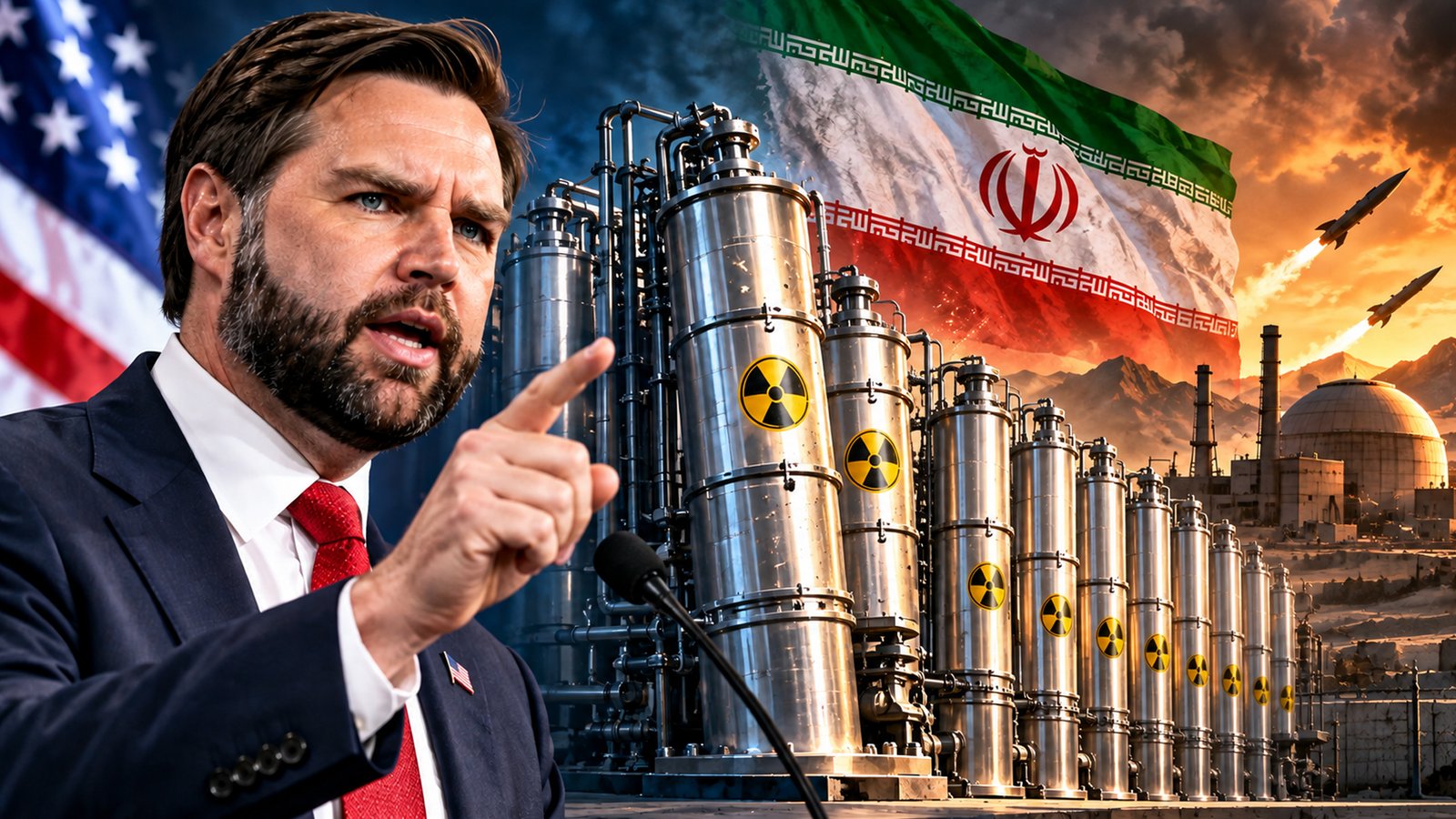
US Vice-President JD Vance has said Iran must significantly reduce its nuclear enrichment capabilities before the United States will agree to end the ongoing conflict, putting the country’s nuclear programme at the centre of any possible diplomatic settlement.
Vance said Washington was not interested in exchanging statements with Tehran and wanted concrete action. His comments came as efforts to bring the seven-month conflict to an end face a major obstacle over Iran’s uranium enrichment programme and the future of its nuclear capabilities.
The US position represents one of the toughest demands facing Iranian negotiators. Washington wants Tehran to roll back enrichment to levels it considers compatible with a civilian nuclear programme, while Iran has long maintained that it has the right to enrich uranium for peaceful purposes under international agreements.
Speaking about the negotiations, Vance said Iran would need to demonstrate a meaningful reduction in its enrichment capacity if it wanted the war to end. He stressed that the US was looking for actions rather than assurances.
The dispute centres partly on Iran’s stockpile of uranium enriched to 60% purity. Such material is well above the level normally required for civilian nuclear power generation, although it remains below the roughly 90% enrichment generally associated with weapons-grade uranium.
The difference in enrichment levels is technically important. Uranium used in conventional nuclear power plants is generally enriched to around 3% to 5%. Enrichment to 60% represents a major step closer to weapons-grade material, meaning the size of Iran’s stockpile and its ability to produce more highly enriched uranium have become central concerns for the US and its allies.
Washington argues that Iran’s enrichment capacity creates a potential pathway towards developing a nuclear weapon. Tehran, meanwhile, has consistently denied seeking nuclear weapons and says its programme is intended for civilian purposes, including energy and medical research.
The disagreement has become more complicated following months of military confrontation. The conflict has increased pressure on both sides to find a diplomatic route while making the nuclear issue harder to separate from broader security concerns.
The US administration’s latest position suggests that a ceasefire alone may not be enough. Washington appears to be seeking a wider agreement that addresses Iran’s nuclear infrastructure and limits its ability to rapidly increase uranium enrichment.
Vance’s comments also underline the gap between the two sides. Iran has resisted demands that would permanently surrender its enrichment capabilities, viewing such conditions as an infringement on its sovereignty and its rights under the nuclear non-proliferation framework.
The United States, however, has increasingly focused on Iran’s ability to enrich uranium at high levels. The concern is not simply how much enriched uranium Iran currently possesses but how quickly it could produce additional material if restrictions were removed.
That distinction could become a major issue in future negotiations. Any agreement would likely need mechanisms to verify Iran’s enrichment levels, stockpiles, centrifuge operations and nuclear facilities.
International inspectors could play a critical role in such a process. Verification would be necessary if Washington were to accept limits on Iran’s nuclear programme and gradually reduce economic or other restrictions.
The issue also has implications beyond the United States and Iran. A prolonged conflict could affect oil supplies, shipping routes and energy prices across global markets. Iran’s position near the Strait of Hormuz gives developments in the country particular importance for international energy security.
Any progress towards a ceasefire could therefore ease pressure on global markets, while renewed fighting could create fresh uncertainty for oil producers, consumers and businesses.
The diplomatic challenge is further complicated by the broader regional security picture. Iran’s relationships with armed groups and regional rivals remain a concern for the United States and its allies, while Tehran has argued that its security environment requires maintaining strategic capabilities.
The nuclear negotiations are consequently taking place against a much wider backdrop of regional tensions.
Vance’s remarks indicate that Washington does not want a temporary pause in fighting to become an opportunity for Iran to rebuild or expand its nuclear infrastructure. The US wants any settlement to address the underlying nuclear concerns at the same time.
Tehran’s response will be closely watched. Accepting major enrichment cuts could open the door to a ceasefire and potentially broader diplomatic engagement, but it could also face strong resistance inside Iran.
A workable agreement would need to balance nuclear restrictions, verification, security guarantees and the lifting or easing of measures imposed on Iran. Reaching that balance will be difficult after months of military confrontation.
The immediate focus, however, remains uranium enrichment. The US has made clear that it wants Iran to reduce its nuclear capacity before the conflict can be brought to a lasting close.
The next stage of diplomacy will determine whether that demand becomes the basis for a negotiated settlement or another point of deadlock.
Vance’s message leaves little ambiguity: Washington is looking for measurable changes in Iran’s nuclear programme, not simply promises. Whether Tehran is prepared to make those concessions could determine the prospects for ending the war and opening a new chapter in US-Iran relations.