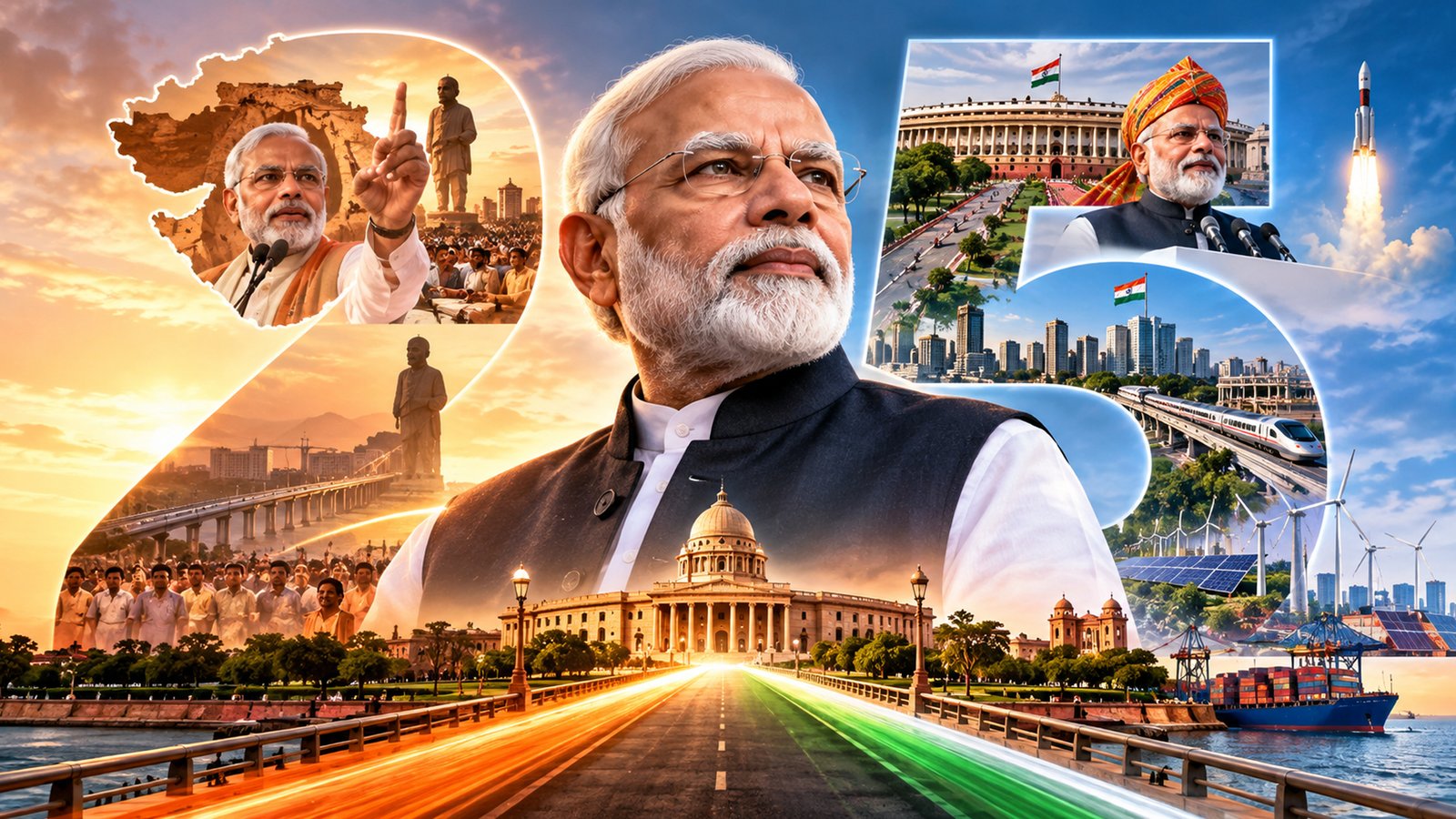
Prime Minister Narendra Modi completed 25 years today, at the helm of a government, marking a political journey that began on October 7, 2001, when he became Gujarat Chief Minister. The milestone was marked across the country with rallies, prayer ceremonies, torch processions and public programmes organised by the Bharatiya Janata Party (BJP).
At the heart of the celebrations was a theme that has remained closely associated with PM Modi’s public life — “seva”, or service. The BJP presented the occasion as a celebration of 25 years of public service and leadership, while PM Modi used the moment to reflect on the responsibilities that came with the trust of the people.
One of the most visible events was the Seva Sankalp Abhiyan, which connected Vadnagar in Gujarat, PM Modi’s birthplace, with Varanasi, his Lok Sabha constituency. A Seva Sankalp bike rally that travelled towards Varanasi culminated in the city on Wednesday, adding a strong personal dimension to the celebrations.
The journey from Vadnagar to Varanasi also carried political symbolism. Vadnagar represents the beginning of PM Modi’s life story, while Varanasi has been central to his national political career since he first contested the Lok Sabha election from the constituency in 2014.
The celebrations were not limited to Uttar Pradesh or Gujarat. BJP units across the country organised programmes, including cleanliness drives, tree plantation campaigns, blood donation initiatives, prayer ceremonies and torchlight processions. Union ministers, chief ministers, party leaders and workers joined events marking the occasion.
PM Modi, meanwhile, looked back at the journey in more personal terms. Speaking at the Viksit Bharat Sankalp Sabha in Delhi, he said his 25 years in public life had been made possible by the trust of citizens and the support of BJP workers.
He said he had tried to live by a mission rather than personal ambition. PM Modi also spoke about the lessons that came with both success and setbacks, saying difficult moments taught him how to begin again while achievements reminded him to remain humble.
His remarks also acknowledged the role played by critics and political opponents. PM Modi said their criticism had helped him understand democracy and encouraged him to examine his own approach. The comments offered a more reflective side to an anniversary otherwise dominated by political celebrations.
The day began with a quieter engagement. PM Modi visited the Shri Vinayaka Mandir in Sarojini Nagar, Delhi, where he offered prayers and sought the well-being and prosperity of citizens. The temple visit added a personal touch to a day centred largely on his public career.
The Union Cabinet had also marked the occasion a day earlier by passing a resolution recognising PM Modi’s 25 years of continuous leadership. The resolution highlighted initiatives associated with his tenure in Gujarat and at the Centre, including welfare programmes, infrastructure expansion, digital governance, manufacturing, defence, space and India’s global diplomatic outreach.
Supporters of PM Modi point to major changes in infrastructure, digital payments, welfare delivery, renewable energy, manufacturing and public services during his years in office. His governments have also placed strong emphasis on initiatives linked to self-reliance, semiconductor production, defence manufacturing and technology.
The 25-year milestone, however, has also renewed political debate over PM Modi’s record. While the BJP and government supporters highlight development, welfare delivery and India’s growing global engagement, critics have raised concerns about employment, inequality, social tensions and institutional issues. These competing assessments remain part of the wider political discussion surrounding his long tenure.
PM Modi’s political journey has also changed in scale over the past quarter-century. His tenure as Gujarat Chief Minister lasted more than 12 years before he moved to national politics in 2014. He has since led the BJP to three consecutive Lok Sabha victories and remained at the centre of Indian politics for more than a decade as Prime Minister.
Yet the message from PM Modi on the 25th anniversary was focused less on the past than on the road ahead. He renewed his commitment to the goal of a Viksit Bharat by 2047 and framed the next phase as another responsibility arising from public trust.
The celebrations therefore marked more than a political anniversary. They brought together different chapters of PM Modi’s public life — from Vadnagar and Gujarat to Varanasi and New Delhi — while placing the emphasis on what he described as the continuing duty to serve.
After 25 years at the head of a government, PM Modi presented the milestone not as an endpoint but as another beginning, with the larger goal of shaping India’s journey towards 2047 still ahead.