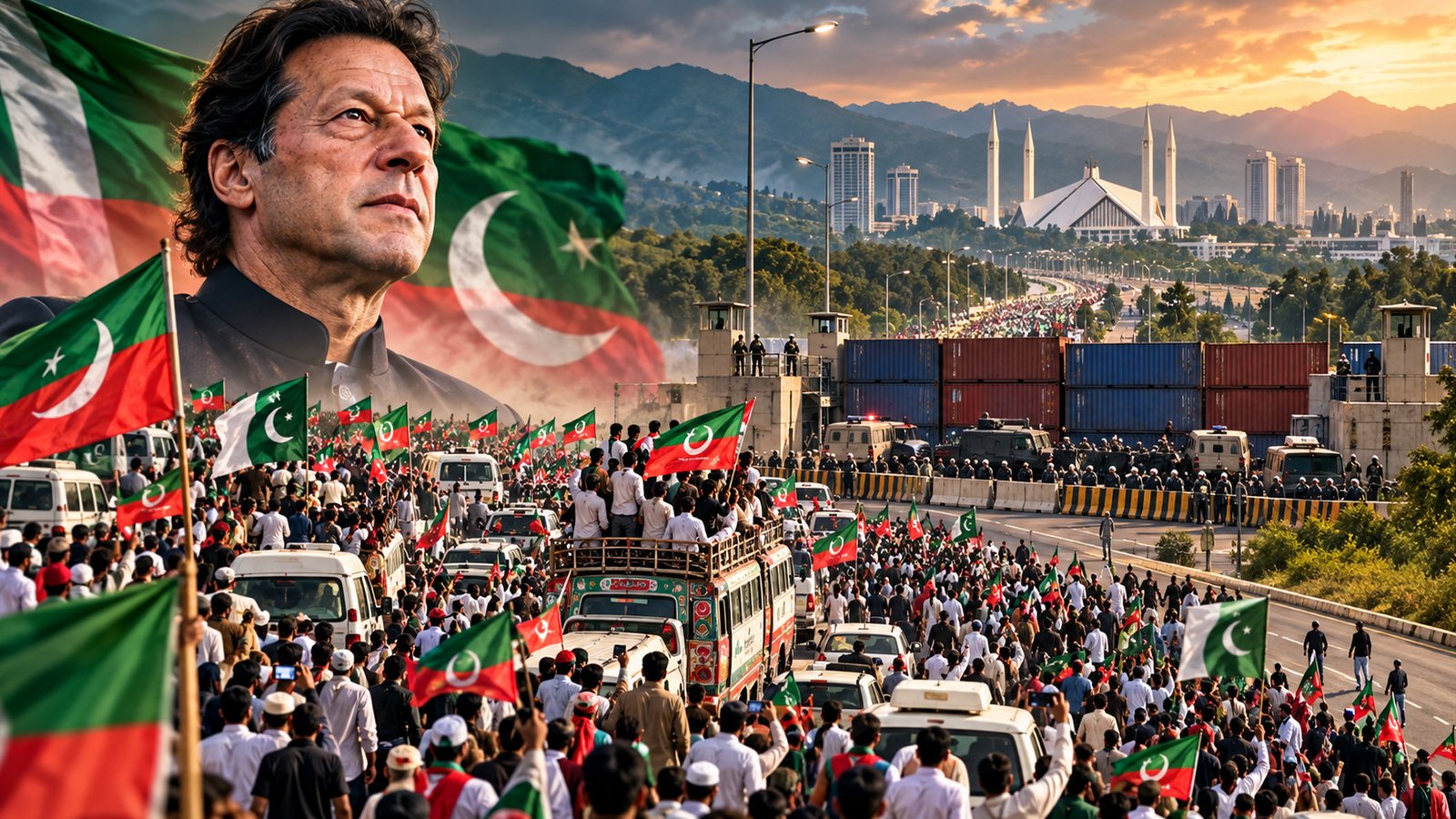
Thousands of supporters of jailed former Pakistan prime minister Imran Khan have begun marching towards Islamabad, setting up a fresh confrontation between his Pakistan Tehreek-e-Insaf (PTI) party and the government of Prime Minister Shehbaz Sharif.
The march began in Khyber Pakhtunkhwa, a stronghold of PTI, after two rounds of talks between the government and the opposition party failed to produce an agreement. PTI supporters are demanding Khan’s release and greater access to him in prison, while authorities have vowed to prevent the protesters from entering the capital.
The procession started on Sunday and is being led by Khyber Pakhtunkhwa Chief Minister Sohail Afridi. Thousands of people had joined the march by Monday, with PTI leaders expecting the crowd to grow as it moves towards Peshawar and eventually towards Islamabad.
The protest had initially been planned earlier but was delayed to give negotiations a chance. Talks focused on several issues, including access to Khan, his health and the treatment of PTI workers detained ahead of the planned demonstration.
The discussions broke down after Khan’s allies insisted that the jailed former prime minister should be involved in the political negotiations. The government rejected that demand, leaving both sides without a compromise and paving the way for the march.
Islamabad has meanwhile been placed under heavy security. Authorities have barricaded major routes leading into the capital using shipping containers and sandbags, while police and paramilitary forces have been deployed across Islamabad and parts of Khyber Pakhtunkhwa.
The government has declared the protest illegal and warned that the marchers will not be allowed to cross into Islamabad. The security measures have raised concerns about possible clashes if PTI supporters attempt to break through the barricades.
The latest confrontation also comes amid growing concern over Khan’s health. The 74-year-old former cricket captain has been in prison since 2023. His family and party colleagues say he is being held in isolation and have raised concerns about access to medical care, particularly because of an eye condition and high blood pressure.
Khan’s supporters have repeatedly demanded that his relatives and doctors be allowed to meet him. The issue has become a central part of the PTI’s campaign, adding a personal dimension to the political dispute between the former prime minister and the government.
Khan remains one of Pakistan’s most influential political figures despite his imprisonment. He served as prime minister from 2018 to 2022 before losing a parliamentary vote of no confidence. His removal was followed by a prolonged political battle with the country’s political establishment and military.
His arrest in 2023 triggered widespread protests and a major crackdown on PTI. Many party leaders and supporters were arrested, while the authorities pursued several legal cases against Khan.
PTI has maintained that the cases against its founder are politically motivated. Khan has denied wrongdoing in the cases and continues to challenge his convictions and imprisonment through the courts.
The latest march also highlights the strength of PTI’s support in Khyber Pakhtunkhwa. The party controls the provincial government and has retained a significant political base in the region despite years of pressure on its leadership.
That has made the dispute particularly sensitive. Any confrontation between the provincial government and federal authorities could deepen the existing political tensions between Islamabad and Khyber Pakhtunkhwa.
The federal government, meanwhile, has defended its security preparations. Information Minister Attaullah Tarar accused PTI of using double standards and said the authorities would take steps to prevent the protesters from breaching the capital’s security arrangements.
Tens of thousands of police and paramilitary personnel have reportedly been positioned in and around the areas likely to be affected by the protest. The heavy deployment reflects the government’s determination to avoid a repeat of earlier PTI demonstrations that ended in violent clashes.
PTI leaders, however, have continued to urge supporters to join the march. Afridi has called on people, particularly young supporters, to come out in support of Khan, presenting the demonstration as a campaign to secure the former prime minister’s freedom.
The march is expected to pass through major areas of Khyber Pakhtunkhwa before moving closer to Punjab and Islamabad. Its size and the response of security forces will determine whether the standoff remains political or develops into another confrontation.
The government faces pressure to maintain control of the capital without triggering further unrest, while PTI is seeking to demonstrate that Khan’s imprisonment has not weakened its support on the ground.
The political crisis also comes as Pakistan faces economic difficulties and continuing security concerns, giving the latest protest wider significance. Khan remains a powerful opposition figure, and his imprisonment has failed to remove him from the centre of the country’s political debate.
The immediate focus is now on whether the government and PTI can reopen dialogue before the march reaches Islamabad. If negotiations remain stalled, the approaching convoy could test the government’s security restrictions and PTI’s ability to sustain a large mobilisation.
With Islamabad under lockdown and Imran Khan’s supporters moving towards the capital, Pakistan once again finds itself facing a tense political standoff. The outcome could shape the relationship between the government, PTI and Khan’s supporters in the weeks ahead.