India has taken two significant steps towards strengthening its indigenous defence manufacturing capabilities, with Defence Minister Rajnath Singh launching the country’s first indigenously designed and built Fleet Support Ship, Surya, in Visakhapatnam and announcing a second production line for Shakti helicopter engines at Hindustan Aeronautics Limited’s Koraput facility in Odisha.
The developments highlight India’s growing focus on reducing dependence on imported defence equipment while building the industrial capacity needed to design, manufacture and maintain complex military platforms within the country.
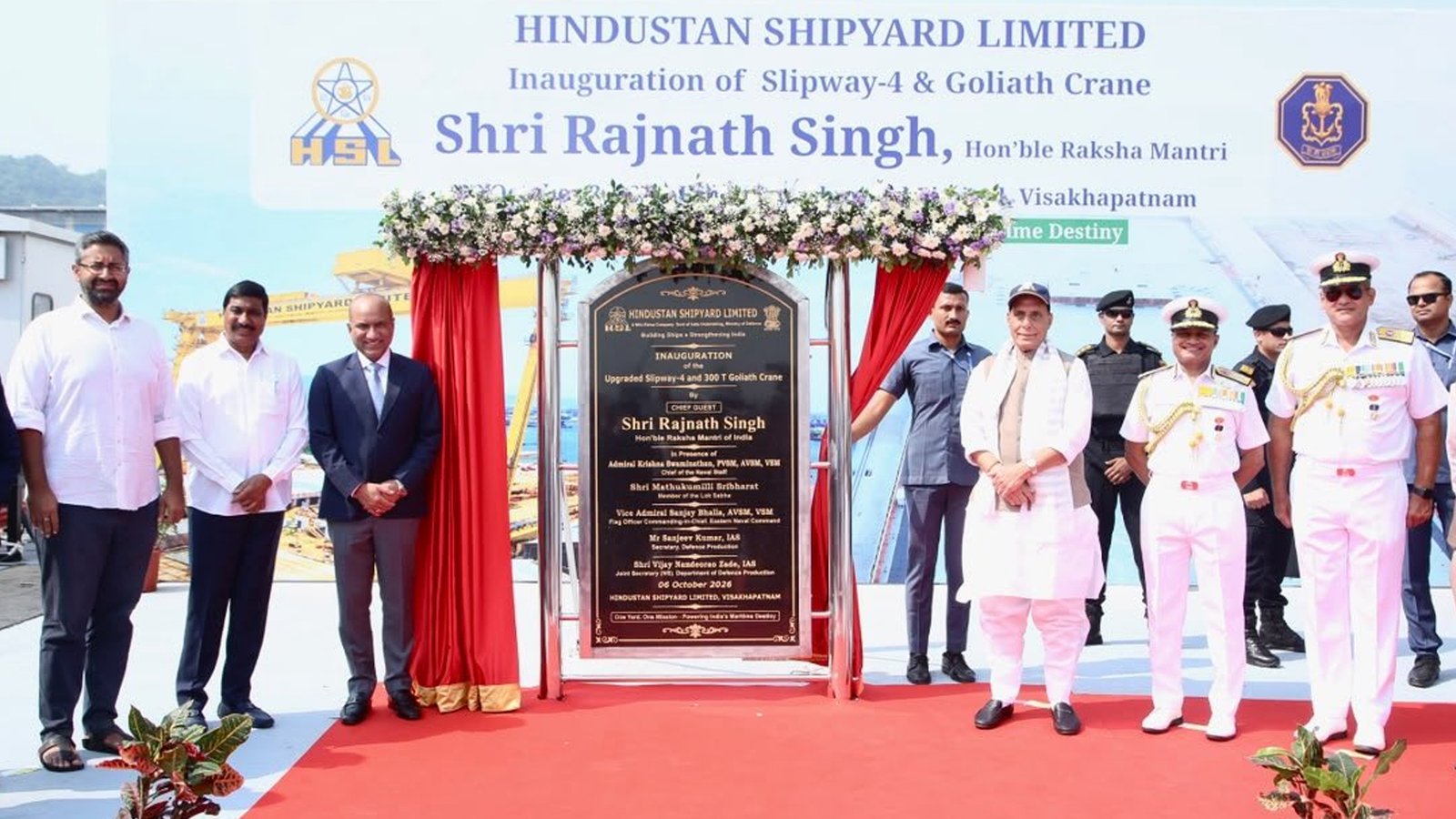
Surya, also designated Fleet Support Ship-1 or FSS-1, was launched at Hindustan Shipyard Limited (HSL) in Visakhapatnam on October 6. Singh also laid the keel of the fifth Fleet Support Ship, FSS-5, and inaugurated an upgraded Slipway-4 and a 300-tonne Goliath crane at the shipyard.
The Fleet Support Ships are designed to function as floating logistics hubs for the Indian Navy. Their primary role will be to replenish frontline warships at sea with essential supplies, allowing naval vessels and carrier battle groups to remain deployed for longer periods without returning to port.
The ships will carry fuel, fresh water, ammunition and other provisions and will have onboard maintenance facilities. They will also feature a helicopter deck and self-defence systems, giving them an important supporting role during extended naval operations.
Surya has more than 82% indigenous content, according to the Defence Ministry. The project brings together HSL, the Indian Navy, domestic defence companies and micro, small and medium enterprises, making it an important example of the Make in India approach in naval shipbuilding.
The importance of the vessel goes beyond its size or equipment. Modern naval power depends not only on frontline destroyers, frigates, submarines and aircraft carriers, but also on the logistics network that keeps them operating far from their home ports.
Fleet support ships provide that missing link. By enabling at-sea replenishment, they can increase the Indian Navy’s operational reach, endurance and mobility across the Indian Ocean Region.
The vessels can also be used for humanitarian assistance and disaster relief operations and for evacuating civilians from crisis zones. That gives the platform a role beyond conventional military operations.
The launch also showcased the effort to expand India’s shipbuilding infrastructure. The upgraded Slipway-4 at HSL has been strengthened to handle vessels of up to 45,000 deadweight tonnes. The new 300-tonne Goliath crane is expected to improve the shipyard’s ability to handle large blocks and build more complex vessels.
Singh called for HSL to move beyond self-reliance and become globally competitive in shipbuilding, with greater emphasis on quality, cost, technology and timely delivery. He also backed the development of Visakhapatnam as a major maritime industrial hub, supported by the Eastern Naval Command, Naval Dockyard, HSL and Visakhapatnam Port.
The second major development came in Koraput, where Singh witnessed the delivery of HAL’s 2,000th aero-engine and announced a new production line for Shakti helicopter engines.
The new facility involves an investment of ₹218 crore and is expected to become fully operational by 2028-29. It will have the capacity to produce up to 100 Shakti engines annually.
The Shakti engine powers several Indian helicopters, including the Advanced Light Helicopter Dhruv and the Light Combat Helicopter Prachand. A stronger production capability will help meet the growing requirements of India’s indigenous helicopter fleet and reduce pressure on existing manufacturing capacity.
The milestone at Koraput also reflects the facility’s long contribution to India’s military aviation sector. HAL’s Koraput division has produced engines for several generations of Indian Air Force aircraft and has also built extensive expertise in engine overhaul and maintenance.
HAL has now delivered 2,000 aero-engines from the facility, while more than 9,000 engines have been overhauled there. The plant is also increasing production capacity for AL-31FP engines used in the Su-30MKI fighter fleet from 30 to 50 engines annually, supported by a ₹335 crore investment.
The two developments underline a larger challenge facing India’s defence industry. Building ships, aircraft and helicopters domestically is only one part of achieving defence self-reliance. India also needs domestic capabilities in propulsion, maintenance, testing, components, supply chains and advanced engineering.
Aero-engine technology remains one of the most difficult areas of defence manufacturing, making the expansion of the Shakti engine programme strategically important. The government is also pursuing a high-thrust indigenous engine programme with an investment of around ₹5,000 crore.
The naval and aerospace milestones therefore represent two sides of the same ambition. At sea, India is building the logistics platforms required to sustain a blue-water navy. In the air, it is expanding the industrial base needed to keep indigenous helicopters and combat aircraft operational.
Both developments also create opportunities for Indian private companies, MSMEs, technology firms and research institutions to become part of a larger defence manufacturing ecosystem.
The focus is now shifting from simply producing more equipment to building a complete domestic capability — from design and engineering to production, maintenance and lifecycle support.
Surya and the new Shakti production line are significant steps in that direction, reinforcing India’s push for Aatmanirbhar Bharat while strengthening the country’s maritime security and aerospace readiness.