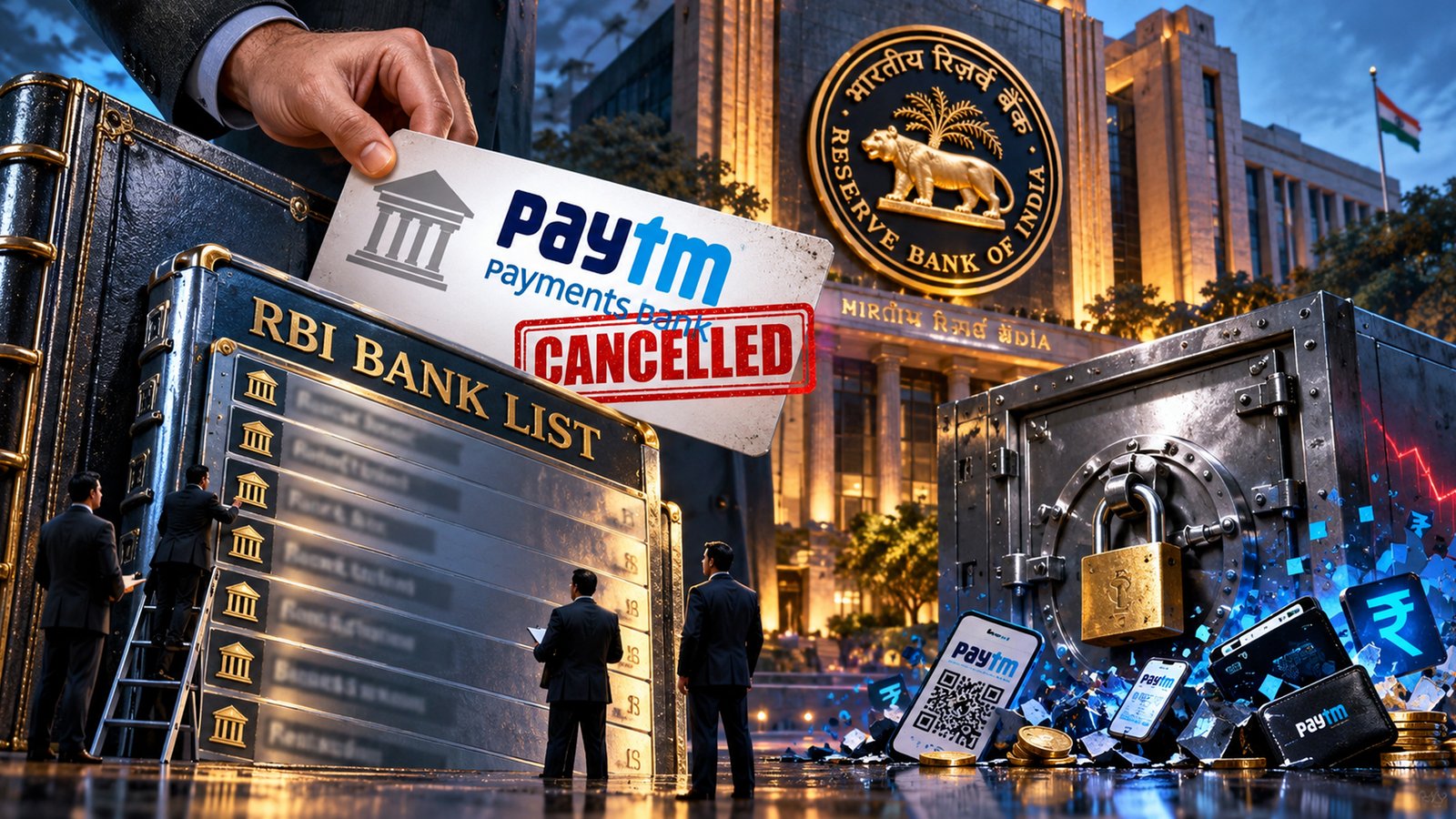
The Reserve Bank of India (RBI) has formally removed Paytm Payments Bank Limited (PPBL) from the list of recognised scheduled banks, marking another significant step in the winding-up of the troubled payments bank.
The central bank said on October 7 that PPBL has been excluded from the Second Schedule to the Reserve Bank of India Act, 1934. The move follows the cancellation of the bank’s licence earlier this year and comes after several years of regulatory action against the lender.
The exclusion itself is largely a formal regulatory step, but it closes another chapter in Paytm Payments Bank’s banking operations. A bank included in the Second Schedule is classified as a scheduled bank and comes under the regulatory framework applicable to such institutions.
Licence cancellation
The RBI cancelled PPBL’s banking licence on April 24, 2026, citing multiple regulatory and governance concerns. The central bank said the affairs of the bank had been conducted in a manner detrimental to the interests of the bank and its depositors.
The RBI also said the general character of the bank’s management was prejudicial to depositors and the public interest. It concluded that allowing the bank to continue would serve no useful purpose in the public interest and noted that PPBL had failed to comply with conditions attached to its payments bank licence.
The licence cancellation meant PPBL could no longer conduct banking business. The RBI also said the bank had sufficient liquidity to repay its entire deposit liability during the winding-up process.
The Delhi High Court subsequently ordered the winding up of Paytm Payments Bank, taking the institution further towards a formal closure.
Years of regulatory pressure
The latest RBI action is the culmination of a regulatory process that began several years ago.
In March 2022, the central bank barred Paytm Payments Bank from onboarding new customers after identifying what it described as material supervisory concerns. It also directed the bank to appoint an IT audit firm to undertake a comprehensive audit of its information technology systems.
The situation escalated in January 2024, when the RBI imposed additional business restrictions on PPBL. The bank was subsequently barred from accepting further deposits, credits or top-ups in customer accounts, prepaid instruments and wallets.
These restrictions significantly changed the way Paytm’s payments ecosystem operated. The company began moving its payments infrastructure away from Paytm Payments Bank and towards partnerships with other banks.
Paytm’s payments business continues
The removal of PPBL from the scheduled banks list does not mean the Paytm app or its wider payments business has shut down.
Paytm is operated by One97 Communications, which has shifted to a multi-bank model for several of its payment services. The company received approval to operate as a third-party application provider (TPAP) on the Unified Payments Interface (UPI), with other banks supporting its UPI transactions.
State Bank of India, HDFC Bank, Axis Bank and YES Bank have been involved as payment service provider banks for Paytm’s UPI operations. This transition allowed Paytm to continue offering UPI payments even after restrictions were imposed on PPBL.
That distinction is important for customers. The regulatory action is specifically against Paytm Payments Bank and does not amount to a ban on Paytm’s broader fintech operations.
Paytm continues to offer services including UPI payments, QR-based payments and other merchant-focused products through its banking partnerships. Its payments business is therefore structurally different from the operations of PPBL.
Impact on Paytm
The RBI’s latest decision nevertheless underlines how dramatically Paytm’s business model has changed since the payments bank became a central part of its ecosystem.
The company has already separated much of its payments activity from PPBL and written down its investment in the bank. The focus has increasingly shifted towards Paytm’s core fintech businesses, including UPI, merchant payments and financial services.
Investors, however, remain sensitive to regulatory developments involving the company. Paytm parent One97 Communications saw its shares fall sharply in early trading on October 8 after the latest RBI action became public, with the stock falling as much as 10% to ₹1,560.60 on the BSE, according to market reports.
The latest development is therefore more than a change in the RBI’s banking list. It represents another milestone in the long-running dismantling of Paytm Payments Bank as a banking institution.
For Paytm, the challenge now is to ensure that customers and merchants see little disruption while the company builds its future around a bank-independent payments model.
The RBI’s action also reinforces the importance of regulatory compliance, governance and technology controls in India’s rapidly expanding fintech sector. Paytm’s journey from a payments bank to a multi-bank fintech platform illustrates how regulatory intervention can fundamentally reshape even some of the country’s most widely used digital payment businesses.