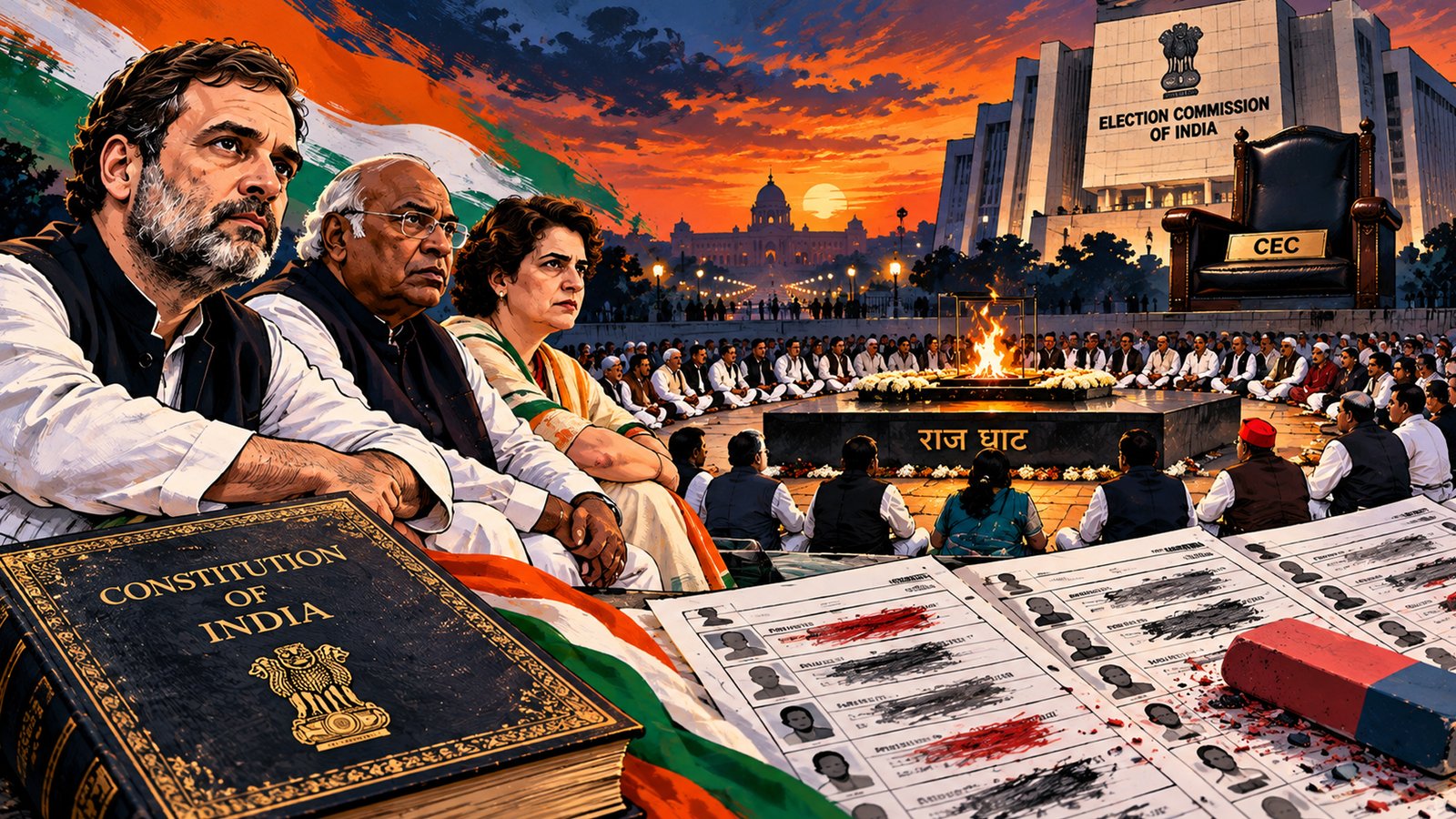
The INDIA bloc’s protest against Chief Election Commissioner (CEC) Gyanesh Kumar entered its third day on Thursday, October 8, as opposition MPs gathered at Raj Ghat for a silent demonstration after two days of confrontations with Delhi Police. The agitation, centred on allegations of electoral irregularities and the Special Intensive Revision (SIR) of voter lists, has also triggered a separate debate over the handling of Congress leader Rahul Gandhi’s security during his detention.
Rahul Gandhi, Leader of Opposition in the Lok Sabha, Congress president Mallikarjun Kharge, Priyanka Gandhi Vadra and several other opposition leaders paid tribute to Mahatma Gandhi at his memorial and observed a period of silence. The shift to a peaceful demonstration followed police action against opposition MPs during their attempts to march towards the Election Commission of India (ECI) headquarters and protest at designated locations.
The opposition has demanded Kumar’s resignation, alleging that the voter roll revision process threatens voting rights and undermines the fairness of elections. The BJP and the Election Commission have rejected accusations of political bias, maintaining that electoral roll revisions are intended to improve accuracy and remove duplicate or ineligible entries.
The protest took a different turn on Thursday after police permitted opposition MPs to gather at Raj Ghat. The INDIA bloc had faced restrictions during its previous attempts to demonstrate, prompting criticism from opposition leaders over the handling of their protests.
The MPs assembled in central Delhi before travelling to the memorial, where they staged a silent protest. Congress leaders described the gathering as a symbolic appeal to Prime Minister Narendra Modi and Union Home Minister Amit Shah to address concerns about electoral transparency. The protest also sought to draw attention to what the opposition calls “vote chori”, or the alleged manipulation of electoral rolls.
The demonstration brought together leaders from several INDIA bloc parties, including the Congress, Trinamool Congress, Rashtriya Janata Dal and Left parties. Priyanka Gandhi Vadra and leaders from other opposition-ruled states also participated. The opposition maintained that the peaceful format did not mean it would withdraw its demand for accountability.
The protests have also exposed reported coordination difficulties between Delhi Police and the Central Reserve Police Force (CRPF) over Rahul Gandhi’s security arrangements. Gandhi is protected under the Z-plus security category, with CRPF personnel responsible for his close protection.
Reports indicated that the repeated detention of the Congress leader during the demonstrations created challenges for the two forces, particularly when he was being moved from protest sites in police vehicles. The episode raised questions about how law enforcement authorities can enforce restrictions and detain a political leader while ensuring that the security personnel assigned to protect him continue to perform their duties.
CRPF commandos form part of Gandhi’s security detail during public appearances, political events and movements outside his residence. The reported friction has brought attention to the practical difficulties of managing protests involving senior political leaders who receive high-level security protection. The security issue has added another dimension to the confrontation, although the opposition’s main demand remains focused on the Election Commission.
At the heart of the INDIA bloc’s agitation is the Special Intensive Revision of electoral rolls. The exercise is intended to verify voter details and update electoral lists, but opposition parties have raised concerns about the possible deletion of eligible voters and the transparency of the process.
Rahul Gandhi and other opposition leaders have questioned the Election Commission’s impartiality and demanded Kumar’s resignation. The BJP has dismissed the allegations, arguing that the opposition is politicising an administrative exercise. The Election Commission has maintained that the revision aims to ensure accurate voter lists and is not intended to favour any political party.
The disagreement has developed into a wider political dispute over electoral transparency, institutional independence and citizens’ voting rights. For the opposition, the issue goes beyond administrative changes to voter lists and concerns public confidence in the electoral process.
The INDIA bloc was also considering its next steps, including seeking an appointment with President Droupadi Murmu to present its concerns over the revision exercise and the conduct of the Election Commission. Opposition leaders have indicated that they intend to continue their campaign and maintain pressure on the government.
The coming days will test whether the INDIA bloc can sustain its agitation and secure a formal response to its demands. The government and the Election Commission, meanwhile, face continued scrutiny over the voter revision process and the handling of opposition demonstrations.
The confrontation has now expanded beyond the immediate question of protest permissions. It has become a broader political contest over voting rights, the credibility of electoral institutions and the space available for dissent in the national capital.