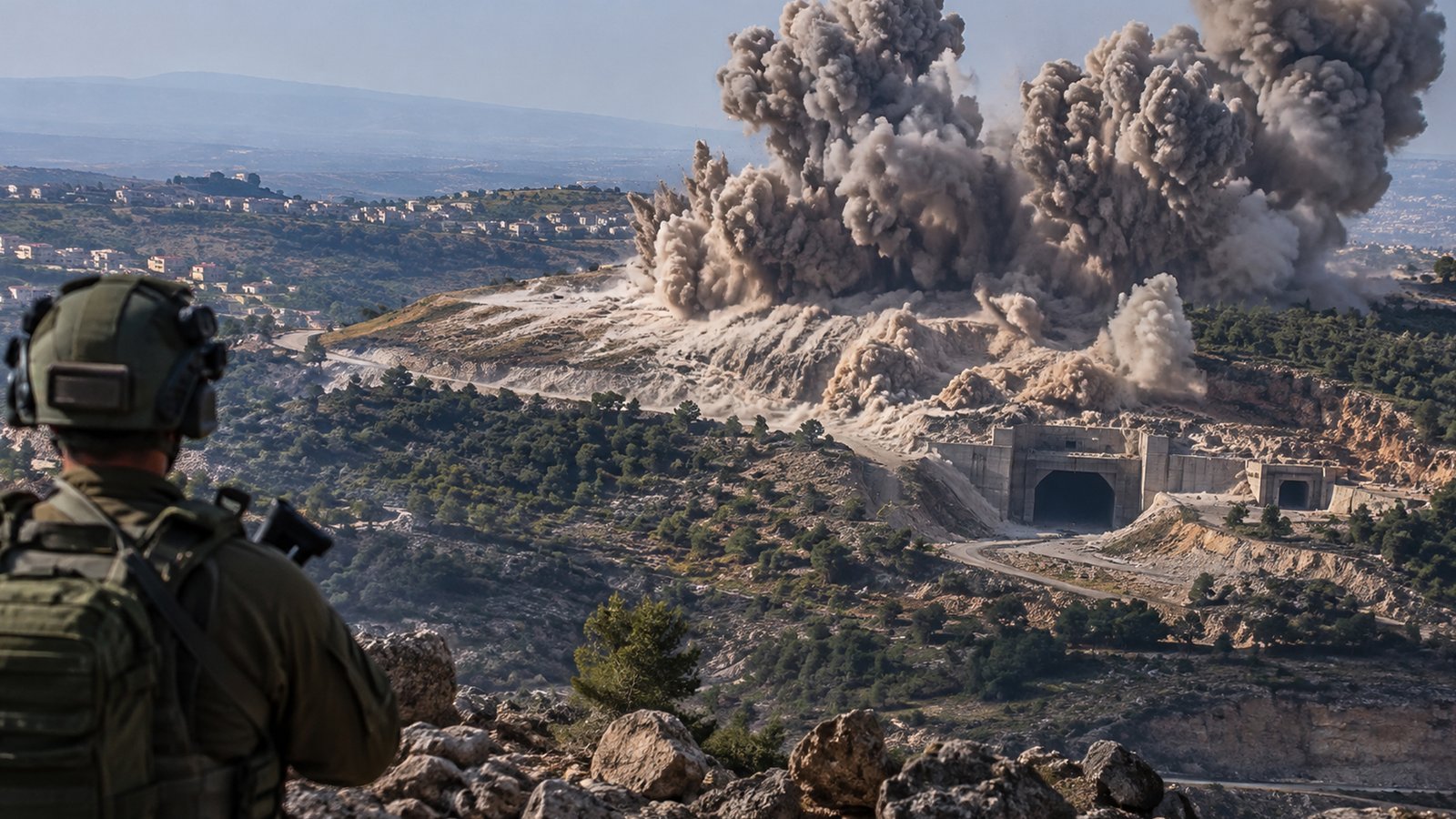
Israel has destroyed a major underground Hezbollah tunnel network in southern Lebanon, in an operation that caused a powerful explosion and triggered a magnitude 4.1 tremor in the region. The blast was felt across parts of southern Lebanon, adding a dramatic new dimension to the ongoing conflict between Israel and the Iran-backed militant group.
The Israeli military said the operation targeted underground infrastructure beneath the Ali al-Taher ridge, a strategic area about 15 km from the Israel-Lebanon border. Israel has been trying to take control of the ridge because of its importance in monitoring and attacking positions in southern Lebanon.
The tunnel network, according to Israel, stretched for more than 2 km underground. It included weapons storage areas, command centres and living quarters where Hezbollah fighters could stay for long periods. Israeli forces said they also found rockets, missiles, drones, anti-tank weapons, mines and explosives inside the network.
The destruction required a large-scale demolition. The United States Geological Survey recorded a magnitude 4.1 seismic event in the area shortly after the tunnels were blown up. Residents in nearby areas reported feeling the ground shake and hearing a large explosion.
The tremor was not considered a normal earthquake caused by movement beneath the Earth’s surface. Reports linked the seismic reading to the huge explosions used by Israeli forces to destroy the underground facilities.
The Ali al-Taher ridge has become one of the main areas of fighting in southern Lebanon. The location rises high above the surrounding region and provides a strategic view across large parts of southern Lebanon. Israel says Hezbollah used the position to support attacks against Israeli towns, including Metula and Kiryat Shmona.
Israel’s military said the underground complex belonged to Hezbollah’s Badr unit. The group is believed to have used the network as a base for storing weapons and organising military operations. Israeli officials said destroying the tunnels would make it harder for Hezbollah to rebuild its presence close to the Israeli border.
Prime Minister Benjamin Netanyahu and Defence Minister Israel Katz said the operation completed what they described as the consolidation of a security zone in the area. Israeli forces are expected to remain in the region to prevent Hezbollah from returning and rebuilding its military infrastructure.
The development comes despite a US-backed agreement aimed at reducing the fighting between Israel and Hezbollah. The agreement called for Israeli forces to gradually withdraw from parts of southern Lebanon and for the Lebanese army to take control of the area after Hezbollah’s weapons were removed.
However, the agreement has faced major difficulties. Hezbollah has rejected demands for complete disarmament, while Israel has said it will not fully withdraw until the group gives up its weapons. This has left the situation along the Israel-Lebanon border unsettled.
The latest operation is part of a wider Israeli campaign in southern Lebanon that began after Hezbollah attacks and a sharp escalation in regional fighting earlier this year. Israel has seized several strategic positions and established what it calls a buffer or security zone inside southern Lebanon.
Israel said its forces had achieved operational control of the Ali al-Taher ridge both above and below ground. Earlier operations had focused on locating and clearing Hezbollah’s underground positions, while the latest demolition was aimed at making the tunnel network unusable.
The scale of the underground system shows the importance Hezbollah has placed on tunnels as part of its military strategy. Such networks can allow fighters to move without being easily detected, store weapons and protect personnel from airstrikes. Israel has repeatedly targeted Hezbollah’s underground infrastructure because it considers the tunnels a direct threat to communities and military positions near its border.
The operation has also raised fresh concerns about the future of the ceasefire. Although the intensity of fighting has fallen compared with earlier months, Israeli airstrikes and military operations have continued in parts of Lebanon, while Hezbollah remains opposed to giving up its weapons.
The conflict has already caused widespread destruction and displacement in Lebanon. Thousands of people have been killed since the latest escalation, while more than one million people have been displaced, according to figures cited by international reports. Many residents of southern Lebanon have also been unable to return to their homes because of continuing military activity and damaged infrastructure.
Hezbollah has not immediately responded to Israel’s latest announcement about the destruction of the tunnel network. The group has previously disputed Israel’s claims about the importance of some positions in southern Lebanon.
The destruction of the Ali al-Taher tunnels is nevertheless a significant development in the Israel-Hezbollah conflict. It shows that even after efforts to reduce the fighting, both sides remain focused on military positions and security arrangements along the border.
The immediate impact was felt on the ground through the powerful explosions and the unusual tremor. The longer-term impact could be more important, however, as Israel seeks to maintain control of strategic areas while Lebanon and international mediators try to revive an agreement that could eventually restore stability to southern Lebanon.
With the dispute over Hezbollah’s weapons and Israel’s military presence still unresolved, the region remains vulnerable to another escalation. The destruction of the tunnel network may weaken Hezbollah’s military infrastructure in one important area, but it has not resolved the larger political and security issues keeping Israel and Hezbollah apart.