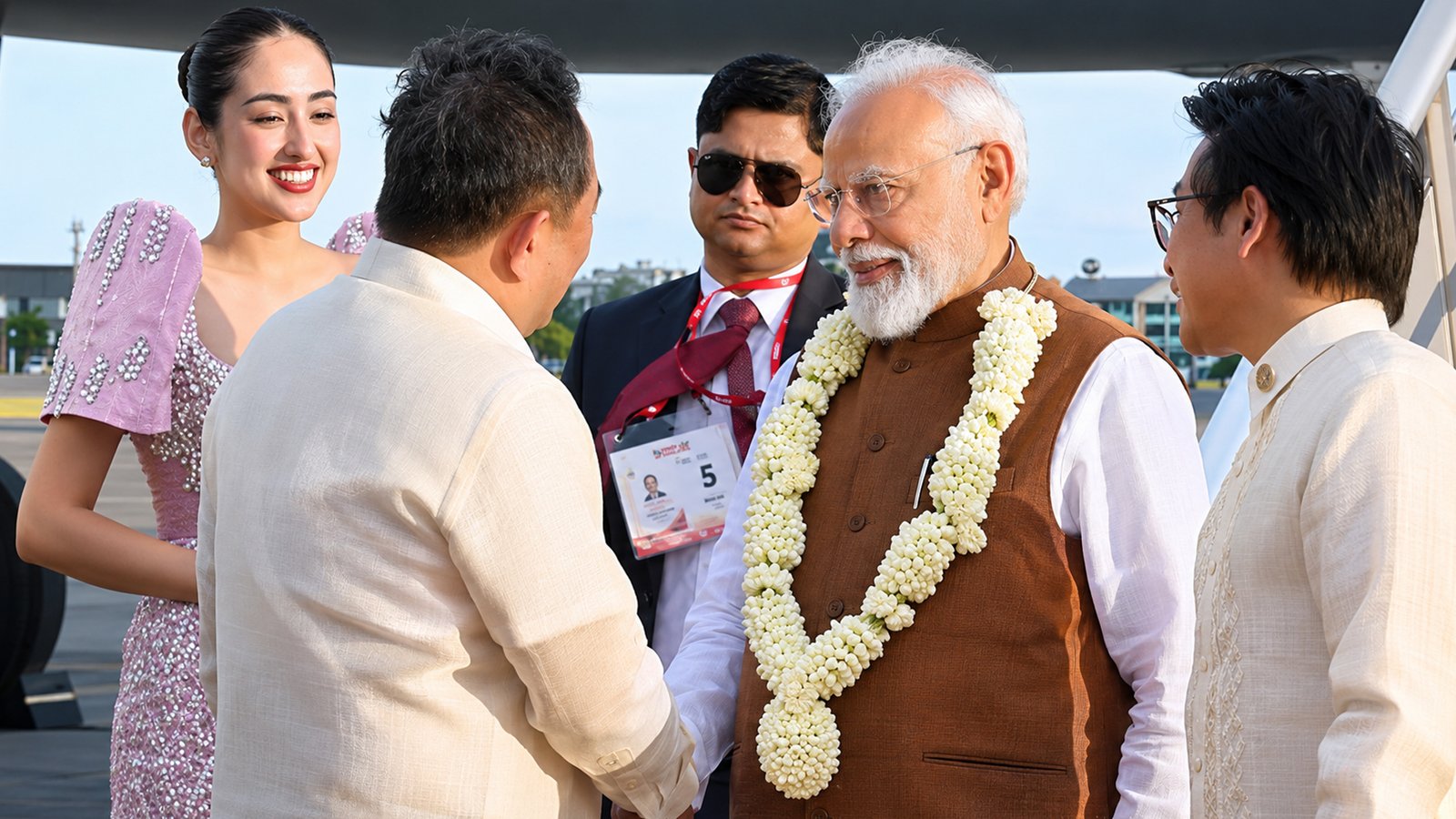
Prime Minister Narendra Modi’s visit to Manila for the 23rd ASEAN-India Summit and the 21st East Asia Summit has brought India’s strategic engagement with Southeast Asia into focus. At a time when geopolitical tensions, maritime disputes and economic uncertainties are reshaping the Indo-Pacific, the meetings offer New Delhi an opportunity to strengthen partnerships and expand cooperation with ASEAN member countries.
The summit, hosted by the Philippines from November 15 to 18, comes amid growing competition between major powers, tensions in the South China Sea, political instability in Myanmar and concerns over global energy supplies. These developments have made regional cooperation and diplomatic engagement increasingly important.
PM Modi’s participation reflects India’s continued commitment to its Act East Policy, which aims to strengthen economic, political and strategic relations with Southeast Asian countries. ASEAN remains a central pillar of this policy, particularly as India seeks to expand its influence and contribute to stability in the Indo-Pacific.
The discussions are expected to focus on trade, investment, defence cooperation, regional connectivity and maritime security. For India, the priority is to deepen its Comprehensive Strategic Partnership with ASEAN and translate diplomatic engagement into practical economic and security cooperation.
The visit also provides an opportunity for Modi to engage with regional leaders on issues affecting India’s interests. He is expected to attend a dinner hosted by Philippine President Ferdinand Marcos Jr. and participate in the summit-level discussions. Bilateral meetings with other participating leaders are also part of the diplomatic engagement.
India and ASEAN have steadily expanded their relationship over the past three decades. The year 2026 has been designated as the ASEAN-India Year of Maritime Cooperation, highlighting the importance both sides attach to secure sea routes, maritime connectivity and the sustainable use of ocean resources. The year 2027 will mark 35 years of ASEAN-India dialogue relations and five years of their Comprehensive Strategic Partnership.
Maritime security is particularly important for both sides because of their dependence on international shipping routes. The Indian Ocean and the wider Indo-Pacific connect major commercial centres and energy markets. Cooperation in maritime surveillance, naval exercises, information sharing and disaster response is expected to remain an important part of the partnership.
India has also strengthened defence relations with individual ASEAN members, particularly the Philippines. The two countries signed a $375-million agreement in 2022 for the supply of India’s BrahMos supersonic cruise missile system. The Philippines became the first foreign country to purchase the missile, marking an important development in India’s defence exports. The agreement has opened opportunities for further cooperation in defence technology and military training.
The South China Sea dispute is another major concern for ASEAN leaders. China and several Southeast Asian countries, including the Philippines, Vietnam, Malaysia and Brunei, have overlapping territorial claims in the strategically important waterway. The region carries a substantial share of global maritime trade and is important for fishing and energy exploration.
ASEAN and China have been negotiating a Code of Conduct to manage tensions and prevent confrontations. However, differences over territorial claims and the nature of the proposed agreement have slowed progress. The Philippines has pushed for a meaningful agreement that respects international law and provides safeguards against maritime incidents.
India has consistently supported freedom of navigation, peaceful settlement of disputes and adherence to international law, including the United Nations Convention on the Law of the Sea. Stability in the South China Sea is important to New Delhi because of its wider economic and strategic interests in the Indo-Pacific.
The continuing political crisis in Myanmar is another difficult issue confronting ASEAN. Leaders reviewed the implementation of the Five-Point Consensus, adopted in April 2021 following the military takeover in the country. The framework calls for an immediate end to violence, dialogue among all parties, mediation by an ASEAN special envoy and humanitarian assistance.
In their November 15 statement, ASEAN leaders expressed deep concern over continuing violence and the deteriorating humanitarian situation. They called on all parties to stop attacks, protect civilians and public infrastructure, and ensure that humanitarian assistance reaches affected communities.
The leaders also reaffirmed that ASEAN’s engagement with Myanmar would depend on developments on the ground and meaningful progress in implementing the peace framework. Restrictions on Myanmar’s political representation at high-level meetings underline the bloc’s continuing concerns over the lack of progress.
Economic and energy security are also expected to feature prominently in the discussions. Southeast Asian countries are facing pressure from changing global trade policies, rising energy costs and disruptions to international oil and gas supplies. The conflict involving the United States, Israel and Iran has added to concerns about energy availability and the stability of supply routes.
The Strait of Malacca, located between Indonesia, Malaysia and Singapore, is particularly important to international commerce. It connects the Indian and Pacific Oceans and serves as a major route for energy shipments and commercial vessels. Any disruption could affect global supply chains and increase transportation costs.
Trade relations with major economies are another concern for ASEAN. US tariffs and intensifying competition between Washington and Beijing have encouraged Southeast Asian countries to diversify their export markets and reduce dependence on individual economies.
The 21st East Asia Summit will provide a wider platform for discussions involving ASEAN members and major regional powers, including India, China, Japan, the United States and Australia. Geopolitical competition, international security and regional economic stability are expected to remain key issues.