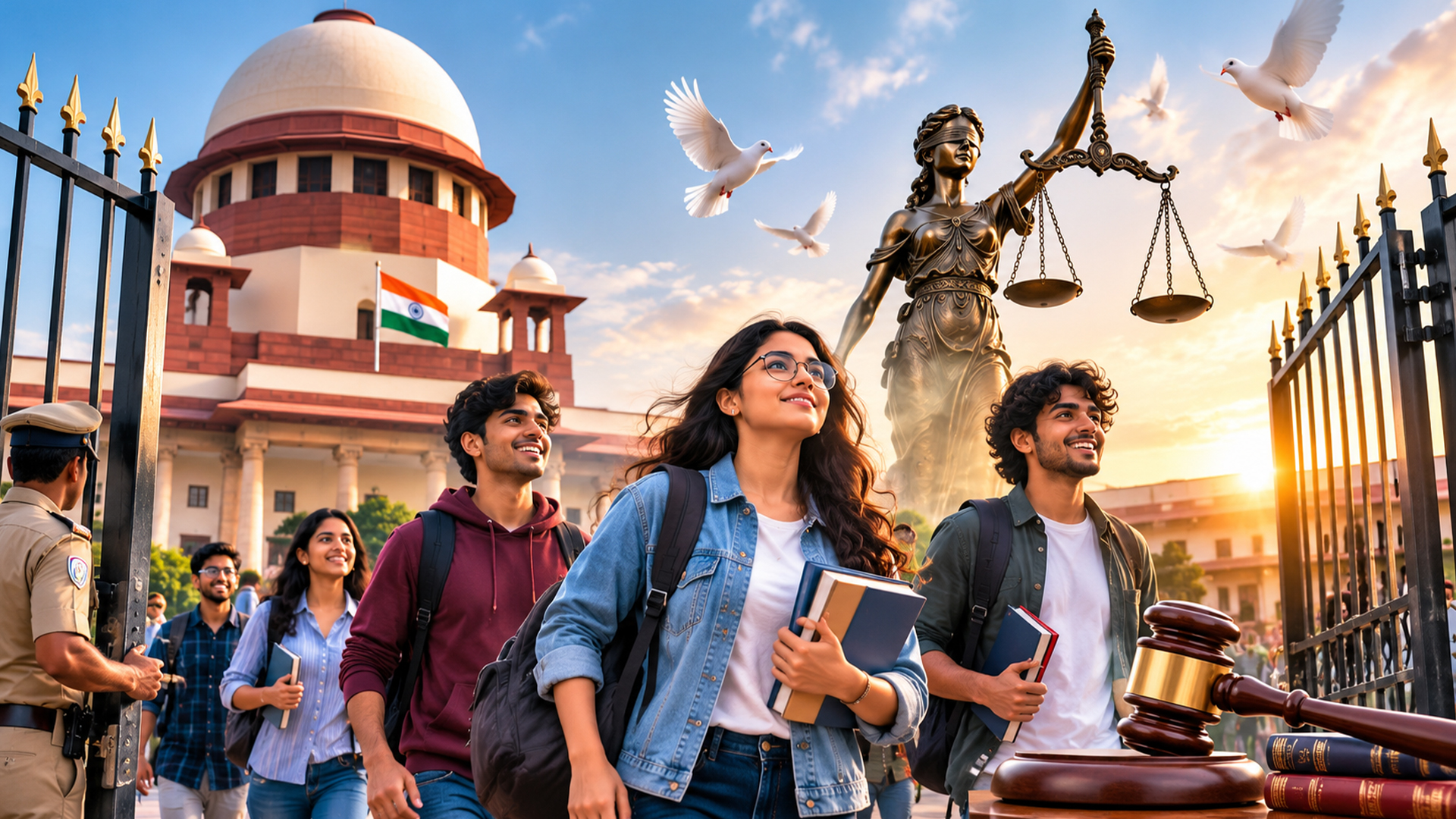
The Supreme Court on Tuesday granted significant interim relief to students detained during the recent nationwide protests, directing all states and Union Territories to immediately release those who have no criminal background. The apex court also made it clear that no coercive action should be taken against peaceful protesters while it examines allegations of police excesses during the demonstrations.
The order came while the court was hearing a batch of petitions challenging the police action taken against students who participated in protests over alleged examination irregularities and related issues. The petitions claimed that several students were arbitrarily detained, subjected to excessive force and booked in criminal cases despite having no involvement in violence.
Calling the matter one that concerns both public order and constitutional freedoms, the bench observed that the right to peaceful protest is a fundamental right guaranteed under the Constitution. It stressed that democratic dissent cannot be treated as a criminal act and that authorities must distinguish between peaceful protesters and those accused of committing violence.
As part of its interim directions, the Supreme Court ordered governments across the country to identify all detained student protesters who do not have any criminal antecedents and ensure their immediate release. The court clarified that its protection extends only to individuals with no criminal background and does not prevent authorities from proceeding against those allegedly involved in serious offences or acts of violence.
The bench also extended relief to minors who were detained during the protests, directing authorities to follow all legal safeguards applicable to juveniles. It said young students should not face long-term consequences merely because they participated in peaceful demonstrations.
In another key development, the Supreme Court announced its intention to constitute a Special Investigation Team (SIT) to probe allegations of violence during the protests. The proposed SIT will independently examine claims of police excesses, including allegations of lathi charges, arbitrary arrests, unlawful detention and excessive use of force against students.
The court clarified that while state police can continue their investigation into criminal cases already registered, the SIT will independently examine allegations against law enforcement agencies. This, the bench said, would ensure that complaints against police personnel are investigated impartially and inspire confidence among the public.
During the hearing, the judges observed that accountability must apply equally to everyone. While those responsible for violence during the protests should face legal consequences, any excesses committed by police personnel must also be thoroughly investigated. The court remarked that maintaining law and order cannot come at the cost of constitutional liberties.
The apex court further directed authorities to preserve CCTV footage, mobile phone recordings, drone footage and other electronic evidence related to the protests. It said such material would be essential for establishing facts during the investigation. The bench also instructed authorities not to disclose or misuse personal digital data collected from protesters and to maintain confidentiality wherever required.
The petitions before the court alleged that police in several states used disproportionate force to disperse student gatherings. Petitioners claimed protesters were subjected to baton charges, tear gas shells and mass detentions, even in situations where demonstrations remained peaceful. They argued that students with clean records were detained alongside others accused of violence and continued to face criminal proceedings despite having no direct role in the unrest.
Senior advocates appearing for the petitioners argued that the police response violated fundamental rights guaranteed under Articles 19 and 21 of the Constitution, including the rights to free speech, peaceful assembly and personal liberty. They sought the court’s intervention to prevent further arrests and ensure an independent investigation into the handling of the protests.
The Centre defended the actions of law enforcement agencies, stating that police were responding to incidents where protests turned violent and public property was allegedly damaged. It submitted that several police personnel were also injured during clashes and that authorities acted to restore law and order. However, the government informed the court that it had no objection if an independent inquiry was conducted under the court’s supervision.
The bench observed that every allegation, whether against protesters or police officials, must be examined fairly and without bias. It noted that constitutional courts have a duty to protect individual liberty while ensuring that public order is maintained through lawful means.
The recent student protests spread across several states after allegations of examination irregularities triggered widespread anger among aspirants and student organisations. Thousands of students took to the streets demanding transparency in the examination process, action against those responsible for alleged lapses and withdrawal of criminal cases against peaceful demonstrators. Civil society groups and legal activists also expressed concern over the manner in which the protests were handled.
The Supreme Court’s interim order has already begun influencing legal proceedings across the country. In West Bengal, for instance, several detained protesters secured bail shortly after the apex court’s observations, while similar relief is expected in other states as authorities begin implementing the court’s directions. Lawyers representing detained students described the order as an important safeguard for civil liberties and due process.