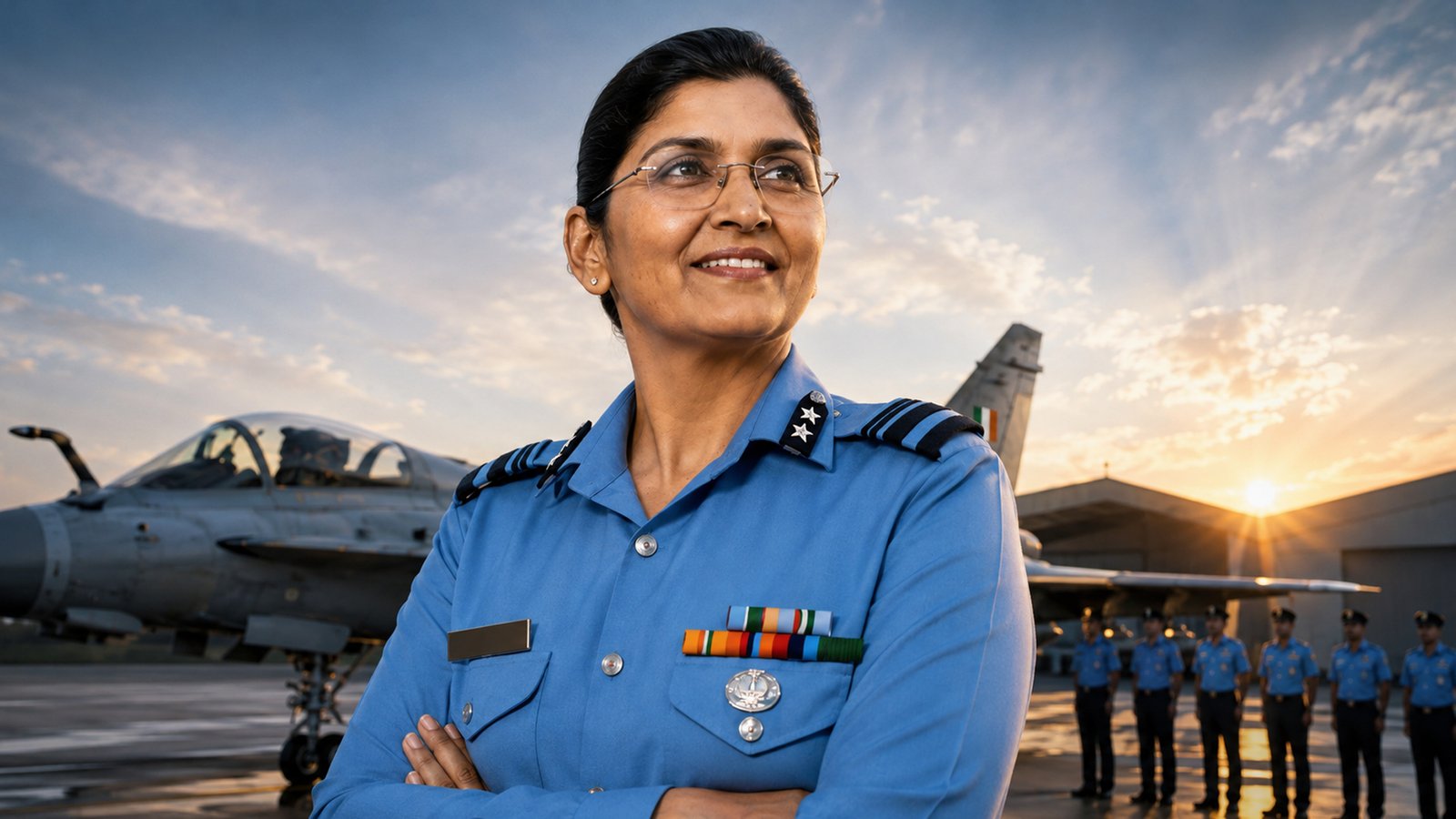
Air Vice Marshal Shakti Sharma has created history by becoming the first woman officer from the non-medical stream of the Indian Defence Forces to attain the rank of Air Vice Marshal or equivalent.
Sharma assumed charge as the Assistant Chief of the Air Staff (Education) at Air Headquarters on September 1, marking a significant moment in the growing participation of women in senior leadership positions in India’s armed forces.
Her elevation to the two-star rank is particularly significant because women officers have traditionally had a more limited presence at the highest levels of military leadership. Sharma’s achievement now opens another important chapter in the story of women in the Indian Armed Forces, demonstrating how careers that began decades ago are increasingly reaching senior command and leadership positions.
Sharma was commissioned into the Education Branch of the Indian Air Force (IAF) on June 18, 1994. Over more than three decades of service, she has held a range of assignments across training establishments, field stations, command headquarters and Air Headquarters.
Her career has been closely associated with education, training and institutional development within the Air Force. Her new appointment as Assistant Chief of the Air Staff (Education) places her in a key position overseeing an area that contributes to the professional development and intellectual preparedness of IAF personnel.
Sharma has also been associated with efforts to strengthen the connection between the armed forces and academic institutions. During her service, she played an important role in establishing IAF Chairs of Excellence at IIT Kanpur and Pune University. These initiatives were aimed at encouraging academic engagement and strategic defence-related collaboration.
Her career has been marked by several other firsts. Before reaching the rank of Air Vice Marshal, Sharma became the first woman Group Captain in the IAF outside the medical branch.
She also broke another barrier when she became the first woman officer from the three services to command a Sainik School. She served as the principal of Sainik School Kapurthala, taking on a leadership role in an institution traditionally associated with preparing young students for careers in the armed forces.
Her journey from the Education Branch in 1994 to one of the most senior ranks attained by a woman in the Indian Air Force reflects the gradual transformation of opportunities available to women officers.
The change has taken place over several decades. Women have increasingly moved beyond traditionally assigned areas and taken on responsibilities across different branches and operational roles. Their presence in senior appointments has also grown, although representation at the highest ranks remains a work in progress.
Sharma’s achievement therefore carries significance beyond her own career. It represents the progress of gender inclusion in the Indian military and the expanding opportunities for women to build long-term careers in the defence services.
Her story also highlights the importance of specialised branches such as education within the armed forces. Military leadership is not limited to combat operations. Training, strategy, academic research, professional development and institutional planning all contribute to maintaining an effective and modern military.
As Assistant Chief of the Air Staff (Education), Sharma will bring her extensive experience in these areas to Air Headquarters. Her career spanning more than 30 years gives her a broad understanding of the requirements of training establishments, field formations and command structures.
The Ministry of Defence described her elevation as a landmark moment in the journey of women officers in the defence services. Her achievement is also being viewed as an example for younger women considering careers in the Indian Air Force and Indian Armed Forces.
For many aspiring officers, such milestones can have a powerful effect. Seeing women reach positions that were once largely inaccessible can change perceptions about what is possible within the military. It can also encourage more women to consider defence careers not merely as an opportunity to serve, but as a long-term profession with opportunities for leadership and advancement.
Sharma’s appointment comes at a time when the Indian military is undergoing broader changes in its approach to recruitment, training and the role of women. The armed forces have been steadily expanding opportunities for women, including through permanent commissions and greater representation across branches.
The IAF, in particular, has seen women officers take on increasingly diverse responsibilities. From flying aircraft and commanding units to handling training, administration and specialised assignments, women officers are now visible across a much wider range of roles.
Against this backdrop, Sharma’s elevation to Air Vice Marshal represents another important step. It shows that the push for greater representation is gradually reaching the senior leadership levels of the defence establishment.
Her career is also a reminder that such breakthroughs are rarely the result of a single appointment. They are built over years of service, professional competence, institutional experience and the ability to take on responsibilities at every stage of a career.