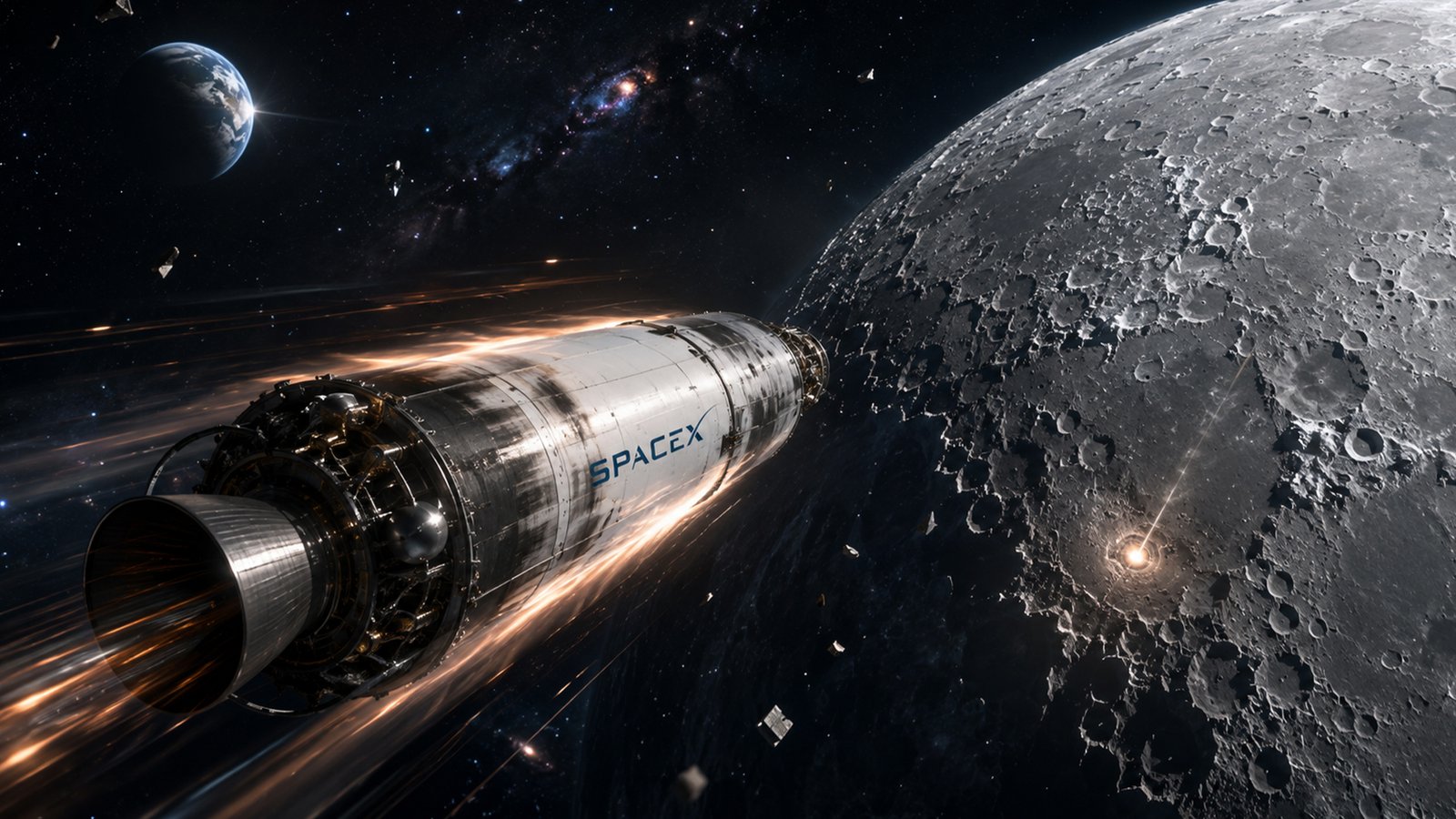
A discarded SpaceX Falcon 9 rocket stage is on a collision course with the Moon and is expected to slam into the lunar surface on August 5, creating a rare opportunity for scientists to observe an artificial impact in real time.
The spent rocket stage is travelling at roughly 5,400 miles per hour (8,700 kmph) and is currently expected to hit the Moon at around 06:35 UTC on August 5, or about 2:35 a.m. EDT. The impact is predicted to occur near Einstein Crater, close to the Moon’s limb as viewed from Earth.
The object is the upper stage of a SpaceX Falcon 9 that launched on January 15, 2025, from NASA‘s Kennedy Space Center in Florida. The rocket carried two private lunar spacecraft — Firefly Aerospace’s Blue Ghost lander and Japanese company ispace’s Resilience lander — on their journey towards the Moon.
The Falcon 9’s first stage returned to Earth as planned, but the upper stage remained in space after completing its role in sending the lunar-bound spacecraft on their trajectories. With no further mission assigned to it, the stage continued travelling through space. Gravitational interactions gradually altered its path, ultimately putting it on course for an unintended collision with the Moon.
Unlike a controlled lunar landing, there is no attempt to guide the rocket stage safely onto the surface. Instead, the approximately 3,900-kilogram object will hit the Moon at about 2.43 kilometres per second, releasing a large amount of energy when it strikes.
For the Moon, such impacts are nothing unusual. Meteoroids regularly hit its surface. What makes this event different is that scientists know in advance what is coming, including the approximate object’s size, mass, speed and impact location.
That gives researchers something they rarely get with natural lunar impacts: a chance to prepare.
Scientists are planning observations from telescopes and spacecraft to capture the impact flash and, more importantly, the cloud of lunar material thrown into space after the collision. Researchers say the event could help improve models of how high-speed objects interact with the Moon‘s surface.
A recent study estimates that the impact could generate a substantial ejecta plume, with the central spike potentially reaching 75 to 100 kilometres above the lunar surface. The debris could also spread laterally for hundreds of kilometres from the impact site.
The plume could prove more scientifically valuable than the initial flash itself. By studying how lunar dust and rock are thrown out of the crater, researchers can learn more about the Moon’s surface material and how it behaves during high-energy impacts.
The event could also help scientists improve their ability to locate and analyse lunar impacts, knowledge that may become increasingly important as lunar exploration expands.
The NASA Lunar Reconnaissance Orbiter is expected to play a role in studying the impact site, including imaging the area before and after the collision. Such observations could help researchers identify the new crater and compare the actual result with computer simulations.
For astronomers on Earth, however, watching the crash will not be as simple as looking up at the Moon.
The impact is expected to take place on sunlit lunar terrain, which creates difficult observing conditions. The flash itself could be extremely brief and faint, although researchers believe the resulting ejecta plume may be detectable with sufficiently powerful telescopes.
Scientists have prepared detailed observation plans because even a successful detection could provide valuable data. A research team has encouraged both professional and amateur astronomers to attempt observations of the event, while warning that the exact brightness and appearance of the impact remain uncertain.
The SpaceX rocket Moon crash is also drawing attention because it highlights a growing issue in the new era of commercial space exploration: what happens to spacecraft and rocket hardware after their missions end?
As governments and private companies prepare to send more landers, rovers, satellites and eventually humans to the Moon, the amount of human-made hardware around and on the lunar surface is likely to increase. The Falcon 9 stage is therefore an unusual reminder that space debris is no longer only an Earth-orbit problem.
The upcoming collision is not expected to pose a danger to people on Earth, and it is not considered a threat to the Moon itself. But it offers scientists a useful real-world experiment involving a human-made object striking another world at high speed.
The Falcon 9 lunar impact on August 5, could provide new information about lunar dust, impact craters and ejecta, while helping scientists prepare for a future in which activity around the Moon becomes much more frequent.