Try to imagine India as we were in 1947 — try it without the sepia photographs, patriotic songs and familiar speeches. Think instead in numbers.
Life expectancy then was only about 32 years. Only around 16% of Indians were literate, according to a government retrospective on the early years of Independence. In the five years from 1946 to 1950, infant mortality averaged 134 deaths for every 1,000 live births. In other words, one baby in seven did not survive its first year.
India had just 17 universities and 636 colleges, educating about 2.38 lakh students.
That was the country freedom inherited.
Now turn the page.
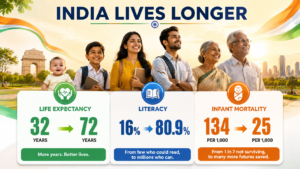
Life expectancy has reached about 72 years. Infant mortality has fallen to 25 per 1,000 births. Literacy was estimated at 80.9% in 2023-24. The higher-education system counted 1,168 universities or university-level institutions and 45,473 colleges in the latest completed All India Survey on Higher Education.
A child born in India today can expect, on average, four decades more life than a child born around Independence!
That single statistic — 32 years becoming 72 — should stop us for a moment. Economic development often gets reduced to GDP. But what could development mean more fundamentally than giving people more years in which to live?
Food tells another extraordinary story. India produced only 50.82 million tonnes of foodgrains in 1950-51. The country soon endured years when large-scale imports became necessary. For 2025-26, the government’s latest advance estimate puts foodgrain production at a record 376.56 million tonnes. Output multiplied more than sevenfold.
The transformation goes well beyond wheat and rice.
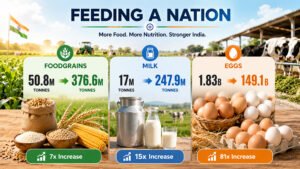
The Economic Survey’s long historical series records 17 million tonnes of milk in 1950-51. India produced 247.9 million tonnes in 2024-25 — nearly 15 times as much. Egg production jumped from 1.83 billion to 149.1 billion, an increase of more than eightyfold. Fish production climbed from 752,000 tonnes to almost 19.8 million tonnes.
Few statistics capture the Green Revolution, White Revolution, agricultural science, irrigation, rural enterprise and millions of farmers’ cumulative work quite so vividly.
Then consider distance.
India had about 3.99 lakh kilometres of roads in 1951. By 2022, the road network covered 65.93 lakh kilometres — almost 17 times as much. Much of that expansion reaches into rural India: village roads now form the majority of the network.
The railways offer an even more visual comparison. In 1950-51, only 388 route kilometres of the railway system were electrified. By March 2026, Indian Railways had electrified almost 69,900 route kilometres, covering 99.6% of the broad-gauge network.
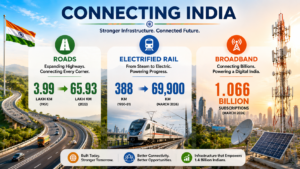
Passenger journeys rose from about 1.28 billion in 1950-51 to roughly 7.41 billion in 2025-26. The India of steam locomotives has almost completely electrified one of the world’s great railway systems.
Connectivity has since acquired an entirely different meaning.
At the end of March 2026, India had 1.33 billion telephone connections and nearly 1.066 billion broadband subscriptions. Average wireless data use had reached 26.7 GB per subscriber per month.
The technological leap becomes almost absurdly spectacular when we remember that India entered Independence with telephone access restricted largely to governments, businesses and the wealthy.
Then came the smartphone — and India turned it into a bank branch.
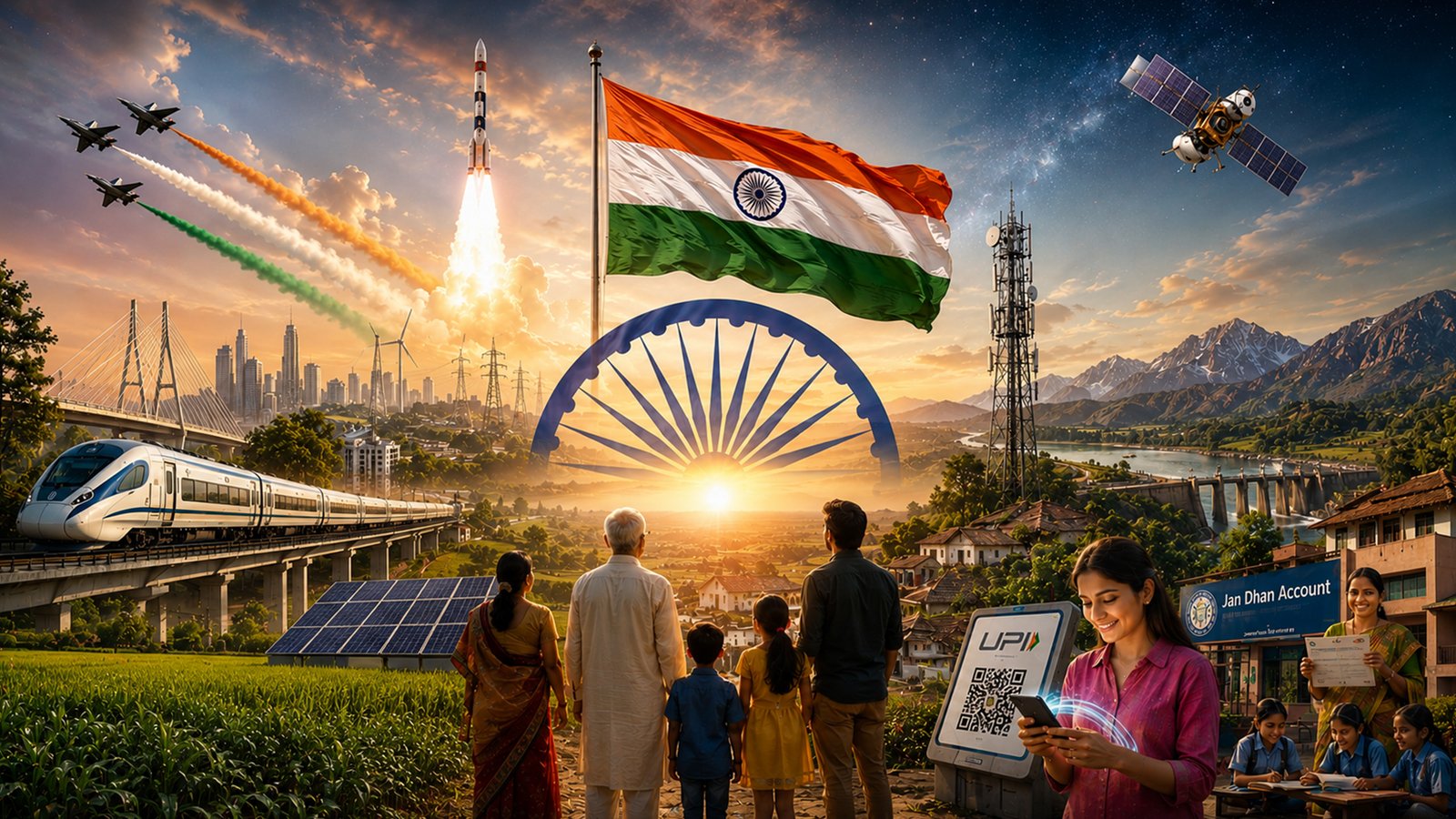
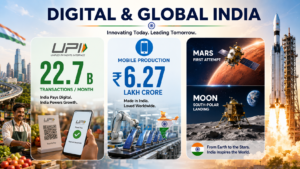
In June 2026 alone, Indians made 22.7 billion UPI transactions worth ₹28.92 lakh crore. That works out to roughly 757 million payments every day! A vegetable seller, auto driver or tiny shopkeeper now receives money instantly through infrastructure that did not exist a decade ago. India has not merely digitised payments — it has made sophisticated financial infrastructure ordinary.
Financial inclusion followed the same logic. By February 2026, India had opened 57.78 crore Jan Dhan accounts holding ₹2.94 lakh crore in deposits. Women owned 55.8% of those accounts, while rural and semi-urban India accounted for 78.2%.
The bank account, once a symbol of formal middle-class life, has become mass infrastructure.
Welfare delivery has changed with it. The government’s Direct Benefit Transfer Dashboard currently records ₹52.95 lakh crore in cumulative transfers across hundreds of schemes. It estimates gains from reduced duplication, leakage and other efficiencies at ₹5.14 lakh crore. Technology cannot eliminate bad governance. It can, however, make some forms of bad governance harder.
Water provides another startling recent example. When the Jal Jeevan Mission began in August 2019, only about 17% of rural households had tap-water connections. By August 9, 2026, the mission dashboard reported 15.84 crore rural households with taps — 81.81% of the total. In seven years, piped water reached well over 12 crore additional rural homes.
The economic numbers have become difficult to comprehend in the scale of everyday life. The IMF estimates India’s economy at roughly $4.15 trillion in 2026. But a more tangible industrial statistic tells the story better.
India manufactured mobile phones worth only around ₹18,000 crore in 2014-15. By 2025-26, production had surged to ₹6.27 lakh crore — 33 times as much. Exports jumped from about ₹1,500 crore to ₹2.59 lakh crore. Mobile phones have become India’s single largest exported item.
A country that once worried about its ability to manufacture basic industrial goods now ships sophisticated electronics to the world. And then we pointed machines towards other planets.
India’s Mars Orbiter Mission reached Mars orbit on its first attempt. ISRO says the mission cost ₹450 crore. It was India’s first interplanetary mission and made ISRO only the fourth space agency to reach Martian orbit successfully.
In 2023, Chandrayaan-3 made India the fourth country to soft-land on the Moon and the first to land in the lunar south-polar region. No comparison between 1947 and 2026 captures technological confidence quite like that journey.
Sport offers its own quieter revolution. For decades, Olympic India largely meant hockey and isolated individual brilliance. At Tokyo 2020, India won a record seven Olympic medals, including Neeraj Chopra’s historic athletics gold. Paris 2024 brought another six medals, with Indian athletes competing seriously across shooting, wrestling, badminton, boxing, athletics and other disciplines. Yes, India still remains far from fulfilling its sporting potential. But the range of ambition has changed.
Even corruption deserves a place in this Independence Day reckoning — precisely because celebration should not become self-deception.
Digital payments, electronic procurement, Aadhaar-linked benefits and direct bank transfers have reduced opportunities for some kinds of petty leakage and ghost beneficiaries. While digital systems have led to enormous efficiency gains, India has emphatically not conquered corruption.
Transparency International’s 2025 Corruption Perceptions Index gives India a score of 39 out of 100 and a rank of 91 among 182 countries. That number should remain beside the celebratory ones. Progress deserves recognition. Complacency does not.
The same principle applies to almost everything in this article.
A 72-year life expectancy remains below that of many richer and several comparable countries. Literacy at 80.9% means millions still cannot read or write adequately. 25 infant deaths per 1,000 births remain 25 too many. Indian cities struggle with pollution and congestion. Schools vary wildly in quality. Healthcare can bankrupt families. Inequality is visible everywhere. Corruption persists.
But Independence Day should not ask whether India has arrived.
It should ask how far India has travelled.
And on that question, the numbers are overwhelming.
For more perspectives examining India’s development, governance and changing national priorities, explore our opinion and analysis coverage.
From 32 years of life expectancy to 72.
From roughly one literate Indian in six to more than four in five.
From 50.8 million tonnes of foodgrain to 376.6 million.
From 3.99 lakh kilometres of roads to 65.93 lakh kilometres.
From 388 kilometres of electrified railway to almost 69,900.
From scarce telephones to 1.33 billion connections.
From inaccessible banking to 57.78 crore Jan Dhan accounts.
From cash and passbooks to more than 22 billion UPI payments a month.
From 17 universities to more than 1,100.
From a country finding its industrial feet to one manufacturing ₹6.27 lakh crore worth of mobile phones.
From the enormous struggle merely to feed a young republic to reaching Mars on the first attempt and the Moon’s southern latitudes before anyone else.
No single leader built this India. No single party can claim it. Our institutions, the Green Revolution, bank expansion, the space programme, economic liberalisation, telecom reform, highways, digital identity, financial inclusion, payments infrastructure, sanitation, electrification, rural water and modern manufacturing belong to different governments, generations and political philosophies.
National progress accumulates even when governments change. Perhaps that is the most inspiring Independence Day statistic of all. Nearly eight decades after 1947, we — the 1.4 billion argumentative Indians — still disagree about almost everything and keep building on what the previous generation left behind.
India remains unfinished.
But look back before looking ahead.
The distance already travelled is astonishing.
And for that alone, we should be proud of India.
Happy Independence Day!