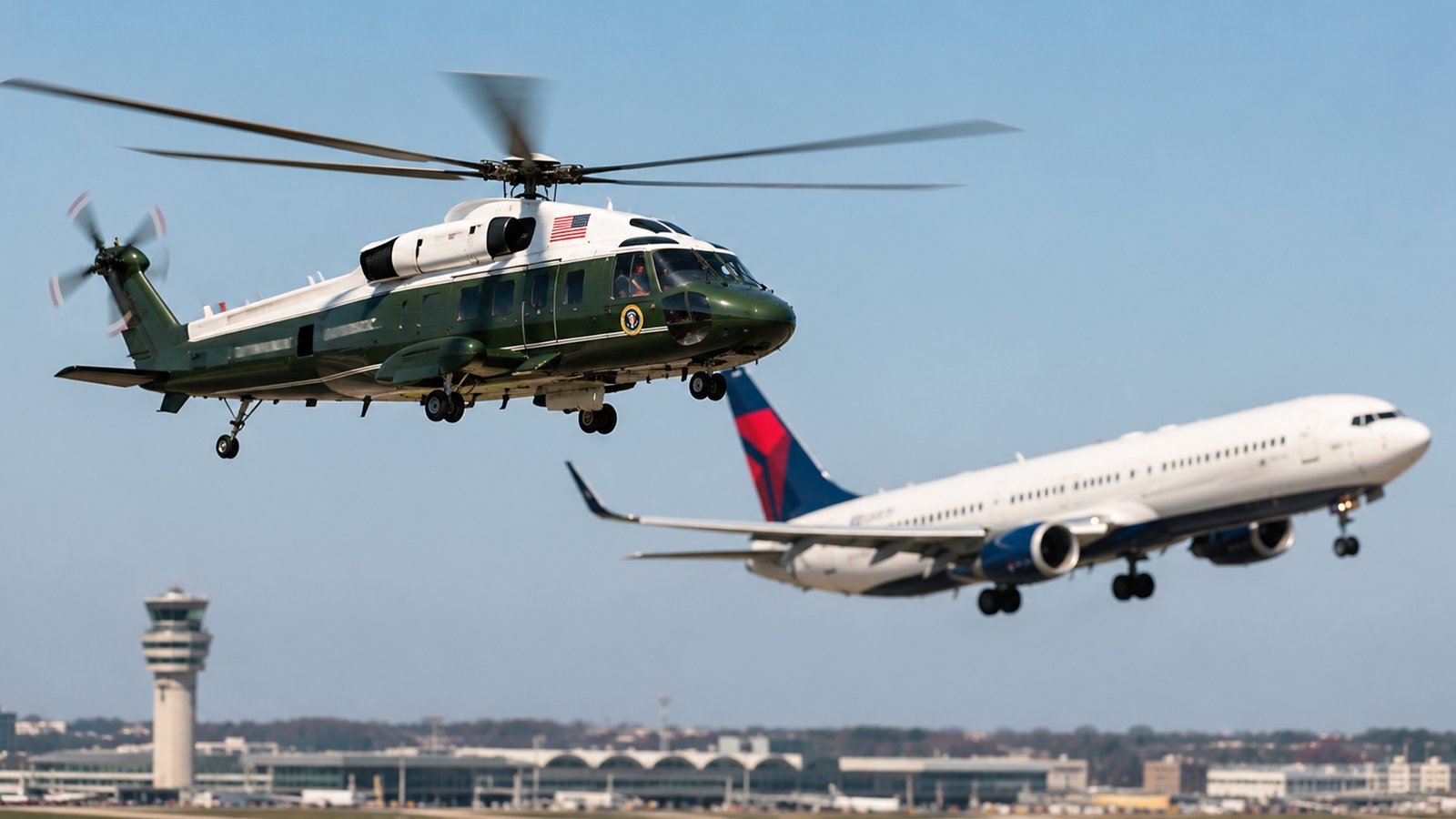
President Donald Trump’s Marine One helicopter briefly came too close to a passenger aircraft over Washington, DC, after air traffic controllers at Ronald Reagan Washington National Airport failed to halt commercial departures as required under aviation safety procedures.
The Federal Aviation Administration (FAA) is now investigating the incident, which occurred on August 4 as Marine One carried Trump from the White House to Joint Base Andrews. Officials have stressed that there was no collision and that the president was never in danger. However, the incident has raised fresh questions about communication between the presidential helicopter, air traffic controllers and commercial aircraft operating around one of the most sensitive airspaces in the United States.
According to information reviewed by aviation authorities, Marine One departed the White House at about 2:33 p.m. local time. Roughly a minute later, Envoy Air Flight 3742, a regional passenger jet operating for American Airlines, was allowed to take off from Reagan National Airport.
The aircraft was bound for Pensacola, Florida. The FAA later confirmed that Marine One and the passenger jet experienced a brief “loss of separation”, meaning they came closer together than the minimum distance required by aviation rules.
Current FAA rules require aircraft operating in the area to maintain at least 1.5 miles of horizontal separation and 500 feet of vertical separation. The rules are particularly significant around Reagan National because the Washington airspace is tightly controlled and carries both heavy commercial traffic and high-security government operations.
Sources cited in reports said the aircraft came within less than a mile of each other horizontally while remaining separated vertically. Some reports put the closest distance at about 0.8 miles and roughly 700 feet vertically. Although that breached the prescribed separation standard, officials said the two aircraft were not on a collision course and were moving away from each other.
The incident appears to have been linked, at least in part, to a breakdown in communication. Audio from air traffic control indicates that the Marine One crew attempted several times to alert the Reagan National tower that the helicopter was preparing to depart.
In one transmission, the crew indicated that Marine One was about three minutes from lifting off. The response from the tower was reportedly unclear, with one transmission described as “broken and unreadable”. Marine One subsequently proceeded with its departure.
The timing became critical because commercial flights were still being cleared to operate from Reagan National. The normal procedure after the 2025 Washington midair collision requires commercial traffic to be stopped or managed differently when presidential helicopter movements create a potential conflict.
The background makes the latest incident particularly sensitive. In January 2025, an American Airlines passenger jet collided with a US Army Black Hawk helicopter near Reagan National Airport. All 67 people aboard the two aircraft were killed. The tragedy prompted an overhaul of aviation procedures around the airport, including tighter restrictions on helicopter operations and stronger separation requirements.
Against that backdrop, the fact that a commercial aircraft was allowed to depart while Marine One was operating nearby has attracted immediate scrutiny.
The FAA said it is assembling a Safety Review Team to examine what happened and determine whether additional measures are necessary. The National Transportation Safety Board (NTSB) is also investigating the incident.
Another aircraft, Republic Airways Flight 4700, was reportedly rerouted as a precaution after the incident. That flight was instructed to alter its course while operating near the airport.
The White House has sought to reassure the public that Trump was not placed in immediate danger. The Marine Corps also described the presidential helicopter’s August 4 flight as routine and said the aircraft was not instructed to delay its departure or change its planned flight profile.
Still, the episode highlights how quickly a small communication problem can become an aviation safety concern in crowded airspace.
Reagan National is located close to the White House, Pentagon and other government landmarks. Aircraft operating in the area must follow complex routes and restrictions, leaving relatively little room for errors in timing or communication.
For passengers aboard Envoy Air Flight 3742, the departure may have appeared completely routine. For aviation officials, however, the incident has become a reminder of the importance of strict coordination when presidential movements overlap with commercial air traffic.
The investigation will now focus on why the required traffic restrictions were not activated, whether the communication problems contributed to the lapse, and whether existing procedures worked as intended.
While there was no crash and no reported injury, the incident has nevertheless renewed attention on aviation safety around Washington. The FAA and NTSB investigations are expected to establish exactly how the separation breach occurred and whether changes are needed to prevent a similar situation in the future.