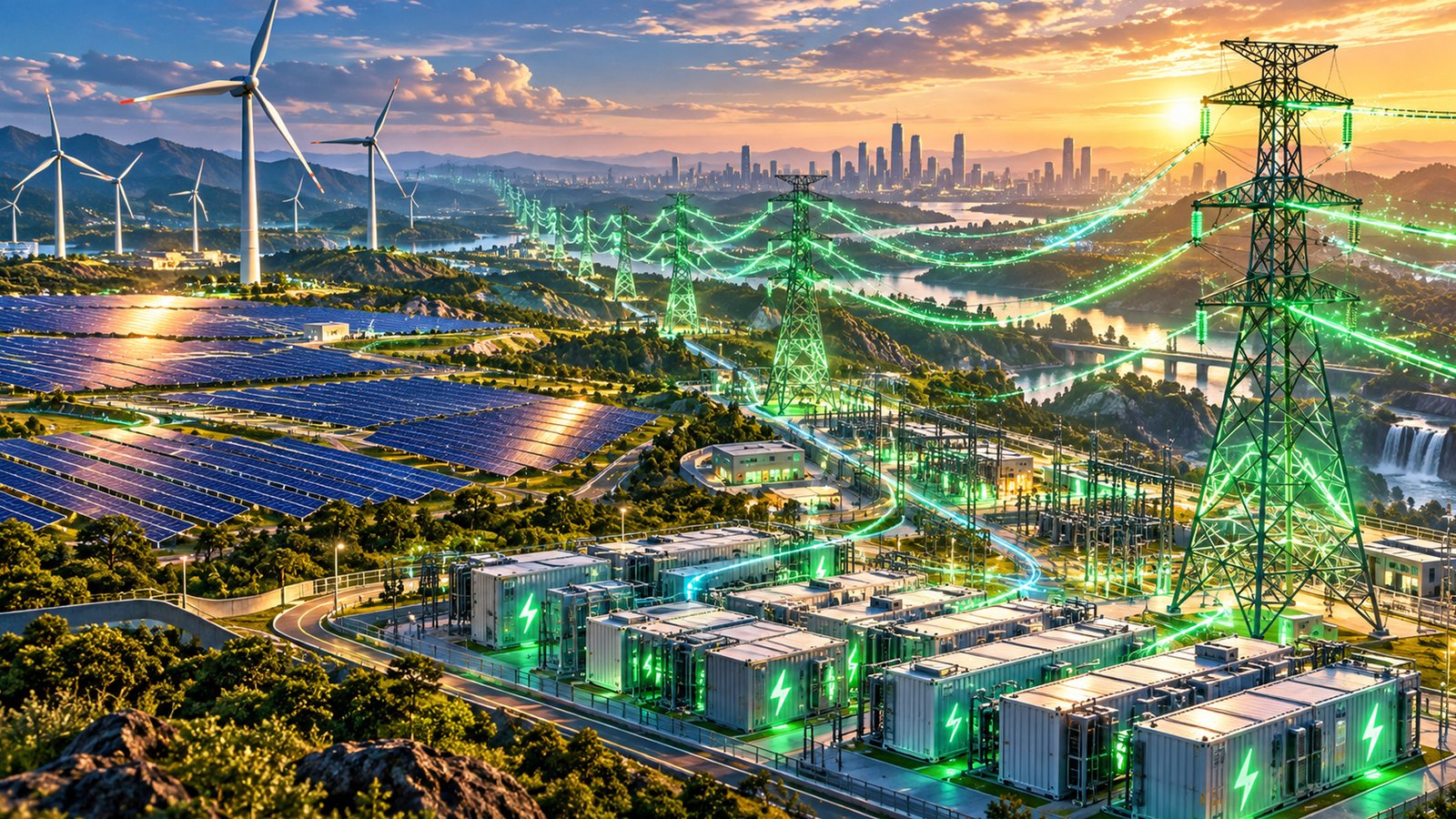
The Union Cabinet has approved a ₹1.86 lakh crore Green Energy Corridor Phase-III (GEC-III) programme to strengthen India’s power transmission network and support the evacuation of up to 135 GW of renewable energy. The scheme, approved on September 30, will focus on expanding transmission infrastructure and adding large-scale battery storage to support the country’s clean energy transition.
The programme will be implemented by 2032-33 and is aimed at addressing a key challenge for India’s renewable energy sector — ensuring that electricity generated from solar and wind projects can reach consumers efficiently.
Of the total investment, around ₹1.36 lakh crore will be used to develop and strengthen intra-state transmission systems. Another ₹50,000 crore has been earmarked for 50 GWh of Battery Energy Storage Systems (BESS).
The Centre will provide financial assistance of about ₹54,082 crore under the scheme. The support is expected to reduce the financial burden on states while helping accelerate the development of renewable power evacuation infrastructure.
The focus on battery storage is particularly important as India increases its dependence on solar and wind power. Renewable generation can fluctuate depending on sunlight and weather conditions. Battery Energy Storage Systems can store surplus electricity and release it when demand rises or renewable generation falls.
The government expects the storage component to help manage renewable energy intermittency, reduce transmission congestion and minimise curtailment of renewable power. Storage can also support electricity demand during non-solar hours, when solar generation is unavailable.
The latest Green Energy Corridor phase significantly expands the scale of earlier programmes. The first two phases covered 10 states and were designed to support the evacuation of about 44 GW of renewable energy.
GEC-III will focus on states and regions where renewable energy capacity is expected to grow substantially. The expansion is expected to create a stronger link between renewable energy generation centres and the wider electricity grid.
India’s power transmission network is also undergoing a major expansion. The transmission network is planned to increase from around 5.09 lakh circuit km in June 2026 to 6.48 lakh circuit km by 2032. Transformation capacity is expected to rise from about 1,478 GVA to 2,345 GVA during the same period.
Inter-regional transmission capacity is also planned to increase from around 120 GW to 168 GW. The expansion is intended to allow electricity to move more efficiently between different regions and improve overall grid flexibility.
The new programme could also generate significant business opportunities across the power infrastructure sector. Transmission equipment manufacturers, engineering and construction companies, battery storage developers and other clean energy businesses are expected to benefit as projects are awarded and implemented.
Transmission projects under the scheme will be developed through Tariff-Based Competitive Bidding. Private transmission service providers will be responsible for building, owning, operating and maintaining the new infrastructure.
The government has also proposed viability gap funding to encourage investment in battery storage. Around ₹6,000 crore will support the development of 50 GWh of battery energy storage capacity.
The investment comes at a time when India is rapidly expanding its renewable energy capacity. The country has set a target of achieving 500 GW of non-fossil fuel-based power capacity by 2030.
The scale of the target means that generation capacity needs to be matched by supporting infrastructure. Solar panels and wind turbines can add large amounts of clean electricity to the system, but without adequate transmission and storage, part of that electricity may not reach demand centres when required.
The Green Energy Corridor is therefore becoming an important part of India’s broader energy transition strategy. The latest phase brings renewable power generation, transmission infrastructure and energy storage into a single expansion plan.
Beyond supporting India’s climate and renewable energy goals, the ₹1.86 lakh crore programme is expected to boost investment in power infrastructure and related industries. It could also create demand for transmission lines, substations, transformers, grid equipment, batteries and associated engineering services.
With implementation planned through 2032-33, GEC-III is expected to provide the infrastructure needed to integrate a larger share of renewable electricity into India’s national power system while improving the grid’s ability to manage changing patterns of electricity generation and demand.
The ₹1.86 lakh crore programme strengthens India’s clean energy infrastructure, combining transmission and storage to support renewable growth, improve grid flexibility and accelerate the country’s transition towards cleaner power.