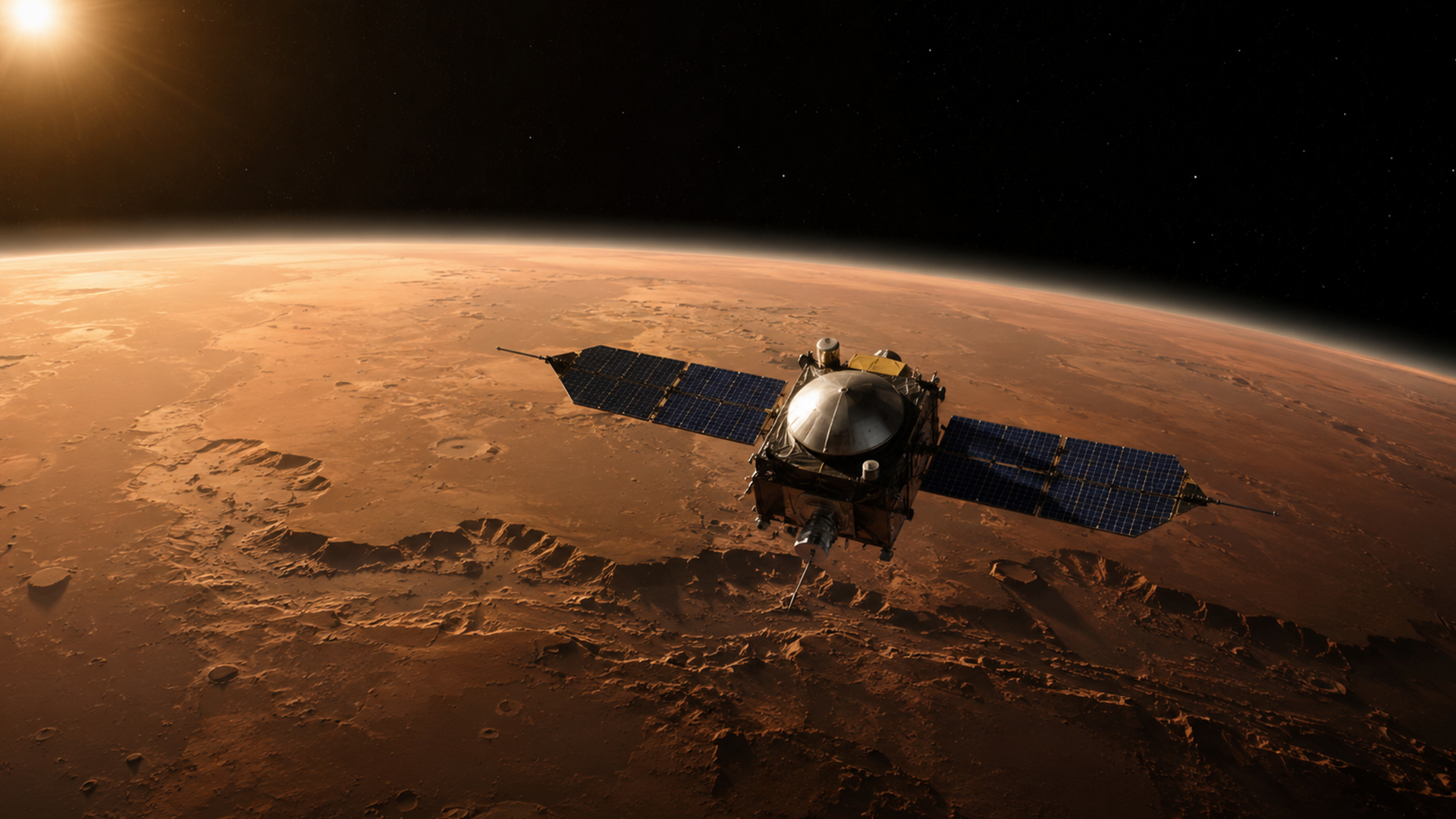
NASA has officially ended the mission of its MAVEN spacecraft after six months of unsuccessful attempts to restore contact with the Mars orbiter. The agency confirmed that the spacecraft is no longer recoverable, bringing to a close one of its most successful missions to the Red Planet.
MAVEN, short for Mars Atmosphere and Volatile Evolution, was launched in 2013 and entered orbit around Mars in 2014. Originally designed for a one-year science mission, the spacecraft operated for more than 11 years, far exceeding expectations.
NASA lost contact with MAVEN in December 2025 after the spacecraft passed behind Mars. Preliminary findings suggest it unexpectedly entered a rapid spin, causing it to lose power and drift into an unrecoverable state. After months of recovery efforts, an agency review board concluded that the spacecraft could no longer perform scientific operations or communications relay duties.
During its mission, MAVEN played a crucial role in helping scientists understand how Mars lost much of its atmosphere over billions of years. Its observations provided important evidence about how solar winds stripped away atmospheric gases, transforming Mars from a potentially habitable world into the cold, dry planet seen today.
The spacecraft also served as a communications relay for NASA’s Mars rovers, including Curiosity and Perseverance, helping transmit valuable scientific data back to Earth. Among its achievements, MAVEN recorded the first visible-light images of a Martian aurora and observed an interstellar comet passing through the solar system.
NASA officials described the mission as a major scientific success despite its unexpected end. The agency said Mars operations will continue without significant disruption, as other orbiters remain available to support rover communications and scientific research.
Although no longer operational, MAVEN is expected to remain in orbit around Mars for another 50 to 100 years. Its scientific legacy is expected to continue shaping researchers’ understanding of the planet and its evolution for decades to come.