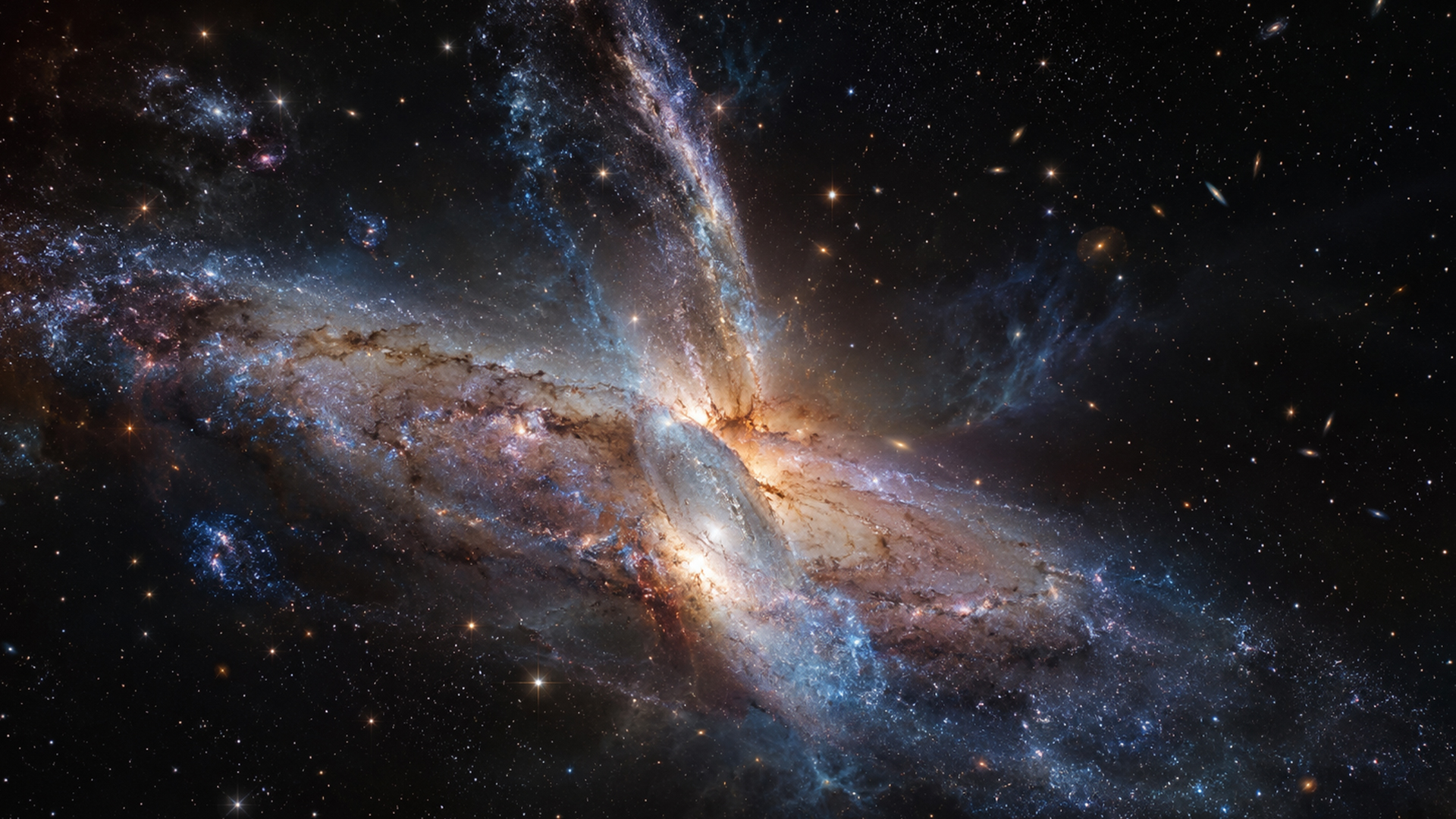
Our home galaxy, the Milky Way, may have experienced a dramatic cosmic transformation around 10 billion years ago, according to new research by astronomers. Scientists now believe that a massive collision with a smaller dwarf galaxy, known as the Gaia-Sausage-Enceladus, may have tilted the Milky Way’s disc by more than 90 degrees, fundamentally reshaping its structure and changing the way it evolved over billions of years.
The findings offer fresh insight into one of the biggest events in the Milky Way’s history and help explain why our galaxy looks the way it does today. Rather than being a calm and unchanging system, the Milky Way appears to have undergone a violent encounter that left a lasting mark on its stars, gas and overall shape.
The international team of astronomers used advanced computer simulations to recreate the ancient collision. Their models suggest that when the Milky Way merged with the dwarf galaxy roughly 10 billion years ago, the impact was powerful enough to slowly rotate the galaxy’s disc over time. Instead of a sudden flip, the process unfolded over hundreds of millions of years as gravity redistributed enormous amounts of matter across the galaxy.
The dwarf galaxy involved in the collision is known as Gaia-Sausage-Enceladus, named after the distinctive sausage-shaped pattern its stars form in data collected by the European Space Agency’s Gaia space observatory. Although much smaller than the Milky Way, it contained enough mass to trigger major structural changes after the merger.
Researchers estimate that before the collision, the Milky Way’s disc was oriented in a completely different direction. As the two galaxies merged, gravitational forces gradually tilted the disc by more than 90 degrees, creating the orientation astronomers observe today. The event also stirred up billions of stars and vast clouds of gas, influencing later generations of star formation.
Scientists say this discovery changes the traditional view of the Milky Way as a stable spiral galaxy. Instead, it highlights that galaxies constantly grow and evolve through mergers and interactions with smaller neighbours. Such cosmic collisions are common across the universe and play a crucial role in shaping galaxies over billions of years.
The study also provides a possible explanation for several unusual features of the Milky Way that have puzzled astronomers for years. These include the motion of ancient stars in the galaxy’s halo, differences in stellar populations and the distribution of dark matter surrounding the galaxy. The new model successfully reproduces many of these observed characteristics, strengthening the theory that the Gaia-Sausage-Enceladus merger was one of the defining moments in the Milky Way’s evolution.
For people on Earth, the findings do not mean the galaxy suddenly turned upside down. The transformation happened over an incredibly long period, far beyond a human timescale. The Solar System and Earth formed billions of years after the collision, meaning our planet has always existed within the Milky Way’s current orientation.
Astronomers say the research demonstrates the growing power of modern astronomy, combining detailed observations from the Gaia mission with sophisticated computer simulations to reconstruct events that occurred billions of years before the Solar System was born. It also highlights how even relatively small galaxies can leave a profound imprint on much larger ones through gravity alone.
The discovery opens new avenues for understanding how spiral galaxies evolve across the universe. By studying ancient galactic mergers, researchers hope to better understand the formation of stars, the behaviour of dark matter and the processes that shape galaxies over cosmic time.
Although the collision occurred around 10 billion years ago, its effects are still visible today in the structure and motion of the Milky Way’s stars. Every night, when people look up at the band of light stretching across the sky, they are seeing a galaxy whose present form was forged by one of the most dramatic cosmic events in its long history.
The study serves as another reminder that the universe is constantly changing. Even the galaxy we call home has a turbulent past, shaped by collisions, gravity and billions of years of evolution, revealing that the cosmos is far more dynamic than it may appear from Earth.