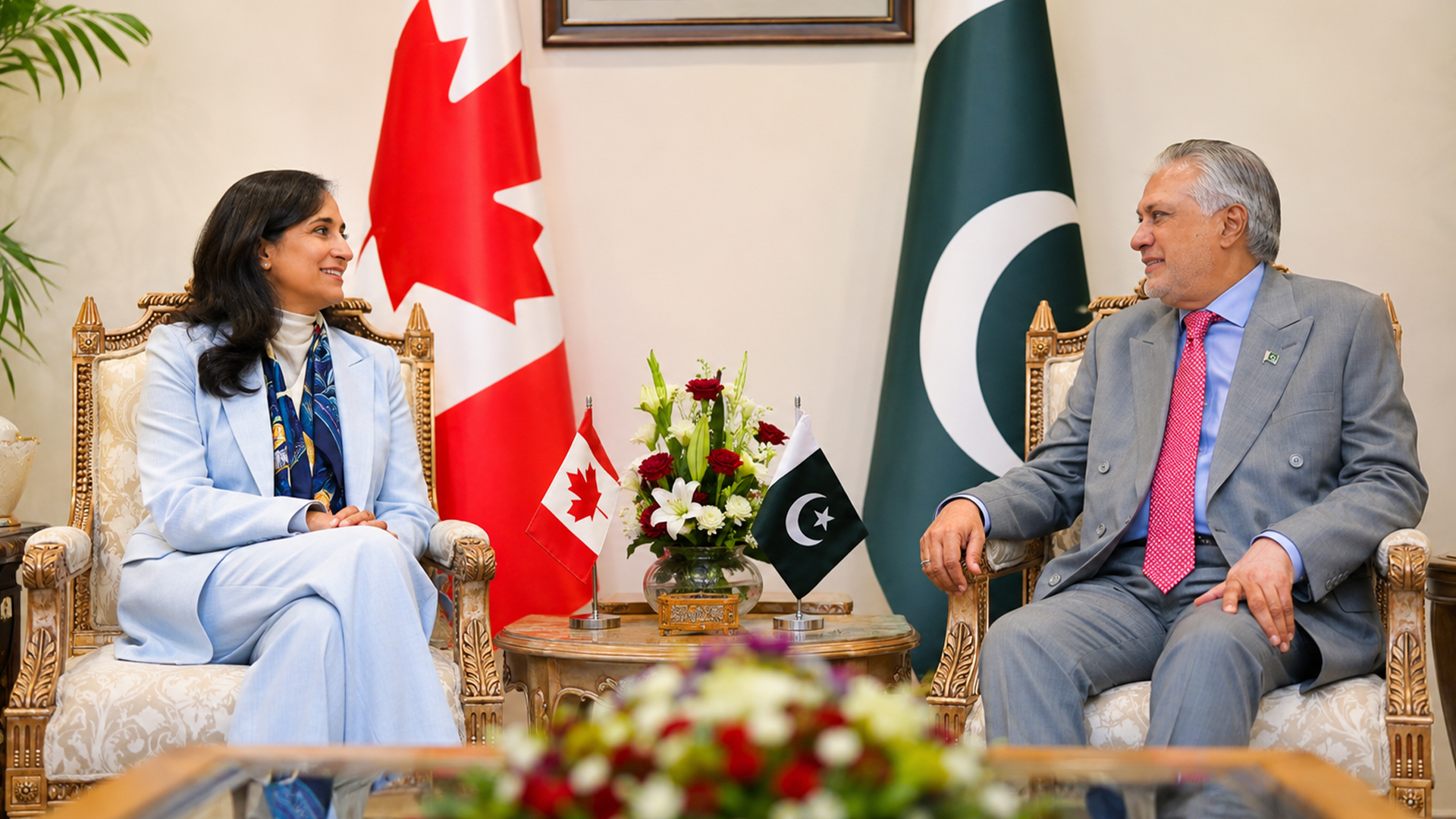
Pakistan has sought Canada’s support on the Indus Waters Treaty (IWT) during Canadian Foreign Minister Anita Anand’s landmark visit to Islamabad, marking the first visit by a Canadian foreign minister to Pakistan in nearly two decades. While the visit focused on strengthening bilateral relations, trade and regional cooperation, the long-standing water-sharing agreement between India and Pakistan emerged as a key issue during high-level talks.
Pakistan’s Deputy Prime Minister and Foreign Minister Ishaq Dar urged Canada to support efforts to preserve the Indus Waters Treaty, which has governed the sharing of river waters between India and Pakistan since 1960. Islamabad has repeatedly expressed concern over the future of the treaty after India announced that it would place the agreement in abeyance following the deadly Pahalgam terror attack earlier this year.
Addressing a joint press conference after their meeting, Dar described the treaty as a vital international agreement and called for its continued implementation. He said access to water is essential for millions of people in Pakistan and stressed that international partners should support dialogue and respect for existing agreements.
Although Canada did not publicly take a position on the treaty, both countries reaffirmed their commitment to peaceful dialogue, regional stability and respect for international law. Their joint statement focused on expanding cooperation in trade, investment, climate action, education, clean energy and people-to-people ties, while avoiding direct reference to the Indus Waters Treaty.
The visit by Anita Anand is being viewed as an important step in rebuilding diplomatic engagement between Ottawa and Islamabad. It is the first visit by a Canadian foreign minister to Pakistan in 20 years and comes at a time when both countries are looking to deepen economic and strategic cooperation.
During the talks, the two sides agreed to strengthen collaboration in agriculture, mining, information technology, clean energy and critical minerals. They also discussed ways to improve business links and create new opportunities for investment.
Canada acknowledged the contributions of the large Pakistani diaspora, which plays a significant role in strengthening ties between the two countries. Around 300,000 Canadians of Pakistani origin serve as an important bridge in trade, education and cultural exchanges.
Security and regional developments also featured prominently in the discussions. Both sides expressed concern over terrorism and reaffirmed their commitment to combating violent extremism. They agreed that regional peace and stability are essential for sustainable economic growth and development across South Asia.
The Indus Waters Treaty, brokered by the World Bank in 1960, has survived several wars and decades of political tensions between India and Pakistan. However, relations over the agreement have deteriorated significantly following recent diplomatic strains. India has argued that cross-border terrorism has fundamentally altered the circumstances under which the treaty operates, while Pakistan maintains that the agreement remains legally binding.
Although the issue dominated Pakistan’s messaging during the visit, analysts believe Canada is likely to maintain a balanced diplomatic approach rather than becoming directly involved in the dispute. Ottawa has traditionally encouraged dialogue and peaceful resolution of differences between countries without taking sides on bilateral issues.
For Pakistan, however, raising the matter with an influential G7 nation reflects its broader diplomatic effort to gather international support for its position on the water-sharing agreement.
Beyond the treaty, the visit highlighted the growing importance both countries attach to expanding economic cooperation. Canada and Pakistan agreed to work more closely on trade diversification, climate resilience, food security and sustainable development, areas seen as offering significant potential for long-term partnership.
The discussions also underscored the evolving nature of Canada-Pakistan relations, shifting beyond traditional diplomatic engagement towards stronger commercial and development cooperation.
While no major agreements were announced on the Indus Waters Treaty, the visit succeeded in reviving high-level political dialogue after a long gap. As both countries seek to broaden their partnership, trade, investment and regional stability are expected to remain at the centre of future engagements.
For Islamabad, the visit offered an opportunity to place its concerns over water security before an important international partner. For Canada, it reinforced its commitment to deeper engagement with South Asia through economic cooperation, diplomacy and support for regional peace.
Also Read: Rupee hits two-month low at 96.44