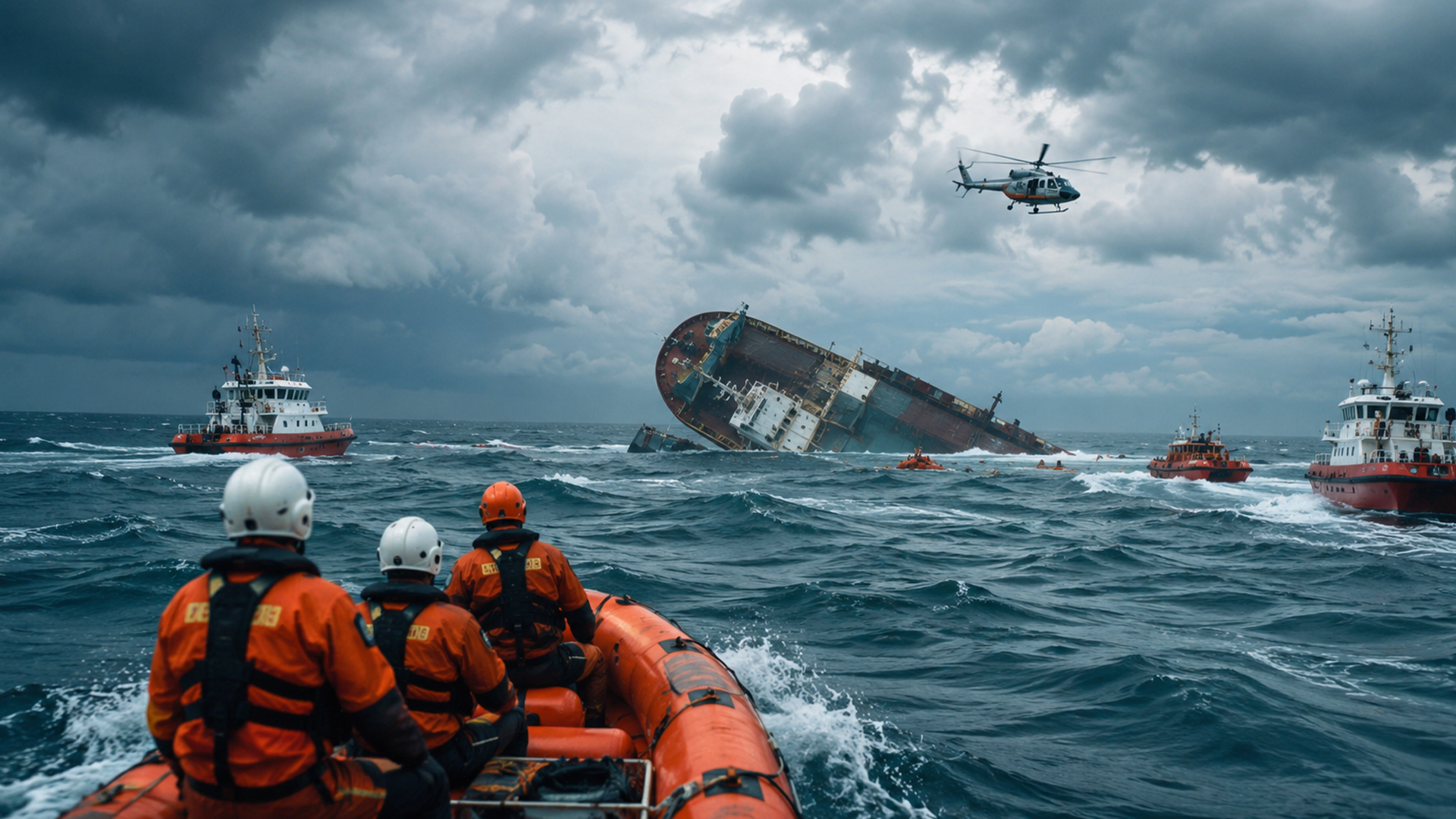
A large-scale search operation is continuing in the South China Sea after a Vietnamese cargo vessel capsized during rough weather, leaving 17 people missing. Rescue teams from Vietnam, China and the Philippines are combing the waters in a race against time after 45 crew members were rescued from the sea.
The cargo ship, Khoi Nguyen 18, was carrying 62 Vietnamese nationals when it encountered severe weather near Fiery Cross Reef in the disputed Spratly Islands late on Saturday. Strong winds and rough seas caused the vessel to sink, triggering an emergency rescue mission involving ships, helicopters and coast guard teams.
According to Vietnamese authorities, the ship issued a distress signal after battling worsening weather conditions. Rescue agencies immediately mobilised nearby vessels, while neighbouring countries responded to the emergency despite the challenging sea conditions.
The first breakthrough came when a Chinese rescue vessel spotted a distress flare and located a life raft carrying dozens of survivors. More rescue ships and aircraft soon joined the operation, helping save 45 people from the water. Many of those rescued had spent hours drifting at sea before being found.
The search, however, is far from over. Rescue teams are continuing to scan the area for the remaining 17 missing crew members, using helicopters, patrol vessels and surveillance equipment. Authorities said strong currents, high waves and poor visibility are making rescue efforts extremely difficult.
For the families waiting onshore, every update brings a mix of hope and anxiety. While the successful rescue of 45 people has offered relief, loved ones of the missing continue to wait for news as search operations enter another critical phase.
Vietnam’s Foreign Ministry said all those on board were Vietnamese citizens and confirmed that authorities are working closely with neighbouring countries to coordinate the rescue mission. Officials also expressed appreciation for the assistance provided by China and the Philippines.
The multinational operation has drawn attention because it is taking place in one of the world’s most politically sensitive maritime regions. The Spratly Islands, where the vessel sank, are claimed by several countries including China, Vietnam, the Philippines, Malaysia, Brunei and Taiwan. Despite competing territorial claims, rescue agencies have put humanitarian efforts first, working together to search for survivors.
The Philippine Coast Guard deployed vessels and aircraft after receiving a request for assistance, while Chinese rescue ships and helicopters remain active in the search zone. Vietnamese rescue teams are also continuing operations despite difficult weather conditions.
Although officials have not disclosed details about the cargo being transported, early assessments suggest that extreme weather was the primary cause of the accident. Maritime investigators are expected to examine the vessel’s voyage records, weather data and communication logs after rescue operations are completed.
The South China Sea is one of the busiest commercial shipping routes in the world, handling a significant share of global maritime trade every year. Thousands of cargo ships travel through these waters, making safety a constant concern, particularly during the annual typhoon and monsoon seasons.
Weather experts said the vessel sailed into an area of intense storms that produced strong winds and rough seas capable of overwhelming smaller cargo ships. Maritime authorities had issued weather advisories for the region, but rapidly changing conditions can still pose serious risks to vessels at sea.
Nearby merchant ships and fishing boats have also joined the search after navigational alerts were issued across the area. Authorities have requested all vessels passing through the region to remain vigilant and immediately report any signs of survivors, life rafts or floating debris.
The incident has once again highlighted the dangers faced by seafarers, who often work in unpredictable weather far from shore. Even with modern navigation systems and safety equipment, sudden storms continue to pose one of the biggest threats to commercial shipping.
Emergency crews remain hopeful that more survivors can still be found. Search aircraft continue to fly over the accident site while rescue vessels methodically cover large sections of the sea, refusing to give up despite difficult conditions.
Once the rescue mission concludes, investigators will seek to determine exactly how the vessel sank and whether additional safety measures could help prevent similar accidents in the future.
For now, the focus remains firmly on saving lives. As families wait anxiously for news, every passing hour becomes increasingly important. The operation has become a reminder that, even in disputed waters marked by geopolitical tensions, humanitarian cooperation can take precedence when lives are at stake.